In a dramatic escalation of tensions in the Middle East, Israel Strikes Iran’s Nuclear Sites in Operation Rising Lion, Killing IRGC Chief. Israel launched a series of coordinated airstrikes on Iran early Friday, targeting critical infrastructure of the Islamic Republic’s nuclear program. The surprise offensive, codenamed Operation Rising Lion, hit multiple strategic military and nuclear sites, including the Natanz uranium enrichment facility and several missile development centers.
Prime Minister Benjamin Netanyahu called the operation a “decisive moment” in Israel’s security policy, vowing that the campaign will continue “for as many days as it takes.”
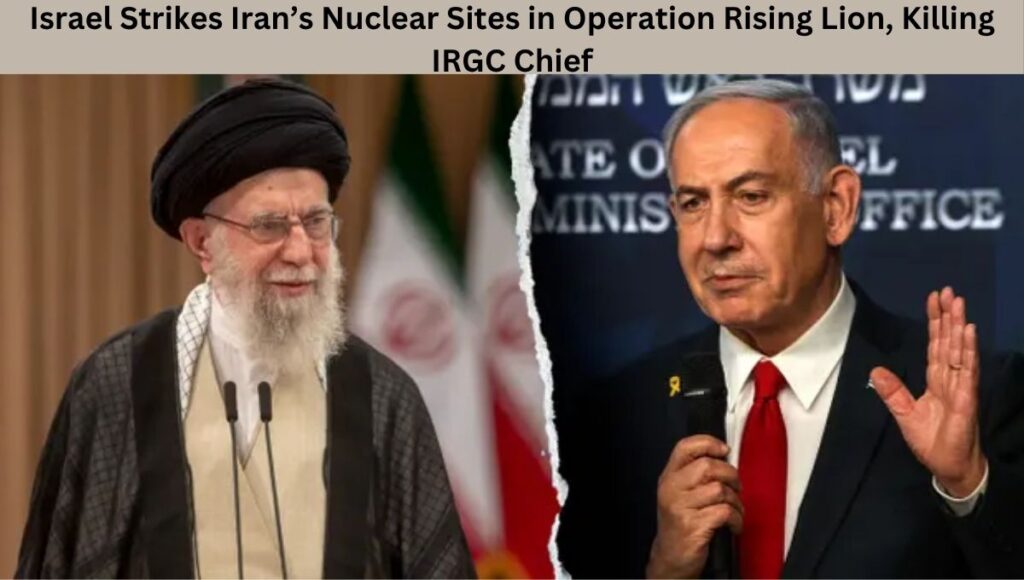
Israel Strikes Iran’s Nuclear Sites in Operation Rising Lion, Killing IRGC Chief
High-Profile Casualties: IRGC Chief Hossein Salami and Army General Bagheri Killed
The most stunning development from the strikes was the confirmed death of Major General Hossein Salami, head of Iran’s Islamic Revolutionary Guard Corps (IRGC), and General Mohammad Bagheri, Iran’s Chief of Armed Forces. Iranian state media reported their deaths as martyrdom, signaling their national importance.
Salami, a central figure in Iran’s nuclear and missile development, had long been a hardline critic of both Israel and the United States. Appointed as IRGC chief in 2019, his leadership helped shape Iran’s regional military strategies and its aggressive defense doctrine.
Israel Justifies the Operation as a Matter of National Survival
Israeli leadership defended the strikes as a preemptive measure against what it sees as an existential threat. Defense Minister Yoav Gallant echoed Netanyahu’s stance, citing intelligence that Iran was nearing a nuclear breakout.
“The time for diplomacy has passed,” Gallant said. “Our actions today are meant to secure the future of the Israeli people.” Among the most heavily targeted facilities were Fordow and Natanz, Iran’s most critical uranium enrichment sites. Analysts suggest Israel used bunker-buster munitions to hit deeply buried targets that lie between 60 to 100 meters underground.
Iran’s Response: Over 100 Drones Launched at Israel
Within hours of the Israeli airstrikes, Iran launched a massive counterattack, deploying more than 100 drones toward Israeli territory. The Israel Defense Forces (IDF) confirmed intercepting a majority of the UAVs but warned of potential incoming missile strikes.
Supreme Leader Ayatollah Ali Khamenei declared that Iran will respond with “severe punishment.” “The Zionist regime has prepared a bitter fate for itself, which it will definitely receive,” Khamenei stated in a televised address.
Airspace Closures Across the Region
The military escalation caused immediate disruption across the Middle East. Israel shut down all flights to and from Ben Gurion Airport, while Iran closed its airspace entirely. Iraq followed suit, grounding all civilian and military flights amid fears of becoming collateral in the Israel-Iran conflict.
The closures disrupted international aviation, notably impacting Air India, which rerouted or returned 16 long-haul flights. Passengers on affected routes were diverted to Vienna, Sharjah, Frankfurt, and other cities, while several planes returned mid-journey to Indian airports.
The Root of the Conflict: Iran’s Advancing Nuclear Program
At the heart of Operation Rising Lion is Iran’s controversial nuclear program. While Tehran insists it seeks only peaceful energy use, recent IAEA reports indicate Iran has amassed 408 kilograms of uranium enriched to 60% purity alarmingly close to the 90% required for weapons-grade fuel.
Experts warn that this stockpile could yield up to nine nuclear bombs if fully enriched, a prospect Israel has repeatedly said it will never allow.
U.S. Denies Involvement But Evacuates Personnel
The United States denied direct involvement in the Israeli operation. However, the State Department confirmed the evacuation of non-essential staff from several embassies across the Middle East. President Donald Trump issued a cautious statement, saying:
“Iran cannot have a nuclear bomb, and we are hoping to get back to the negotiating table. There are several people in leadership that will not be coming back.” While maintaining neutrality, Trump’s comments underscore the geopolitical stakes of the unfolding crisis.
Analysts Warn of a Wider Regional Conflict
Security analysts say this may be just the beginning of a prolonged confrontation between the two bitter enemies. With both Iran and Israel vowing continued military action, neighboring countries like Lebanon, Syria, and Iraq risk being drawn into a broader regional war.
“There’s a real risk of this conflict spiraling out of control,” said Middle East expert Rodger Shanahan. “If Iran hits Israeli civilian areas, we could see a cycle of escalation from which there is no return.”
Others warn of cyberattacks, proxy strikes, or assaults on international shipping and oil infrastructure, especially in the Strait of Hormuz, a vital artery for global energy supplies.
The Global Impact: Energy Prices Surge, Diplomacy on Edge
The immediate fallout from the attacks included a sharp spike in oil prices, as traders feared supply disruptions from the Persian Gulf. The United Nations, European Union, and several countries, including China and India, issued urgent calls for restraint.
“Diplomacy must prevail,” said EU foreign policy chief Josep Borrell. “This is a dangerous moment not just for the Middle East, but for the world.”
Conclusion: Middle East on the Brink
The launch of Operation Rising Lion, the assassination of key Iranian generals, and the largest drone attack in recent memory have pushed the Middle East to the brink of a potentially devastating war. The Israel-Iran conflict, once waged in the shadows, is now an open confrontation with the potential to reshape regional and global politics.
As both nations stand firm in their positions, the international community faces an urgent challenge: preventing a full-scale regional war that could spiral far beyond the borders of the Middle East.
For now, the world watches, holds its breath, and waits for the next move in this dangerous game of brinkmanship.
Also Read: Israel’s Operation Rising Lion: Satellite Images Confirm Strikes on Iran’s Nuclear Sites
Also Read: Israel’s Operation Rising Lion: A Look Inside Iran’s Key Nuclear Sites
Related Posts:
- 9 Explosive Signals as Netanyahu Says Israel Is…

- 11 Explosive Warnings as Trump Vows to ‘Knock the…

- 10 Explosive Strikes: Israel Bombs Tehran Oil Depots…

- Operation Rising Lion: Israel Strikes Deep into Iran…
- 3 Explosive Conditions Iran Sets to End War with US…

- Iran Defiant on Nuclear Enrichment Despite US-Israel…