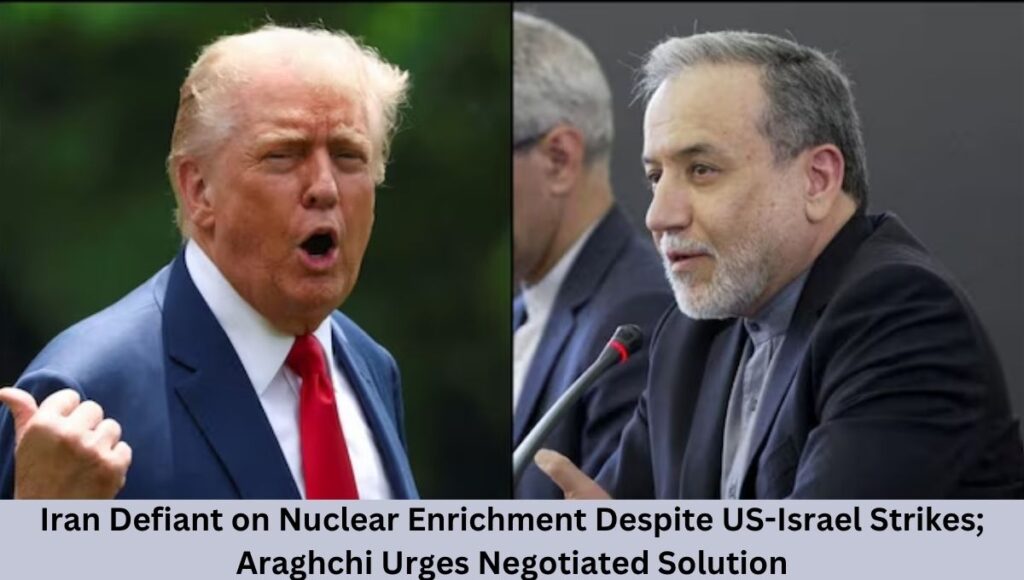
Amid threats from Trump Iran Defiant on Nuclear Enrichment Despite US-Israel Strikes; Araghchi Urges Negotiated Solution. In a powerful and defiant statement, Iranian Foreign Minister Abbas Araghchi declared that Iran will not abandon its uranium enrichment program, calling it a matter of “national pride.”
His comments come just weeks after U.S. and Israeli airstrikes reportedly caused “severe” damage to multiple nuclear facilities across Iran, including core enrichment sites. Speaking to Fox News in a rare 16-minute interview aired Monday, Araghchi said, “It is now stopped because, yes, damages are serious and severe, but obviously, we cannot give up our enrichment because it is an achievement of our own scientists.” He added, “And now, more than that, it is a question of national pride.”
Iran Defiant on Nuclear Enrichment Despite US-Israel Strikes; Araghchi Urges Negotiated Solution
Iran Open to Indirect Talks, But No Direct Dialogue with US Yet
Despite the devastation, Araghchi made it clear that Iran is still open to diplomacy, stating, “We are open to talks, not direct [talks] for the time being. If they are coming for a win-win solution, I am ready to engage with them.”
He emphasized Iran’s willingness to build international confidence in the peaceful nature of its nuclear program.
“We are ready to do any confidence-building measure needed to prove that Iran’s nuclear programme is peaceful and would remain peaceful forever,” he said, calling on the United States to reciprocate by lifting sanctions.
Trump Responds with Threat: “Will Do It Again, If Necessary”
Hours after the interview aired, former U.S. President Donald Trump responded forcefully via his Truth Social platform.
Citing Araghchi’s own words, Trump doubled down on the impact of the airstrikes, posting:
“Iran’s Foreign Minister, Abbas Araghchi, on the Iran Nuclear Sites: ‘Damages are very severe, they are destroyed.’ Of course they are, just like I said, and we will do it again, if necessary!”
Trump also attacked CNN and MSNBC, accusing them of downplaying the effectiveness of the strikes and labeling them “Fake News” and “ratings losers.”
Israel-Iran War Caused Heavy Casualties and Halted Nuclear Talks
The recent escalation between Israel and Iran began with surprise Israeli airstrikes on June 13 targeting Iranian nuclear and military sites.
The air war lasted 12 days, leaving over 900 dead in Iran and 28 in Israel, before a ceasefire was brokered by Washington on June 24.
The conflict effectively ended months of indirect nuclear negotiations between Tehran and Washington, which had previously seen five rounds of talks mediated by Oman.
Araghchi: Nuclear Technology Is “Too Dear” to Be Abandoned
Throughout the Fox News interview, Araghchi repeatedly underlined the symbolic and technological value of Iran’s nuclear program.
“Our enrichment is so dear to us. It is not only science, it is national dignity,” he said. He also reaffirmed Supreme Leader Ayatollah Ali Khamenei’s position, quoting him:
“The number of countries in the world that have achieved a complete nuclear fuel cycle is perhaps fewer than the number of fingers on a person’s two hands. We’re capable of producing nuclear fuel starting from the mine and all the way to the power plant.”
The United States has floated an alternative to Iran’s domestic enrichment program a regional uranium-sharing agreement involving countries like the United Arab Emirates and Saudi Arabia. But Iran has flatly rejected that proposal.
“We will not rely on others for our energy needs or scientific progress,” Araghchi said. “This program is ours.”
IAEA Tensions and Monitoring Uncertainty
Iran’s Atomic Energy Organization is still assessing the full extent of the damage caused by the strikes.
Araghchi said the agency would soon inform the International Atomic Energy Agency (IAEA) about its findings.
However, Iran’s cooperation with the IAEA remains in question after President Masoud Pezeshkian signed a law suspending monitoring agreements.
IAEA inspectors were forced to leave Iran, and Tehran has accused IAEA chief Rafael Grossi of being politically motivated.
On June 12, the IAEA board passed a resolution accusing Iran of non-compliance, which Iranian officials say gave Israel the pretext for launching its attacks.
Global Community Urges Restart of Talks
The United Nations has expressed cautious optimism about upcoming meetings between Iran and European powers.
UN spokesperson Stephane Dujarric said the organization “welcomes dialogue” and will support efforts to revive diplomacy.
Iran is set to meet with France, Germany, and the United Kingdom the so-called E3 in Türkiye on Friday.
The talks aim to salvage elements of the Joint Comprehensive Plan of Action (JCPOA), the landmark 2015 nuclear deal that the Trump administration unilaterally withdrew from in 2018.
The E3 nations have warned Tehran that further delays could trigger the snapback of international sanctions.
Nuclear Program at Risk of More Sanctions
Time is running out for Tehran. If Iran does not reach a new nuclear agreement by end of August, international sanctions could intensify.
Iran’s economy, already strained by years of punitive measures, may not withstand another blow.
Although Russia and China remain strong allies, especially on the diplomatic front, their support may not be enough to shield Iran from Western financial pressure if the E3 countries proceed with reimposing sanctions.
A Divided Global Response to Iran’s Position
While Iran remains defiant, the international community is sharply divided. The US and NATO believe Iran is dangerously close to enriching uranium at weapons-grade levels.
The IAEA chief Rafael Grossi has warned that Iran may be just “weeks away” from having enough fissile material to build nuclear weapons.
Yet, Tehran has consistently stated that its nuclear intentions are peaceful and aimed at civilian energy use.
Iran remains a signatory to the Nuclear Non-Proliferation Treaty (NPT), while Israel widely believed to possess nuclear weapons is not.
Trump’s Narrative vs Iran’s Denials
Former President Trump has made nuclear containment in Iran a top foreign policy priority and used Araghchi’s interview to validate his previous claims that the strikes “obliterated” Iran’s nuclear facilities.
He also rejected reports suggesting that Iran may have removed nuclear material before the US strikes, calling such suggestions “phony” and “fake news.”
According to CNN, a preliminary Pentagon intelligence assessment said Iran’s program was set back only by a few months. Trump dismissed this, insisting his administration’s operation was “perfect.”
Future of US-Iran Talks Uncertain
Araghchi hinted that despite the collapse of direct talks, backchannel diplomacy may still be viable.
“There is a negotiated solution for our nuclear programme. We have done it once in the past. We are ready to do it once again,” he said.
But so far, no new direct dialogue between Washington and Tehran has taken place since the airstrikes.
The Biden administration has remained largely silent about the potential for resuming talks, possibly due to the complicated domestic political optics of engaging with Iran so close to the U.S. elections.
Conclusion: Will Pride or Pragmatism Prevail?
As Iran pushes forward with rebuilding its nuclear infrastructure and reiterates its right to enrich uranium, the question now is whether diplomacy can salvage a path forward.
With indirect talks planned with both the E3 and allies like Russia and China, and with the U.S. watching closely, the coming weeks will be crucial for the future of Iran’s nuclear program and for regional security. Whether Iran clings to its national pride or bends to international pressure will determine if another devastating conflict erupts or if diplomacy still has a chance.
Also Read: Iran to Submit Counterproposal for Nuclear Deal as Uranium Enrichment Remains Key Sticking Point
Also Read: Defiant Iranian foreign minister says nuclear enrichment ‘too dear’ to abandon