

7 Explosive Impacts of Trump’s 25% Iran Tariff on Global Trade amid protests. United States President Donald Trump has opened a new and highly controversial front in Washington’s confrontation with Tehran by announcing a sweeping 25 percent tariff on any country that does business with Iran.
The declaration, made via Trump’s Truth Social platform, comes as Iran grapples with its largest wave of anti-government protests in decades, driven by economic collapse, inflation, and public anger at political repression.
“Effective immediately, any country doing business with the Islamic Republic of Iran will pay a Tariff of 25% on any and all business being done with the United States of America,” Trump wrote, adding that the order was “final and conclusive.”
The blunt message, delivered without accompanying legal documentation or clarification from the White House, has injected uncertainty into global markets and placed Iran’s major trading partners — including China, India, Türkiye, the United Arab Emirates, and Brazil — under intense pressure.
Analysts warn the move risks reigniting global trade wars, destabilising oil markets, and deepening Iran’s economic crisis at a moment of extreme domestic unrest.
This article examines what Trump said, how Iran’s trade network functions under sanctions, and how the proposed 25 percent tariff could affect Iran’s key trading partners and the global economy.
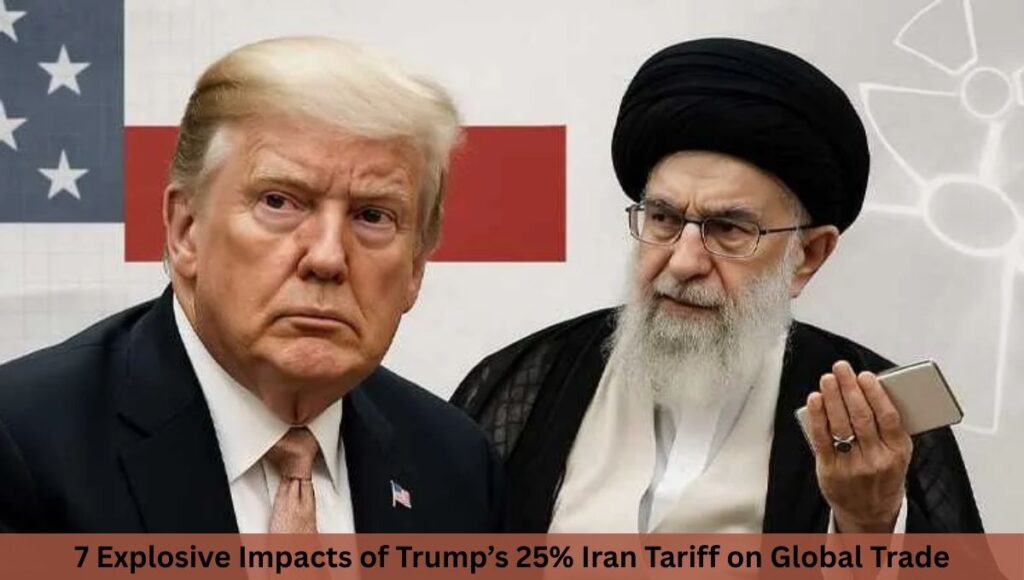
7 Explosive Impacts of Trump’s 25% Iran Tariff on Global Trade
What Exactly Did Trump Announce?
Trump’s tariff threat was notable as much for its scope as for its lack of detail. In his Truth Social post, the US president did not define what constitutes “doing business” with Iran, nor did he specify whether the tariff would apply to goods, services, or financial transactions.
No executive order, legal memo, or policy framework had been published on the White House website at the time of the announcement.
The absence of clarity has raised fundamental questions:
- Would the tariff apply to all exports from a country that trades with Iran, or only to specific sectors?
- Would humanitarian trade, such as food and medicine, be exempt?
- What legal authority would Trump use to impose the tariffs, especially as his previous reliance on emergency economic powers faces scrutiny in US courts?
Despite the ambiguity, Trump doubled down publicly, saying the tariffs had gone into effect “immediately,” even as senior administration officials declined to elaborate.
Iran’s Economy Under Pressure: Sanctions, Protests, and Isolation
Iran’s economy has been battered by years of Western sanctions aimed at curbing its nuclear programme. Washington accuses Tehran of seeking nuclear weapons, a claim Iran denies, insisting its nuclear activities are for civilian purposes.
The reimposition of US sanctions after Trump withdrew from the 2015 nuclear deal in 2018 marked a turning point.
Iran’s oil exports plunged by as much as 80 percent at their lowest point, foreign investment dried up, and access to global banking systems was sharply curtailed.
By 2024, Iran’s GDP per capita had fallen to just over $5,000, down from more than $8,000 in 2012. The national currency, the rial, has collapsed repeatedly, fuelling inflation and eroding purchasing power.
The current protests, which began amid anger over rising prices and economic mismanagement, have spread nationwide.
Hundreds have reportedly been killed in a violent crackdown, and authorities imposed prolonged internet shutdowns to suppress communication.
Against this backdrop, Iran’s foreign trade remains one of the few remaining lifelines for its economy.
Who Are Iran’s Main Trading Partners?
Despite sanctions, Iran maintains trade relations with dozens of countries, often through complex arrangements designed to bypass restrictions. According to World Bank data, Iran exported goods to 147 trading partners in 2022.
Fuel Dominates Iran’s Exports
Fuel, particularly crude oil and condensates, remains Iran’s most valuable export. Major imports include machinery, intermediate goods, food items, and industrial equipment.
In 2024, Iran’s total exports were valued at approximately $22.9 billion, equivalent to about 5 percent of its GDP.
China: The Biggest Stakeholder in Iran Trade
China is by far Iran’s most important trading partner and the country most exposed to Trump’s proposed tariff.
China–Iran Trade Volume
- Bilateral trade exceeded $13 billion in 2024, according to UN Comtrade.
- World Bank estimates suggest actual trade may be closer to $37 billion when unreported transactions are included.
- China is estimated to buy more than 80 percent of Iran’s oil exports, often through intermediaries and so-called “teapot” refineries.
Chinese purchases of Iranian oil provide Tehran with crucial revenue that few other buyers are willing or able to supply under US sanctions.
Impact of Trump’s 25% Tariff on China
Chinese goods already face an average US tariff of around 35 percent following a fragile trade truce negotiated in late 2024. Adding an additional 25 percent levy could push total tariffs on some Chinese exports above 60 percent.
Chinese officials have reacted sharply. Beijing has condemned what it calls “illicit unilateral sanctions and long-arm jurisdiction,” warning it will take “all necessary measures” to defend its interests.
Analysts say Trump’s move risks derailing the fragile US–China trade détente and could complicate a planned presidential visit to Beijing.
India: Rice, Pharmaceuticals, and Strategic Balancing
India is another key trading partner likely to feel the impact of Trump’s Iran tariff threat.
India–Iran Trade Snapshot
- Total bilateral trade stood at about $1.6 billion last year.
- Major Indian exports include basmati rice, pharmaceuticals, tea, sugar, and machinery.
- Imports from Iran consist mainly of dry fruits, chemicals, and glassware.
India is Iran’s largest supplier of rice, accounting for nearly two-thirds of Iranian rice imports.
Basmati Rice Exports Under Strain
Indian basmati rice exports to Iran have slowed to a near standstill amid protests, payment delays, and fears of additional US tariffs.
Exporters report difficulties receiving payments as Iranian buyers struggle with currency collapse and banking disruptions.
Industry groups have warned of falling domestic rice prices and rising financial stress for farmers and millers if shipments remain stalled.
Limited Macro Impact, High Sectoral Risk
Indian government sources have downplayed the overall economic impact, noting India’s diversified trade base. However, for sectors like basmati rice, the consequences could be severe if access to the Iranian market remains constrained.
Türkiye: A Neighbour Caught in the Middle
Türkiye shares a long border with Iran and has historically maintained pragmatic trade relations despite geopolitical differences.
Trade Figures
- Bilateral trade was valued at around $5.7 billion in 2024.
- Türkiye exports machinery, plastics, chemicals, and agricultural goods to Iran.
- It imports natural gas and metals.
Türkiye already faces US tariffs of around 15 percent on its exports, with higher duties on steel and aluminium. A further 25 percent tariff could significantly affect Turkish manufacturers and exporters.
United Arab Emirates: Re-Export Hub at Risk
The UAE plays a unique role in Iran’s trade ecosystem as a re-export hub.
UAE–Iran Trade
- Total trade reached approximately $6.6 billion in 2024.
- Goods often pass through UAE ports before being shipped onward to Iran or global markets.
While UAE goods face a baseline US tariff of 10 percent, Trump’s threat could complicate its position as a logistics and trading hub for Iran-linked commerce.
Brazil and Other Emerging Partners
Iran has expanded trade ties with non-Western partners, including Brazil.
Brazil–Iran Trade
- Brazilian exports to Iran exceeded $3 billion in 2024.
- Key products include soybeans, corn, sugar, and agricultural commodities.
Brazil’s participation in BRICS, alongside China, India, and Russia, adds another layer of political complexity as Trump has previously threatened tariffs against the bloc.
Oil Markets and Global Energy Implications
Iran’s oil exports are a critical variable in global energy markets.
Analysts warn that further pressure on Iran’s trade could:
- Reduce available supply if buyers retreat.
- Increase reliance on opaque shipping and shadow fleets.
- Heighten volatility in oil prices, especially amid geopolitical tensions in the Middle East.
China’s continued purchases have so far stabilised Iranian exports at around 1.5 million barrels per day in 2025, still below pre-2018 levels.
Legal and Political Uncertainty in Washington
Trump’s aggressive use of tariffs as a foreign policy tool faces legal challenges in the United States. The Supreme Court is expected to rule on whether the president exceeded his authority under emergency economic powers.
If the court limits Trump’s tariff powers, the Iran-related levies could be delayed, narrowed, or overturned altogether.
Will the Tariffs Actually Be Enforced?
Much remains uncertain. Past experience suggests Trump often uses tariff threats as leverage in negotiations rather than as permanent policy.
However, the stakes are unusually high. Iran’s internal unrest, US–China relations, and global trade stability are all intertwined in this decision.
Conclusion: High-Risk Gamble With Global Consequences
Trump’s announcement of a 25 percent tariff on countries doing business with Iran represents a dramatic escalation in economic pressure on Tehran — and a risky gamble for the global economy.
For Iran, the move threatens to further isolate an economy already under immense strain. For China, India, Türkiye, and other partners, it raises the cost of maintaining trade ties and forces difficult strategic choices. For the world, it risks renewed trade wars, volatile energy markets, and deeper geopolitical fragmentation.
Whether the tariff threat becomes a lasting policy or a negotiating tactic, its impact is already being felt — in markets, ministries, and the streets of Iran itself.
Also Read: 9 Explosive Signals as Trump Cancels Iran Talks and Urges Protesters to Seize Power
Also Read: Trump’s tariff gambit over Iran risks derailing U.S.–China trade deal
Related Posts:
- 11 Explosive Warnings as Trump Vows to ‘Knock the…

- 10 Explosive Warnings as Donald Trump Calls Iran…
- Trump's 3 Blunt Warnings to China and Russia Over…
- 9 Explosive Claims as Trump Says US Winning Iran War

- 3 Explosive Conditions Iran Sets to End War with US…

- Trump’s 2025 Gaza Peace Plan Signing and Historic…
