

In the ongoing nuclear negotiations, Iran to Submit Counterproposal for Nuclear Deal as Uranium Enrichment Remains Key Sticking Point. In a significant development, Iran announced it will soon present a counterproposal to the United States via mediator Oman, rejecting the American plan offered during the fifth round of talks.
Iran’s foreign ministry emphasized that Washington’s proposal lacked key concessions most notably the lifting of US sanctions and recognition of Iran’s right to enrich uranium.
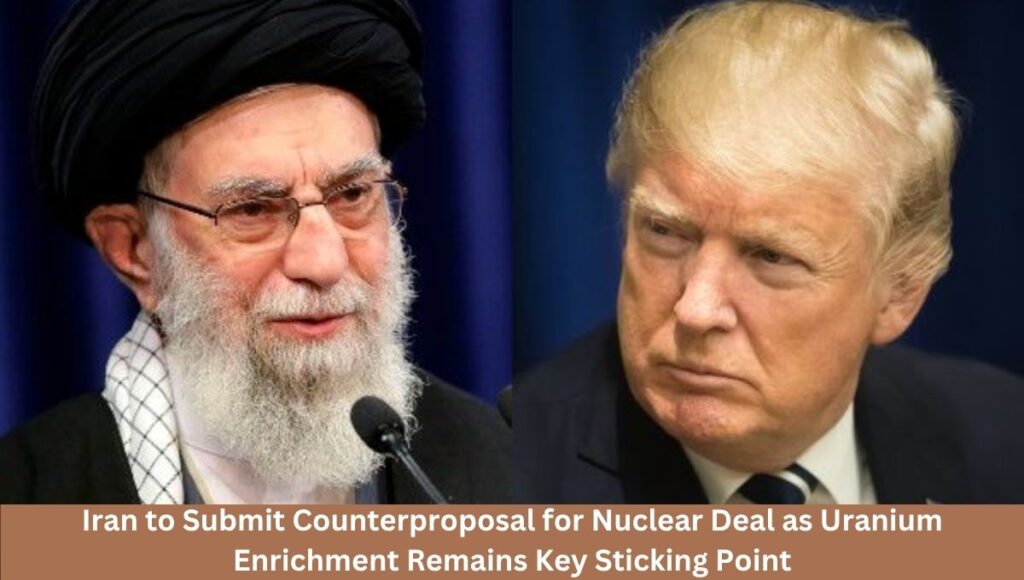
Iran to Submit Counterproposal for Nuclear Deal as Uranium Enrichment Remains Key Sticking Point
Iran Rejects US Proposal as Unacceptable
At a press conference in Tehran, Foreign Ministry spokesperson Esmaeil Baghaei confirmed that Iran is preparing an alternative proposal. He criticized the American draft as “unacceptable” and failing to reflect the progress of previous negotiations.
“We will soon submit our own proposed plan to the other side through Oman once it is finalised,” Baghaei said.
He further asserted that the US proposal “lacked elements” consistent with earlier negotiation rounds and failed to guarantee any economic benefits for Iran in exchange for limiting its nuclear program.
Trump: “We Can’t Allow Enrichment”
US President Donald Trump confirmed that nuclear talks with Iran would resume later this week, though exact timing and venue remain fluid. He reiterated Washington’s red line: no uranium enrichment on Iranian soil.
“They’re just asking for things that you can’t do. They seek enrichment. We can’t have enrichment. We want just the opposite,” Trump said. Trump acknowledged Iran’s reputation as “tough negotiators” and admitted the path to agreement remains fraught with challenges.
Enrichment Debate at the Heart of the Deadlock
At the center of the standoff is the uranium enrichment program, which Iran insists is a sovereign right under the Nuclear Non-Proliferation Treaty (NPT). Iran maintains that its nuclear efforts are for peaceful energy production, not weapons development.
However, the US and its allies argue that enrichment capabilities leave the door open for nuclear weaponization.
The American side has demanded the shipment of Iran’s enriched uranium stockpile abroad, a condition Tehran has so far rejected.
Iran’s Supreme Leader Ayatollah Ali Khamenei doubled down last week, declaring uranium enrichment a “non-negotiable” symbol of national sovereignty and scientific progress.
Talks Continue Through Back Channels
Although Trump stated the next round of nuclear talks would happen Thursday, both Iranian and US officials indicated that Sunday in Muscat, Oman, is a more likely date.
The negotiations remain indirect, with Omani diplomats acting as intermediaries between US envoy Steve Witkoff and Iran’s chief negotiator Abbas Araqchi.
Baghaei noted, “Based on recent consultations, the next round of Iran–US indirect negotiations is being planned for next Sunday in Muscat.”
JCPOA Legacy and Mistrust
The Joint Comprehensive Plan of Action (JCPOA), signed in 2015, once curbed Iran’s nuclear ambitions in exchange for sanctions relief. But it collapsed after Trump unilaterally withdrew from the deal in 2018, reimposing economic sanctions.
Since then, Iran has ramped up enrichment to 60%, far beyond JCPOA limits, and reduced cooperation with the International Atomic Energy Agency (IAEA). A recent IAEA report criticized Iran’s transparency, prompting Tehran to accuse the watchdog of bias and reliance on “forged Israeli documents.”
Iran’s stance reflects deep-rooted distrust, especially given past incidents like the assassinations of nuclear scientists and sanctions on medical uranium.
Israel Looms Large in the Background
President Trump also confirmed he had a phone call with Israeli Prime Minister Benjamin Netanyahu to discuss Iran. Israel has long opposed any nuclear deal with Iran, viewing Tehran’s nuclear capability as an existential threat.
Baghaei warned that Israel is trying to sabotage the diplomatic process and criticized the international community’s “blind eye” toward Israel’s undeclared nuclear arsenal. “Parties constantly questioning Iran’s peaceful nuclear programme actively work to strengthen Israel’s military nuclear programme,” he stated.
Regional and Global Implications
The failure to reach an agreement could have dire consequences. Saudi Arabia has stated it will match Iran’s nuclear capabilities, raising fears of a regional nuclear arms race.
Meanwhile, Russia and China continue to strengthen ties with Iran through trade and infrastructure deals.
The geopolitical vacuum created by stalled US-Iran talks may further destabilize the Middle East, especially with Israel hinting at unilateral military action should diplomacy fail.
A Path Forward?
Despite the deadlock, both sides seem to be keeping the diplomatic window open. Iran is reportedly willing to accept limited enrichment under IAEA supervision if sanctions are lifted and economic normalcy restored.
Experts suggest that any sustainable agreement must go beyond the JCPOA, with permanent verification mechanisms, guaranteed access for inspectors, and clear red lines. Crucially, analysts argue that decoupling Iran’s regional activities from nuclear negotiations would increase the likelihood of success.
As long as Washington ties the nuclear file to Iran’s support for groups like Hezbollah and Hamas, reaching an agreement remains elusive.
Time is Running Out
With UN Resolution 2231 which endorsed the JCPOA set to expire in October 2025, time is running out for a durable solution. The world now watches to see whether diplomacy can succeed, or if yet another chapter of confrontation, sanctions, and escalation will follow.
Conclusion:
The resumption of talks in Oman marks a critical moment in US–Iran nuclear diplomacy. Both sides remain far apart on the issue of uranium enrichment, but the willingness to continue negotiations provides a narrow window for progress. As global powers await the next round, the fate of the Middle East’s nuclear future hangs in the balance.
Also Read: Khamenei Rejects U.S. Nuclear Proposal, Vows Iran Will Continue Uranium Enrichment
Also Read: Israeli attack could drive Iran to seek nuclear weapons, IAEA chief warns
Related Posts:
- Iran Defiant on Nuclear Enrichment Despite US-Israel…
- 11 Explosive Warnings as Trump Vows to ‘Knock the…

- 3 Explosive Conditions Iran Sets to End War with US…
- 7 Explosive Impacts of Trump’s 25% Iran Tariff on…
- 10 Explosive Warnings as Donald Trump Calls Iran…
- Khamenei Rejects U.S. Nuclear Proposal, Vows Iran…
