Israel Intercepts Gaza Aid Flotilla: 42 Boats Seized, Global Outrage Follows, triggering debates over international law and Israel’s blockade. In one of the most dramatic episodes of the ongoing Gaza crisis, Israel has intercepted the last boat of the Global Sumud Flotilla, bringing to a close a tense mission that saw 42 vessels carrying over 500 activists from 44 countries seized by Israeli naval forces.
The flotilla, launched from Barcelona last month, was billed as a humanitarian mission to deliver food, medicine, and aid supplies to the besieged Gaza Strip. It included prominent figures such as Greta Thunberg, Nelson Mandela’s grandson Zwelivelile Mandela, Barcelona mayor Ada Colau, and European parliament member Rima Hassan.
Israel, however, called the flotilla a provocation, alleging that it was backed by Hamas and intercepted the vessels in international waters, sparking a storm of global condemnation, legal debate, and diplomatic fallout.
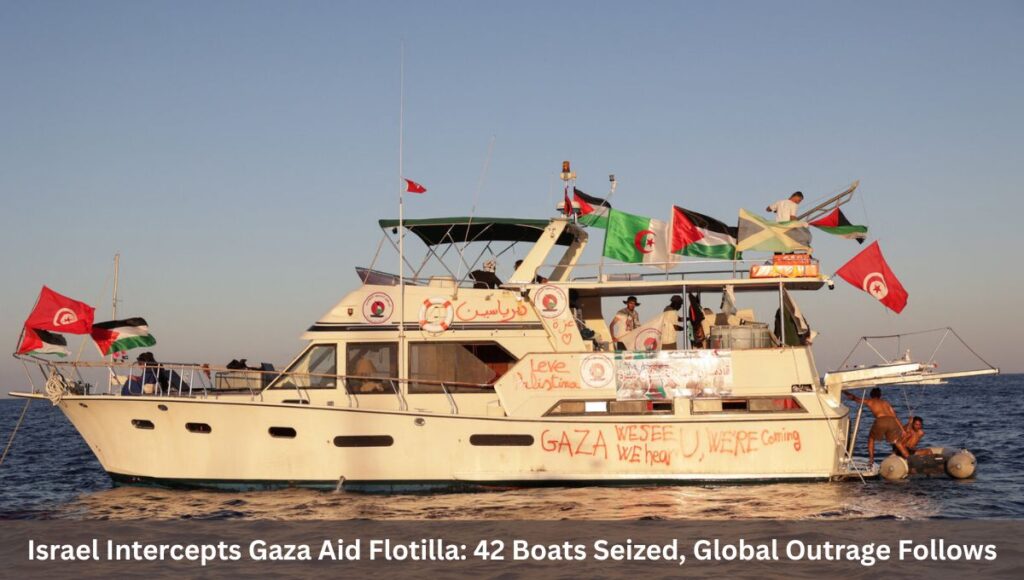
Israel Intercepts Gaza Aid Flotilla: 42 Boats Seized, Global Outrage Follows
“We See a Ship”: The Last Vessel Intercepted
The final boat of the flotilla, the Marinette, was intercepted on Friday morning at 10:29 am local time (0729 GMT), approximately 42.5 nautical miles from Gaza.
Moments before the boarding, a passenger held up a handwritten sign to a livestream camera reading: “We see a ship!”. Within half an hour, armed Israeli commandos on dinghies surrounded the Marinette, supported by a larger naval vessel in the background.
The flotilla organisers announced on Telegram:
“Over 38 hours, Israeli occupation naval forces illegally intercepted all 42 of our vessels—each carrying humanitarian aid, volunteers, and the determination to break Israel’s illegal siege on Gaza.”
Israel’s Shayetet 13 naval commandos boarded the Marinette and detained all those on board.
Also Read: The Global Sumud Flotilla to Gaza: Everything you need to know
Global Sumud Flotilla: A Humanitarian Mission or Political Provocation?
The Activists’ View
The Global Sumud Flotilla (GSF) framed its journey as a nonviolent humanitarian mission. Activists carried symbolic amounts of aid—baby formula, medical supplies, and food—while emphasizing their real goal:
- Break Israel’s blockade on Gaza
- Establish a humanitarian corridor
- Draw global attention to the humanitarian crisis
Activists live-streamed their journey, chanting “Free Palestine!” and defying Israeli naval warnings. Many cited a provisional International Court of Justice (ICJ) ruling ordering Israel to “enable the provision of urgently needed humanitarian assistance” to Palestinians in Gaza.
Spokesperson Thiago Ávila told the Israeli navy via radio:
“You are not allowed by international law to stop us. Therefore we do not comply with your request.”
Israel’s Position
Israel insists the flotilla was never about humanitarian aid but rather a political stunt backed by Hamas. Officials stressed that they had offered to transfer aid through established channels, but flotilla organisers refused.
Prime Minister Benjamin Netanyahu praised the navy:
“I commend the soldiers and commanders who carried out their mission on Yom Kippur in the most professional and efficient manner. Their action prevented dozens of vessels from entering the war zone and repelled a campaign of delegitimisation against Israel.”
Israeli Police spokesperson Dean Elsdunne even filmed himself aboard one of the seized ships, showing empty rooms and claiming there was no humanitarian cargo.
Detentions and Deportations
According to Israeli authorities:
- 470+ activists were detained during the interceptions.
- At least four Italian citizens have already been deported.
- Others, including high-profile activists, are being processed for deportation.
Israel confirmed that all detainees are “safe and in good health.”
However, flotilla organisers accused Israeli forces of assaulting activists with water cannons during the seizures. Livestreams were cut shortly after the final interception, leaving uncertainty over the condition of some detainees.
Greece Protests Treatment of Its Citizens
The issue has become a diplomatic flashpoint, especially in Greece.
The Greek Foreign Ministry lodged a formal protest after Israeli Minister of National Security Itamar Ben-Gvir referred to flotilla participants as “terrorists” while standing in front of detained activists.
“These are the terrorists of the flotilla,” Ben-Gvir declared.
Greek diplomats visited 27 detained Greek citizens, including MP Peti Perka, to ensure their well-being. Opposition parties in Athens demanded immediate government action for their release.
Allegations of Hamas Involvement
For the first time, Israel alleged direct Hamas involvement in the flotilla.
According to documents Israel claims to have recovered in Gaza:
- A 2021 letter signed by Hamas leader Ismail Haniyeh endorsed the flotilla’s organising body, the Palestinian Conference for Palestinians Abroad (PCPA).
- A list of PCPA operatives linked to flotilla coordination included Zaher Birawi, long associated with pro-Palestinian flotillas, and Spain-based activist Saif Abu Kashk, whose company allegedly owns flotilla vessels.
Israel argued this showed the flotilla was a Hamas-orchestrated operation disguised as humanitarian aid.
Flotilla organisers rejected the allegations, insisting their mission was independent and humanitarian.
Protests and Global Backlash
The interceptions sparked mass protests worldwide, including:
- Italy: General strike in solidarity with flotilla detainees.
- Greece: Demonstrations demanding the release of Greek citizens.
- Colombia & Argentina: Protests against Israel’s blockade.
- Spain: Support rallies in Barcelona, where the flotilla began.
- Tunisia & Mexico: Street demonstrations with chants of “End the blockade!”
International leaders also weighed in:
- Colombian President Gustavo Petro expelled Israeli diplomats.
- Turkey called the interceptions “an act of terrorism.”
- Malaysia’s Prime Minister Anwar Ibrahim said Israel showed “utter contempt” for humanitarian principles.
Legal Debate: Can Israel Intercept Ships in International Waters?
Under the U.N. Convention on the Law of the Sea (UNCLOS), territorial waters extend 12 nautical miles from shore. States may exercise control up to 24 nautical miles to enforce customs or security laws.
The flotilla was intercepted 70 nautical miles from Gaza, raising questions of legality.
Arguments Against Israel
- Critics say Israel has no jurisdiction in international waters.
- Human rights groups call the blockade collective punishment, a violation of international law.
- Activists argue they had legal right to sail with humanitarian aid.
Arguments Supporting Israel
- Israel argues it is in an armed conflict with Hamas, allowing naval blockades under international law.
- Legal experts like Robbie Sabel (former Israeli foreign ministry adviser) say wartime exceptions permit such interceptions.
- Israel maintains the blockade is vital to prevent weapons smuggling into Gaza.
The 2010 Mavi Marmara incident, in which 10 activists were killed during a similar flotilla raid, continues to haunt these debates.
Wider Context: The Gaza Blockade
The Gaza blockade, enforced by Israel (and to varying extents by Egypt), has been in place since 2007, when Hamas seized power.
- Israel says the blockade prevents Hamas from importing weapons.
- Humanitarian groups say it has led to famine, poverty, and mass suffering.
- The United Nations and aid organisations repeatedly warn of Gaza’s humanitarian catastrophe, with severe shortages of food, medicine, and fuel.
The flotilla movement, beginning with earlier campaigns like the Mavi Marmara (2010), seeks to challenge the blockade through direct action.
Conclusion
The interception of the Global Sumud Flotilla has once again placed the Gaza blockade at the heart of international debate.
For Israel, the operation was a necessary security measure against Hamas. For activists, it was an illegal assault on humanitarian volunteers.
As deportations continue and diplomatic protests mount, the flotilla episode raises urgent questions about international law, humanitarian access, and the limits of naval blockades in modern conflict.
Whether history remembers this flotilla as a symbol of solidarity or a failed provocation tied to Hamas will depend largely on how governments, international bodies, and civil society respond in the coming weeks.
Related Posts:
- 171 Gaza Flotilla Activists Deported Amid Alleged Torture

- Greta Thunberg Detained as Israeli Navy Intercepts…
- Greta Thunberg Detained by Israel During Gaza Aid…

- Greta Thunberg, Rima Hassan Detained as Israeli Navy…
- Trump’s 20-Point Gaza Peace Plan Gains Urgent Global…

- 7 Powerful Facts About Ayatollah Ali Khamenei’s…