

Trump’s Shocking Gaza Ceasefire Fallout: 47 Israeli Violations, civilian deaths mount. In the wake of the Trump-brokered Gaza ceasefire, hopes for lasting peace are fading fast. Despite a truce signed on October 10, Israel has reportedly committed 47 violations, killing at least 38 Palestinians and wounding over 140 others, according to Gaza’s media office.
The ceasefire—hailed by US President Donald Trump as a “historic breakthrough”—has come under intense strain after Israeli forces carried out repeated airstrikes and shootings across the Gaza Strip, including deadly attacks on civilians.
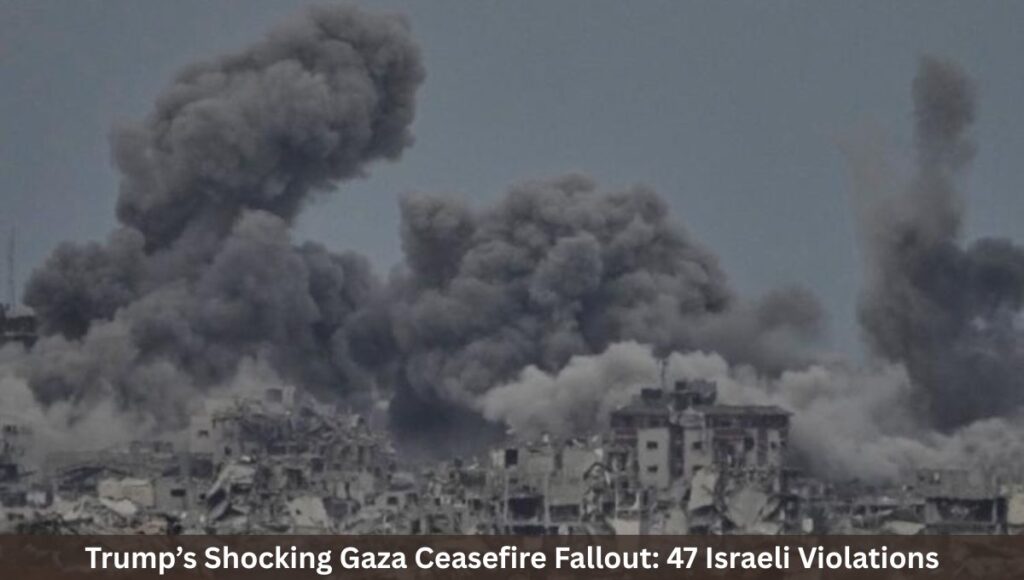
Trump’s Shocking Gaza Ceasefire Fallout: 47 Israeli Violations
Trump Downplays Israeli Strikes After Gaza Civilian Deaths
When asked about Israel’s latest air raids that killed 45 people, including women and children, Trump initially appeared unaware of the details.
“Striking where?” he asked a reporter.
“In Gaza today and overnight,” came the reply.
“I’ll have to get back to you on that,” Trump said.
Despite the violence, Trump maintained that the ceasefire was “still holding,” suggesting that “some rebels within” Hamas may have violated the deal rather than the group’s leadership.
“We want to make sure that it’s going to be very peaceful with Hamas,” Trump said. “It’s going to be handled toughly, but properly.”
However, the Palestinian Civil Defence Agency confirmed that at least 45 people were killed in the latest Israeli strikes—figures backed by multiple hospitals in Gaza.
Israel’s military responded that it was “looking into” reports of civilian casualties while vowing to “respond firmly to any violation” of the ceasefire.
Ceasefire Terms and the Fragile Truce
The October 10 ceasefire, brokered by Trump and backed by Egypt and Qatar, temporarily ended more than two years of war.
It outlined hostage exchanges, Israeli troop withdrawals from key parts of Gaza, and a “yellow line” demarcating ceasefire zones.
But this “yellow line”—a boundary marked only on maps shared by the US—has become a flashpoint. Many Gaza residents say the area lacks visible markers, creating confusion that has turned deadly.
“The whole area is in ruins. We saw the maps but we can’t tell where those lines are,” said Samir, a resident of Tuffah in eastern Gaza City.
Since the truce began, at least 97 Palestinians have been killed in a series of cross-border shootings and airstrikes.
Israel Blames Hamas; Hamas Denies Involvement
Israel says its recent operations were in retaliation for anti-tank missile attacks that killed two Israeli soldiers in Rafah. The Israel Defense Forces (IDF) claim Hamas militants breached the ceasefire and “posed a threat.”
Hamas, however, denied any involvement.
“We have no contact with any of our remaining units in Israeli-controlled areas of Rafah,” a Hamas spokesperson said, accusing Israel of fabricating “flimsy pretexts” to justify further aggression.
Hamas insists it is focused on recovering hostages and bodies from the rubble, not fighting. The group says the devastation caused by Israel’s bombings has made that work nearly impossible.
Also Read: Hamas Executes 50 Rivals After Ceasefire – Inside Gaza’s Deadly Power Struggle
Mounting Civilian Deaths and Widespread Destruction
In the deadliest violation yet, Israeli airstrikes on Friday killed 11 members of one family, including seven children and three women, in Gaza City’s Zeitoun neighborhood.
According to civil defense officials, the victims were returning to their home when their vehicle crossed the invisible “yellow line.”
“I am certain the family couldn’t distinguish between the yellow and red lines because there are no actual physical markers on the ground,” said Gaza Civil Defence spokesperson Mahmoud Basal.
The death toll across Gaza since the ceasefire began has climbed rapidly. Hospitals report hundreds of injuries, mostly women and children.
US and UN Call for Calm Amid ‘Blatant Breaches’
Even as the violence escalates, US officials have sought to salvage the deal.
Vice President JD Vance urged Gulf nations to support a “security infrastructure” that can enforce the truce, while Trump’s envoys Jared Kushner and Steve Witkoff visited Jerusalem to meet with Israeli Prime Minister Benjamin Netanyahu.
At the United Nations, UNRWA chief Philippe Lazzarini demanded accountability, calling for investigations into “blatant breaches of international law.”
“The fragile ceasefire in Gaza must be upheld,” Lazzarini wrote on X, warning that civilian suffering was reaching “unacceptable levels.”
Meanwhile, UN spokesperson Stephane Dujarric confirmed that humanitarian aid convoys had resumed, but on a limited scale. “Several military checkpoints are still blocking entry,” said Al Jazeera’s Tareq Abu Azzoum from Gaza.
Hamas vs. US Narrative: Who Is Breaking the Truce?
Amid growing outrage over Israeli attacks, the US State Department claimed it had “credible reports” that Hamas was planning a new attack on civilians in Gaza—a statement Hamas dismissed as “misleading Israeli propaganda.”
“These claims provide cover for continued Israeli aggression,” Hamas said, accusing Washington of “repeating the occupation’s narrative.”
Palestinian officials argue that the occupation forces are committing “crimes of direct gunfire against civilians, deliberate shelling, and arrests,” despite the supposed end of hostilities.
The Humanitarian Crisis Deepens
The Rafah crossing, Gaza’s only gateway to Egypt and a critical aid lifeline, has been closed indefinitely, according to Netanyahu’s office.
“Its reopening will depend on Hamas fulfilling its obligations to return the hostages and the bodies of the deceased,” the Israeli government said.
Gaza authorities say that 10,000 bodies remain buried beneath the rubble, victims of what they describe as Israel’s “genocidal war.”
The 2023 Gaza war, sparked by Hamas’s October 7 attack on Israel, has killed more than 68,000 Palestinians, according to figures deemed credible by the UN. More than half are women and children.
Trump’s Envoys Race to Save His Signature Deal
In a bid to preserve his diplomatic victory, Trump dispatched his senior advisors to Israel and Cairo.
Kushner and Witkoff met with Netanyahu on Monday, while Egyptian officials hosted senior Hamas figure Khalil al-Hayya to discuss compliance with the ceasefire.
Trump remains adamant that Hamas must disarm.
“They have to be good, and if they’re not good, they’ll be eradicated,” he warned. “But we’re not putting US troops on the ground.”
Still, Trump appeared to tolerate limited Hamas crackdowns within Gaza.
“Hamas took out a couple of gangs that were very bad; very, very bad gangs,” he said earlier. “And that didn’t bother me much, to be honest with you. That’s OK.”
West Bank Raids and Settler Violence Escalate
Even as attention focuses on Gaza, Israeli raids in the occupied West Bank have intensified.
- A 42-year-old Palestinian man was killed in al-Ein refugee camp near Nablus.
- An 11-year-old boy, Mohammad Hallaq, was shot dead in Al-Rihiya, south of Hebron.
- Multiple settler attacks were reported in Palestinian villages since the ceasefire took effect.
These incidents underscore what Palestinian rights groups call Israel’s “systematic violation of ceasefire commitments.”
Global Reaction and Growing Anger
Across the world, outrage is mounting. Humanitarian organizations accuse Israel of exploiting vague ceasefire language to justify its ongoing operations.
The European Union called for “maximum restraint,” while Qatar urged Washington to hold Israel accountable. In Cairo, Egyptian mediators warned that “continued breaches risk total collapse” of the deal.
Meanwhile, thousands rallied in London, Paris, and Amman, demanding an end to the strikes and a full humanitarian corridor into Gaza.
Conclusion: A Ceasefire in Name Only
The Trump-brokered ceasefire that once promised an end to Gaza’s suffering is on life support.
While both Israel and Hamas publicly claim commitment to the agreement, the mounting civilian toll tells a different story. Each new airstrike, each new grave, chips away at what little trust remains.
For the people of Gaza, who once dared to believe peace was possible, the reality is stark: the guns may have fallen silent on paper, but the war continues in the skies above them.
Related Posts:
- Trump’s 2025 Gaza Peace Plan Signing and Historic…

- Trump’s Historic Gaza Ceasefire Deal 2025 - Powerful…

- 11 Explosive Warnings as Trump Vows to ‘Knock the…

- 9 Explosive Revelations as Trump Declares His Health…

- 5 Powerful Highlights as Trump Lands Second Nobel…

- Trump’s 20-Point Gaza Peace Plan Gains Urgent Global…
