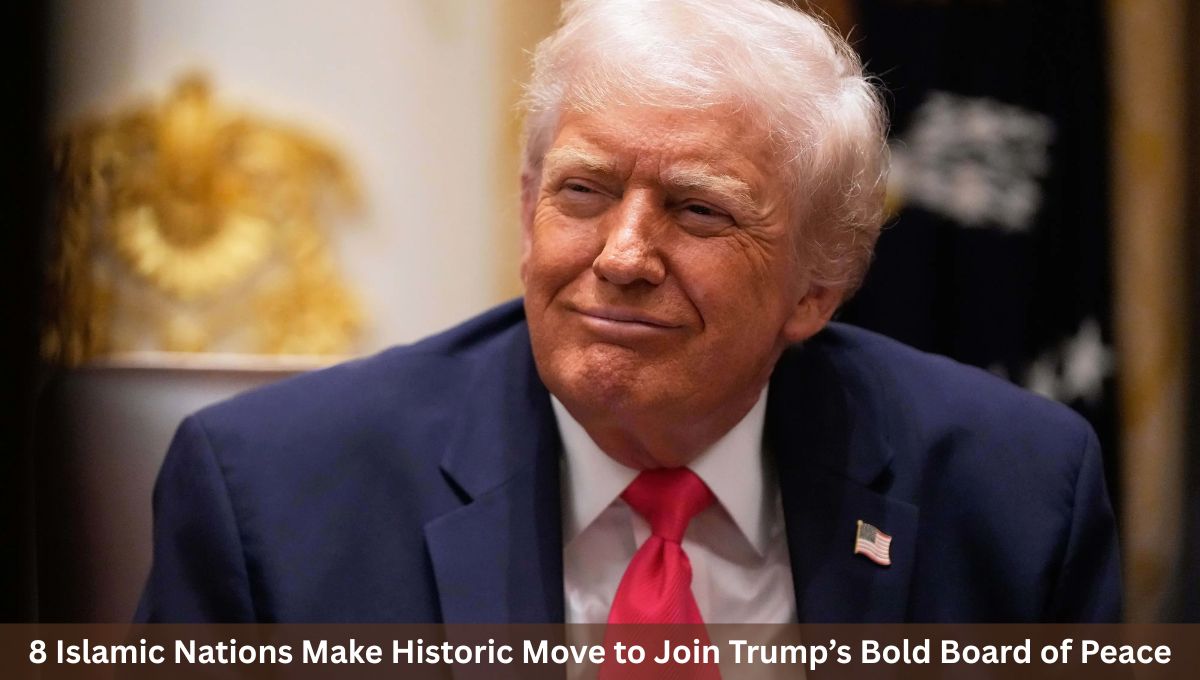
8 Islamic Nations Make Historic Move to Join Trump’s Bold Board of Peace — A new diplomatic initiative.Eight Muslim-majority nations — Saudi Arabia, Pakistan, Turkey, Qatar, Egypt, Jordan, Indonesia, and the United Arab Emirates — have formally agreed to join United States President Donald J.
Trump’s newly unveiled “Board of Peace,” marking one of the most consequential diplomatic developments since the Israel–Gaza war began.
The decision, announced through a joint statement by their foreign ministers, signals broad Islamic-world backing for Trump’s controversial yet ambitious initiative to oversee Gaza’s post-war governance, reconstruction, and long-term political settlement.
The Board of Peace forms the centerpiece of Phase Two of a fragile U.S.-brokered ceasefire between Israel and Hamas, endorsed by United Nations Security Council Resolution 2803.
While supporters describe the move as a pragmatic attempt to stabilize Gaza and end decades of conflict, critics warn it could undermine the United Nations, centralize unprecedented authority under the U.S. president, and entrench geopolitical divisions.
8 Islamic Nations Make Historic Move to Join Trump’s Bold Board of Peace
What Is Trump’s Board of Peace?
President Trump first proposed the Board of Peace in September 2025 as part of a broader 20-point plan to end the Gaza war. Initially framed as a Gaza-specific transitional authority, the initiative has since expanded into a global peace mechanism intended to address conflicts beyond the Middle East.
Core Mandate
According to draft charter documents seen by international media, the Board of Peace is tasked with:
- Consolidating a permanent ceasefire in Gaza
- Overseeing reconstruction and redevelopment of the territory
- Coordinating international funding and investment
- Supporting the creation of a Palestinian technocratic administration
- Deploying a temporary International Stabilization Force (ISF)
- Advancing a political process rooted in Palestinian self-determination and statehood
Trump will serve as the inaugural and potentially indefinite chairman, wielding extensive executive authority including veto powers and the ability to remove members.
Which Islamic Nations Have Joined — and Why It Matters
The eight Islamic countries joining the Board of Peace represent a powerful cross-section of the Muslim world, spanning the Gulf, South Asia, Southeast Asia, and the eastern Mediterranean.
Countries Joining the Board of Peace
- Saudi Arabia
- Pakistan
- Turkey
- Qatar
- Egypt
- Jordan
- Indonesia
- United Arab Emirates
Kuwait later confirmed it has also accepted Trump’s invitation, bringing the number of Muslim-majority participants to nine.
Joint Statement Highlights
The foreign ministers reaffirmed:
- Support for Trump’s peace efforts
- Commitment to Gaza’s reconstruction
- Backing for Palestinian statehood under international law
- Endorsement of UNSC Resolution 2803
The statement emphasized that each country would complete accession “according to their respective legal and constitutional procedures,” with Egypt, Pakistan, and the UAE already confirming formal participation.
Pakistan’s Decision: Diplomacy Amid Economic Strain
Pakistan’s decision to join the Board of Peace has drawn particular attention due to its severe economic challenges.
Pakistan’s Official Position
Islamabad stated it joined:
- To support the implementation of the Gaza Peace Plan
- To push for humanitarian aid expansion
- To advance a time-bound political process leading to a sovereign Palestinian state based on pre-1967 borders, with Al-Quds Al-Sharif (Jerusalem) as its capital
Foreign Minister Ishaq Dar described Pakistan’s participation as a continuation of its longstanding diplomatic advocacy for Palestinian rights.
Financial Questions
The Board’s charter allows countries to secure permanent membership by contributing $1 billion, raising concerns about Pakistan’s capacity as it:
- Seeks a $2.5 billion debt rollover from the UAE
- Remains under a $7 billion IMF programme
- Carries public debt exceeding $286 billion
Pakistani officials have not confirmed whether Islamabad will seek permanent membership or remain a term-based participant.
Saudi Arabia, Qatar, and Turkey: Strategic Calculations
Saudi Arabia
Riyadh’s participation underscores its desire to:
- Shape Gaza’s post-war future
- Maintain diplomatic leverage with Washington
- Balance normalization talks with Israel against domestic and regional opinion
Qatar
As a key Gaza mediator, Qatar views the Board as a platform to:
- Preserve ceasefire mechanisms
- Ensure humanitarian access
- Protect its diplomatic relevance
Turkey
An outspoken critic of Israel’s Gaza campaign, Ankara sees membership as:
- A way to influence reconstruction
- Counter Israeli dominance in post-war governance
- Assert leadership in Muslim-world diplomacy
Israel Joins — Reluctantly
Israeli Prime Minister Benjamin Netanyahu has accepted Trump’s invitation, despite strong misgivings about sharing a platform with Turkey and Qatar.
An Israeli official admitted:
“Not participating was simply not an option. Israel has an interest in being involved in decision-making, especially with Trump leading the way.”
Israel views the Board as a counterweight to the United Nations, which it increasingly regards as hostile.
Russia, China, and the Global Power Question
Russia
President Vladimir Putin confirmed he has accepted Trump’s invitation, though Moscow is still studying the charter.
Putin controversially proposed using frozen Russian assets to:
- Pay the $1 billion contribution
- Fund Gaza reconstruction
- Potentially support post-war rebuilding in Ukraine
China
Beijing has adopted a cautious stance, insisting that:
- Any peace mechanism must operate under the UN framework
- The UN-centered international order must remain intact
China has neither accepted nor rejected the invitation outright.
Europe Pushes Back
Several close U.S. allies have declined or expressed reservations, including:
- France
- Norway
- Italy
- Sweden
European officials cite:
- Constitutional incompatibilities
- Concerns over Trump’s veto powers
- Fear of undermining the UN Charter
France and Norway explicitly refused to attend the Davos signing ceremony.
Does the Board of Peace Undermine the United Nations?
This remains the central controversy.
Although UNSC Resolution 2803 authorizes the Board solely for Gaza through 2027, Trump has suggested the body “might replace” the UN — a claim UN officials strongly reject.
Diplomats warn:
- The Board’s charter barely mentions Gaza
- Its remit extends far beyond UNSC authorization
- Trump’s indefinite chairmanship raises legitimacy concerns
Former US diplomats argue that the Board’s success or failure in Gaza will determine whether it gains broader international credibility.
On the Ground in Gaza: Deep Skepticism
Palestinians in Gaza remain unconvinced.
Residents interviewed by Al Jazeera questioned:
- How reconstruction will begin amid ongoing Israeli strikes
- Whether Hamas disarmament will be genuine
- Why Netanyahu is included despite ICC arrest warrants
Since the ceasefire began in October, at least 466 Palestinians have reportedly been killed in continued Israeli attacks, according to Gaza’s Health Ministry.
What Happens Next?
Immediate Steps
- Formal signing of the Board’s charter in Davos
- Establishment of a Palestinian technocratic committee
- Deployment planning for an International Stabilization Force
Key Unresolved Questions
- Will Hamas fully disarm?
- Who controls security on the ground?
- Can reconstruction proceed without political settlement?
- Will the Board remain Gaza-focused or expand globally?
Conclusion: A High-Stakes Gamble for Peace
The decision by eight Islamic nations to join Trump’s Board of Peace represents a historic diplomatic alignment, but also a profound gamble.
Supporters see a rare opportunity to break diplomatic paralysis and rebuild Gaza under a new framework. Critics fear the erosion of multilateral norms and the concentration of global peace authority in the hands of one leader.
Whether the Board of Peace becomes a transformational mechanism or a temporary political experiment will depend not on speeches or charters — but on whether Gaza finally sees peace, dignity, and reconstruction after years of devastation.
Also Read: 9 Stark Realities Behind Gaza’s Reaction to Trump’s ‘Board of Peace’ Plan
Also Read: Netanyahu Joins Trump’s ‘Board of Peace’
Related Posts:
- Trump’s 2025 Gaza Peace Plan Signing and Historic…

- 5 Powerful Highlights as Trump Lands Second Nobel…

- Trump’s 20-Point Gaza Peace Plan Gains Urgent Global…

- 7 Shocking Reasons FIFA’s Peace Prize for Trump…

- Dramatic Moments Behind Trump’s Gaza Peace Push and…

- Trump’s Nobel Peace Prize Bid: Gaza Peace Plan, 8…