

7 Explosive Claims: Trump Links Greenland Push to Nobel Snub, triggering EU retaliation plans.U.S. President Donald Trump has once again upended transatlantic diplomacy, this time by explicitly linking his controversial push to seize control of Greenland with his failure to win the Nobel Peace Prize.
The remarks, disclosed through an extraordinary text message exchange with Norwegian Prime Minister Jonas Gahr Støre, have rattled European capitals, unsettled financial markets, and revived fears of a renewed U.S.–EU trade war. Trump’s comments mark a sharp escalation in a dispute that had already strained relations between Washington and its NATO allies.
By tying his Greenland ambitions to what he described as an unjust Nobel snub, Trump injected personal grievance into an already volatile mix of security concerns, trade threats, and alliance politics.
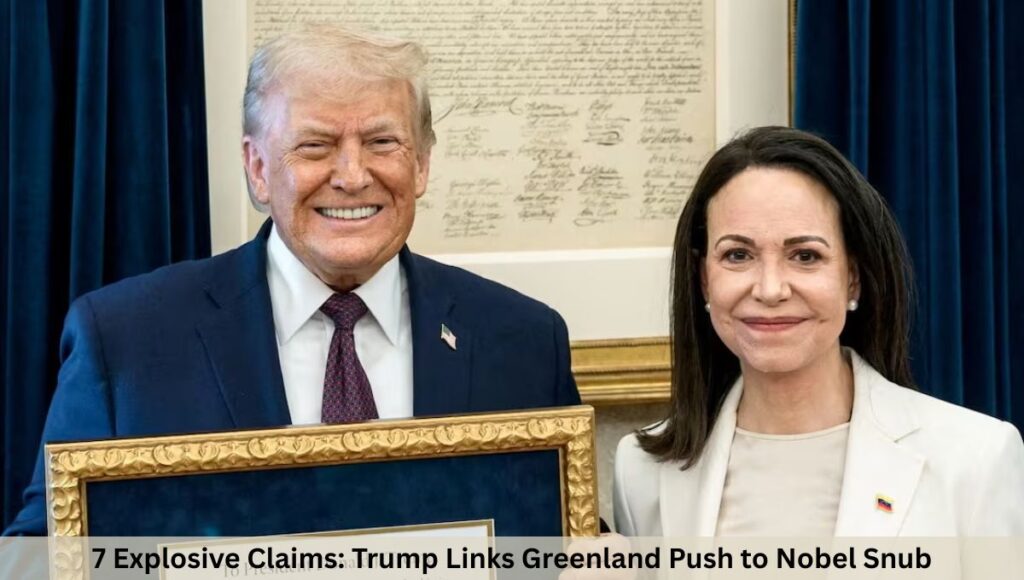
7 Explosive Claims: Trump Links Greenland Push to Nobel Snub
Greenland at the Center of a Growing Transatlantic Rift
Greenland, a vast Arctic island with a population of just 57,000 people, has become the focal point of Trump’s latest foreign policy confrontation.
An autonomous territory within the Kingdom of Denmark, Greenland has long been of strategic interest to the United States because of its location, natural resources, and role in Arctic security.
Trump has repeatedly argued that Denmark is incapable of defending Greenland against potential threats from Russia and China.
In his message to Støre, he questioned Denmark’s legal claim to the island, asserting that the world would not be secure unless the United States had “complete and total control of Greenland.”
European leaders have reacted with disbelief and alarm. For them, Trump’s language represents not just a challenge to Danish sovereignty, but a fundamental threat to the principles underpinning NATO and the post-war international order.
The Nobel Peace Prize Snub That Sparked Outrage
At the heart of the controversy is Trump’s anger over the 2025 Nobel Peace Prize, which was awarded to Venezuelan opposition leader María Corina Machado rather than to him.
Trump has repeatedly claimed credit for stopping “eight wars,” arguing that he deserved the prize more than any other world leader.
In a text message sent on Sunday, Trump told Norway’s prime minister that because his country had “decided not to give me the Nobel Peace Prize,” he no longer felt obliged to think “purely of peace.”
Although he added that peace would remain predominant, the implication was clear: Trump sees the Nobel decision as a turning point in how he approaches global affairs.
Norway’s government later released the messages under public disclosure laws, confirming their authenticity and triggering a wave of criticism across Europe.
Norway Pushes Back: ‘We Don’t Award the Prize’
Norwegian Prime Minister Jonas Gahr Støre moved quickly to clarify that the Nobel Peace Prize is awarded by an independent committee, not by the Norwegian government.
He said he had “clearly explained” this to Trump, adding that he was prepared to repeat the explanation as many times as necessary.
The Norwegian Nobel Committee, appointed by parliament but operating independently, selects the Peace Prize laureate through a confidential nomination and evaluation process.
Despite this, Trump has insisted that Norway “totally controls” the prize, a claim widely dismissed by diplomats and Nobel experts.
Tariffs as a Weapon: Trump’s Economic Threats
Alongside his Greenland rhetoric, Trump has threatened to impose a wave of escalating tariffs on European countries unless the U.S. is allowed to buy Greenland.
The list of targeted nations includes Denmark, Sweden, France, Germany, the Netherlands, Finland, Britain, and Norway. The tariffs, set to begin on February 1, have alarmed European industry and investors.
Markets still remember the volatility of the 2025 trade war, which disrupted supply chains and weighed heavily on global growth before easing mid-year through negotiated deals.
U.S. Treasury Secretary Scott Bessent warned European governments that retaliation would be “very unwise,” insisting that Trump’s focus on Greenland is rooted in strategic concerns rather than personal resentment.
EU Prepares to Retaliate
Despite calls for calm, the European Union is preparing for the possibility of confrontation. EU leaders are set to meet at an emergency summit in Brussels on Thursday to discuss their options.
One proposal under consideration is a package of tariffs on €93 billion worth of U.S. imports, which could automatically take effect on February 6 following the expiration of a six-month suspension.
Another, more aggressive option is the use of the EU’s Anti-Coercion Instrument (ACI), a powerful but never-before-used mechanism designed to counter economic pressure from third countries.
The ACI could restrict U.S. access to public tenders, limit investment opportunities, or curtail trade in services such as digital platforms and financial services—areas where the United States enjoys a surplus with the EU.
NATO Under Strain
The Greenland dispute comes at a precarious moment for NATO. The alliance is already under pressure due to the ongoing war in Ukraine and Trump’s long-standing criticism of allies who, in his view, fail to spend enough on defence.
Trump has claimed he has done more for NATO than any leader since its founding, arguing that the alliance now owes the United States tangible concessions.
European officials fear that his rhetoric risks undermining the mutual trust that has underpinned Western security for decades.
Danish Foreign Minister Lars Løkke Rasmussen captured the mood when he said: “We are living in 2026. You can trade with people, but you don’t trade people.”
Greenland’s Own Voice
Amid the escalating rhetoric, Greenland’s leaders have sought to assert their right to self-determination. Prime Minister Jens-Frederik Nielsen said the territory would not be pressured into any decision about its future.
“We stand firm on dialogue, on respect and on international law,” Nielsen said in a Facebook post, adding that Greenlanders should be allowed to decide their own fate.
Denmark has also taken steps to demonstrate its commitment to Greenland’s security. Danish soldiers are set to land in Kangerlussuaq as part of the Arctic Endurance military exercise, a move Trump dismissed as insignificant.
Military Posturing in the Arctic
The Arctic has become an increasingly contested region as melting ice opens new shipping routes and access to natural resources.
NATO allies have stepped up surveillance and military exercises in response to growing Russian and Chinese interest.
Trump, however, has downplayed the presence of allied forces in Greenland, suggesting they are inadequate to counter potential threats.
His comments have raised concerns that the United States could act unilaterally, further destabilizing the region.
Davos Diplomacy: A Chance for De-escalation?
Attention now turns to the World Economic Forum in Davos, where Trump is expected to meet several European leaders.
Norwegian Prime Minister Støre has said he will adjust his schedule to attend, while German Chancellor Friedrich Merz has also signaled his willingness to engage.
Merz said Germany did not want a trade dispute but warned that Europe was capable of responding if faced with unreasonable tariffs.
British Prime Minister Keir Starmer echoed calls for calm, saying he did not believe Trump was considering military action to seize Greenland.
Markets React to Renewed Uncertainty
Financial markets have responded nervously to the escalating dispute. Investors fear a repeat of the turbulence seen during previous U.S.–EU trade clashes, particularly given the scale of the proposed tariffs and the strategic stakes involved.
Analysts warn that a prolonged confrontation could damage global growth, disrupt supply chains, and weaken confidence in the international trading system.
How the Nobel Peace Prize Is Decided
The controversy has also drawn renewed attention to how the Nobel Peace Prize is awarded. Unlike other Nobel prizes, the Peace Prize is decided by a Norwegian committee rather than a Swedish institution.
Nominations can be submitted by qualified individuals worldwide, including lawmakers, academics, and former laureates. The committee’s deliberations are secret, and governments have no formal role in the decision-making process.
A Dispute with Global Consequences
What began as an unconventional proposal to buy Greenland has evolved into a far-reaching crisis touching on trade, security, and the future of the transatlantic alliance.
By linking his ambitions to a perceived personal slight, Trump has added an unpredictable dimension to an already complex geopolitical landscape.
European leaders now face difficult choices: how to stand firm against pressure while avoiding a damaging escalation with their most powerful ally.
For Trump, the Greenland dispute has become a test of leverage, resolve, and his belief that strategic necessity justifies extraordinary measures.
What Comes Next
With EU retaliation plans on the table, NATO unity under strain, and markets on edge, the coming weeks will be critical. Whether diplomacy at Davos can defuse tensions or whether the standoff hardens into a full-blown trade and security crisis remains to be seen.
One thing is clear:
Greenland, long a quiet outpost on the world map, has suddenly become a flashpoint in global politics—caught between great-power rivalry, alliance politics, and the personal convictions of the U.S. president.
Also Read: Trump’s 2025 Nobel Peace Prize Snub: Politics Over Global Peace
Also Read: Trump ties his stance on Greenland to not getting Nobel Peace Prize
Related Posts:
- Trump’s 2025 Nobel Peace Prize Snub: Politics Over…

- 7 Shocking Reasons FIFA’s Peace Prize for Trump…

- Trump’s Nobel Peace Prize Bid: Gaza Peace Plan, 8…

- Trump Says “They Won’t Give It to Me” as Pakistan…
- 5 Powerful Highlights as Trump Lands Second Nobel…

- Dramatic Moments Behind Trump’s Gaza Peace Push and…
