7 Explosive Signals: Netanyahu’s Stark Iran Warning as US Forces Mass amid rising war fears. Israeli Prime Minister Benjamin Netanyahu has issued one of his strongest warnings yet to Iran, declaring that Israel would respond with “a force it has not yet experienced” if Tehran were to attack the Jewish state.
Speaking before the Knesset, Israel’s parliament, Netanyahu said Israel was closely monitoring developments inside Iran as the country reels from mass protests and a brutal state crackdown.
“If Iran makes a mistake and attacks us, we will act with a force it has not yet seen,” Netanyahu said, underlining Israel’s readiness to confront what it sees as its most dangerous regional adversary.
The remarks came at a moment of heightened tension across the Middle East, with growing signs of US military reinforcement in the region and renewed concern that the crisis surrounding Iran’s internal unrest could spill into a wider regional conflict.
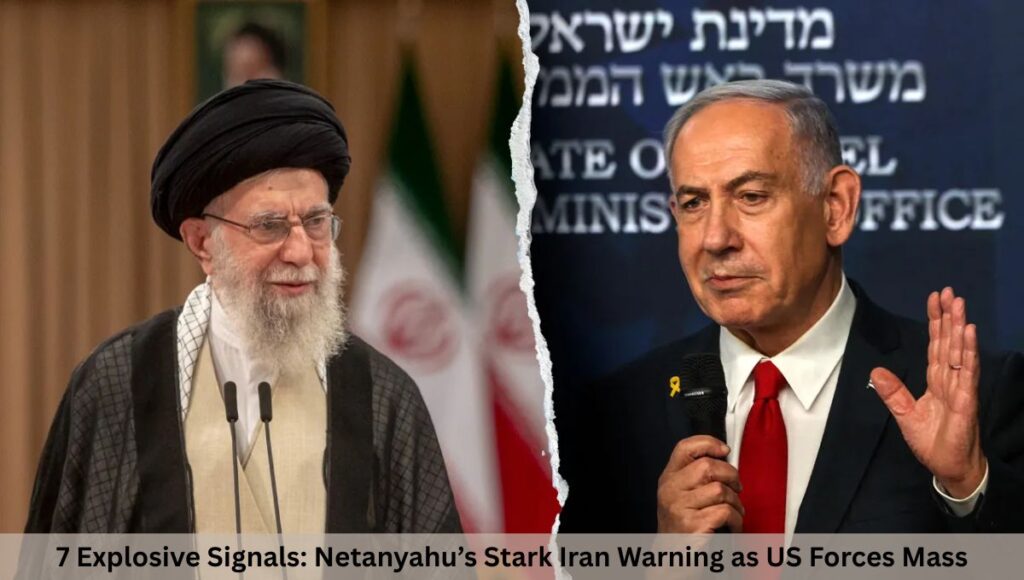
7 Explosive Signals: Netanyahu’s Stark Iran Warning as US Forces Mass
Iran’s Internal Crisis and Regional Ripples
Netanyahu’s comments were closely tied to the situation unfolding inside Iran, where weeks of nationwide protests have challenged the authority of the Islamic Republic.
Demonstrations triggered by worsening economic conditions and long-standing grievances have been met with sweeping repression by Iranian security forces.
According to the US-based Human Rights Activists News Agency, at least 4,029 people have been killed in the crackdown, with more than 26,000 detained. The group says the dead include demonstrators, security personnel, children, and bystanders.
Independent verification remains difficult due to Iran’s repeated internet shutdowns, but the agency has been regarded as reliable during previous episodes of unrest.
Netanyahu suggested that the unrest could mark a turning point for the Islamic Republic. “No one can predict what will happen in Iran,” he told lawmakers, “but whatever happens, it will never be the same again.”
US Military Movements Add to Tension
The Israeli leader’s warning coincided with reports that the United States is rapidly repositioning military assets toward the Middle East.
Ship-tracking data and multiple US media reports indicate that the nuclear-powered USS Abraham Lincoln Carrier Strike Group has been moving westward after transiting the Strait of Malacca.
The carrier, which had previously been deployed in the South China Sea as part of US efforts to deter China amid tensions over Taiwan, is now widely believed to be heading toward the Middle East.
Accompanying the Lincoln are several Arleigh Burke-class guided missile destroyers, including the USS Frank E. Petersen Jr., USS Michael Murphy, and USS Spruance.
While US officials have not publicly confirmed the carrier’s final destination, analysts say its arrival would significantly enhance Washington’s military options at a time when the region lacks a permanent US carrier presence.
Washington Draws Red Lines for Tehran
Tensions between Washington and Tehran have intensified since President Donald Trump publicly condemned Iran’s handling of the protests.
Trump has warned Iranian leaders against the killing of peaceful demonstrators and against carrying out mass executions in the wake of the unrest.
The movement of the USS Abraham Lincoln is widely seen as a signal of deterrence, underscoring that the United States is prepared to protect its interests and allies if the crisis escalates.
However, Gulf Arab states have expressed reservations about a direct military confrontation with Iran, complicating any potential US operation.
Israel’s Calculated Silence — Until Now
For much of the unrest in Iran, Israel maintained an unusually low public profile. Netanyahu reportedly instructed ministers to avoid public commentary on Iran, seeking to prevent the regime in Tehran from portraying the protests as a foreign-backed conspiracy.
Analysts say Israel’s restraint reflected a strategic calculation. Any overt Israeli involvement, they argue, could have allowed Iranian authorities to redirect public anger toward an external enemy and justify harsher repression.
Netanyahu’s warning in the Knesset marked a shift in tone, signaling that while Israel prefers to stay out of Iran’s internal struggle, it will not hesitate to act if directly threatened.
IDF on High Alert
Israel’s defense establishment has echoed Netanyahu’s tough rhetoric. Israel Defense Forces Chief of Staff Lt. Gen. Eyal Zamir said the military stands ready to deploy “offensive capability of unprecedented power” against any attempt to harm Israel.
During a visit to the Home Front Command headquarters, Zamir emphasized that Israel’s multilayered defense systems are fully prepared.
“Faced with the scale of the threats against the State of Israel, the Home Front Command is prepared, trained, and vigilant,” he said.
In recent days, Israel has taken visible steps to bolster readiness. Three new F-35I Adir stealth fighters landed at Nevatim Airbase, strengthening Israel’s air superiority and strike capabilities amid growing uncertainty.
US-Israel Coordination Intensifies
Behind the scenes, coordination between Washington and Jerusalem has intensified. Israeli security officials report frequent discussions between IDF leadership and US Central Command, focusing on preparedness and contingency planning.
Israeli assessments suggest that the rapid US force buildup could be completed within days, potentially giving Washington the capacity to conduct large-scale operations rather than limited strikes.
Such a development would carry major implications for Israel, which could face retaliation from Iran or its regional proxies.
Strategic Calculations and Risks
Despite the growing military posture, analysts caution that any strike on Iran carries enormous risks. A limited attack might fail to weaken the regime while strengthening hardliners by rallying nationalist sentiment. A broader campaign could destabilize the region and draw Israel into a wider war.
Israeli officials remain wary of miscalculation, particularly given Iran’s missile and drone capabilities and the potential for retaliation through allied militias across the region.
A Region on Edge
As Iran’s internal crisis simmers and US forces move closer to the region, the Middle East finds itself on edge. Netanyahu’s warning underscores Israel’s red lines, while Washington’s military movements signal deterrence rather than inevitability.
For now, Israel appears determined to keep its focus on defense and preparedness, watching closely as events inside Iran and decisions in Washington shape the next phase of an increasingly volatile confrontation.
Whether the crisis leads to regime change in Tehran, renewed diplomacy, or open conflict remains uncertain. What is clear is that the stakes for regional stability — and for Israel’s security — have rarely been higher.
Also Read: 11 Explosive Warnings as Trump Vows to ‘Knock the Hell Out’ of Iran
Also Read: Netanyahu Warns Iran: Any Attack Would Trigger Unprecedented Israeli Response
Related Posts:
- 3 Explosive Conditions Iran Sets to End War with US…

- 11 Explosive Warnings as Trump Vows to ‘Knock the…

- 10 Explosive Warnings as Donald Trump Calls Iran…
- 10 Explosive Strikes: Israel Bombs Tehran Oil Depots…

- 7 Powerful Facts About Ayatollah Ali Khamenei’s…

- 12 Explosive Claims as Donald Trump Says Iran War…