
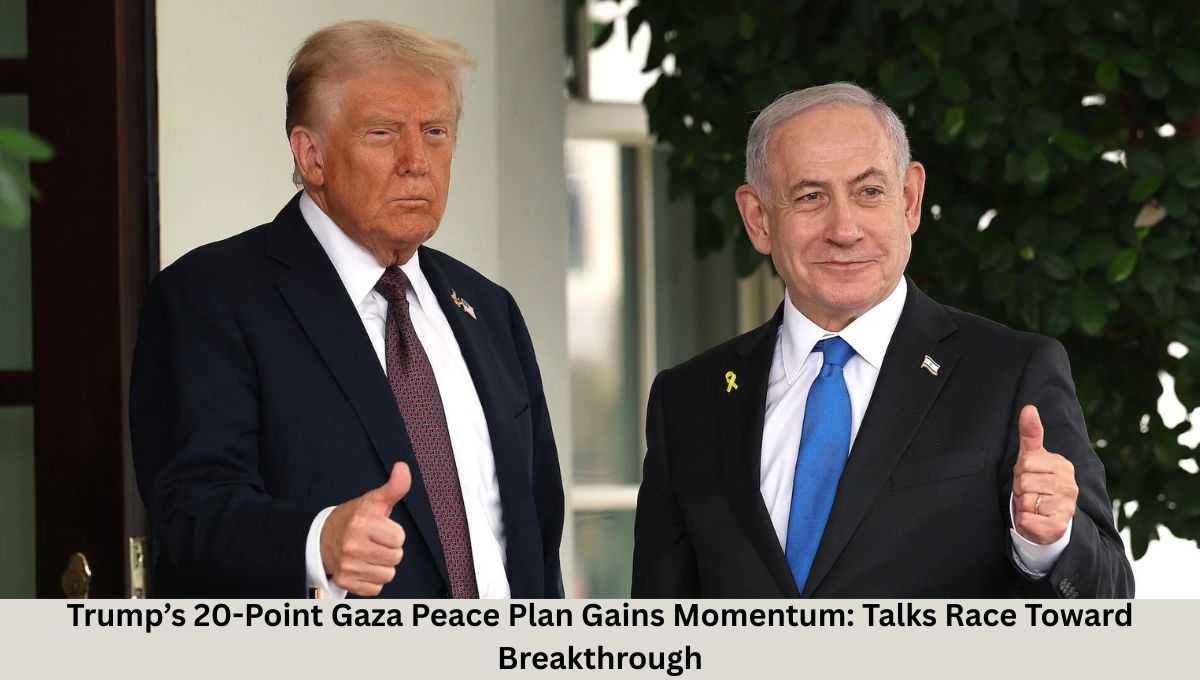
Trump’s 20-Point Gaza Peace Plan Gains Momentum: Talks Race Toward Breakthrough as Hamas and Israeli delegates Meet in Egypt. US President Donald Trump announced that negotiations to end the Gaza war and secure the release of hostages held by Hamas were “moving very fast,” with the first phase of his 20-point Gaza peace plan expected to be completed this week.
Speaking on Truth Social, Trump said discussions over the weekend had been “very positive,” involving Hamas, Arab and Muslim countries, and “everyone else.” He emphasized that this effort represents a global attempt to bring long-sought peace to the Middle East after nearly two years of devastating conflict.
“I am told that the first phase should be completed this week, and I am asking everyone to MOVE FAST,” Trump posted. “Time is of the essence, or massive bloodshed will follow.” The comments come just hours after Trump threatened the “complete obliteration” of Hamas if it failed to comply with his peace proposal and hand over control of Gaza to a transitional administration.
Trump’s 20-Point Gaza Peace Plan Gains Momentum: Talks Race Toward Breakthrough
Deadline Passes Amid Trump’s Ultimatum to Hamas
Trump’s Sunday evening deadline, set for 6 p.m. Washington time (3:30 a.m. IST Monday), marked the expiration of Hamas’s window to accept the peace deal. His warning came in stark terms: if Hamas refused to cede power and disarm, the United States would back Israel in a “total annihilation” campaign.
Despite the threat, Trump’s tone shifted as reports emerged that Hamas had accepted several parts of his proposal, including a ceasefire, Israeli withdrawal, and hostage exchange, though the group requested further discussions on key political points.
Hamas Delegation Arrives in Egypt for Crucial Talks
The negotiations gained traction as a Hamas delegation led by Khalil al-Hayya, the group’s exiled Gaza chief, arrived in Sharm el-Sheikh, Egypt, on Sunday night. The delegation is expected to meet with US, Qatari, and Egyptian mediators to discuss the first phase of the peace plan.
An Israeli delegation, led by Strategic Affairs Minister Ron Dermer, was set to arrive Monday to join the talks, marking the first direct engagement since Trump’s proposal was introduced.
US Secretary of State Marco Rubio called the next few days “critical,” saying the outcome would reveal whether Hamas was serious about peace.
“We will know very quickly whether Hamas is serious or not by how these technical talks go,” Rubio told NBC News. “It cannot take weeks or even multiple days.”
Inside Trump’s 20-Point Gaza Peace Plan
According to officials briefed on the process, the first phase of Trump’s plan centers on the release of 48 hostages, including 20 believed to be alive, in exchange for Palestinian prisoners held in Israeli jails.
Subsequent phases are expected to include:
- The gradual withdrawal of Israeli troops from Gaza.
- The establishment of a transitional governing authority—the “Board of Peace”—composed of Palestinian technocrats and international monitors.
- The disarmament of Hamas and restoration of basic services in Gaza.
Hamas has reportedly accepted the hostage exchange and the idea of handing over administration to Palestinian technocrats but rejected foreign control, particularly any leadership role for Tony Blair, who is viewed unfavorably in much of the Arab world for his role in the 2003 Iraq War.
Trump Urges Mediators to ‘Move Fast’
As delegations prepared to convene in Egypt, Trump urged mediators to “move fast,” warning that delays could reignite violence.
“Everybody has pretty much agreed to it,” Trump told reporters. “It’s a great deal for Israel, it’s a great deal for the Arab and Muslim world — a great deal for the world.”
He insisted that the peace process could not drag on and that hostage releases must happen “very soon.”
Despite his optimism, Trump acknowledged that minor changes might occur during the negotiations but rejected the idea of broad flexibility.
Also Read: Rubio says Gaza war has hurt Israel’s global support. How has that played out at the UN?
Ongoing Israeli Bombardments Threaten Talks
While progress has been reported in diplomatic circles, Israeli air and ground attacks continued across Gaza on Sunday. Local health officials said at least 19 people were killed, including civilians seeking aid in southern Gaza.
Israeli government spokesperson Shosh Bedrosian confirmed there was no formal ceasefire, though some bombings had paused.
“While certain bombings have stopped inside the Gaza Strip, there’s no ceasefire in place at this point in time,” she said. “Defensive fire continues if our forces are threatened.”
Despite Trump’s public call to “immediately stop bombing Gaza,” Israeli strikes persisted overnight, destroying residential blocks in Gaza City and parts of Khan Younis.
Hamas Accepts Core Points but Seeks Revisions
On Friday, Hamas submitted its written response to Trump’s peace plan, signaling unprecedented flexibility. The group agreed to:
- An immediate ceasefire,
- The exchange of Israeli hostages and Palestinian prisoners, and
- The transfer of Gaza’s administration to a Palestinian technocratic body backed by Arab and Islamic nations.
However, Hamas declined to commit to disarmament and rejected the creation of a foreign-led transitional authority, especially the “Board of Peace” under Tony Blair’s oversight.
Senior Hamas official Mousa Abu Marzouk stated bluntly:
“We will never accept anyone who is not Palestinian to control the Palestinians.”
Reactions from Mediators and World Leaders
Qatar’s Foreign Ministry welcomed Hamas’s response and said it had begun coordinating with Egypt and the United States to advance the peace process.
Egypt also expressed optimism, saying it hoped for “positive developments” that could lead to a permanent ceasefire.
United Nations Secretary-General Antonio Guterres urged both parties to seize the moment:
“This is a critical opportunity to bring the tragic conflict in Gaza to an end.”
Also Read: Trump Warns Gaza War is “Hurting Israel” as Global Support Declines
Netanyahu Under Pressure at Home
Inside Israel, Prime Minister Benjamin Netanyahu is facing mounting domestic pressure to accept Trump’s Gaza peace plan.
Israeli media reported that Netanyahu was “surprised and shocked” by Trump’s direct order to halt bombings and his public praise for Hamas’s “positive” response. Opposition leaders in Israel have reportedly offered to form a unity government to support the deal if Netanyahu’s right-wing coalition resists.
Families of Israeli captives have also voiced support for the plan, arguing that continued bombing endangers the hostages still in Gaza.
Trump Warns Hamas of ‘Complete Obliteration’
Speaking to CNN’s Jake Tapper, Trump said Hamas faced “complete obliteration” if it refused to relinquish power.
“Complete obliteration!” Trump said when asked what would happen if Hamas stays in power. “Only time will tell whether they are serious.”
He also confirmed that Israel had agreed to an initial withdrawal line, pending Hamas’s confirmation, which would trigger an immediate ceasefire and hostage exchange.
Trump claimed the map had been shared with both sides and would mark the beginning of “the end of a 3,000-year catastrophe.”
The Withdrawal Map Controversy
According to Israeli and Palestinian sources, Trump’s withdrawal map envisions Israeli pullbacks from much of Gaza but excludes several key areas, including:
- Rafah in the south,
- Beit Hanoun and Beit Lahia in the north,
- Nearly a quarter of Gaza City, and
- Parts of Khan Younis and Deir al-Balah.
If implemented, nearly 900,000 Palestinians would still be displaced and unable to return to their homes initially. Hamas had rejected similar maps in previous talks earlier this year.
A Tentative Calm — But Fragile
For the first time in months, Gaza experienced relative quiet over the weekend. Local journalists reported fewer air raids and the temporary silencing of Israeli drones overhead.
Al Jazeera’s Hani Mahmoud said, “Compared to the past few days, the intensity of bombardment is definitely less and could be the beginning of a complete halt.”
Still, the risk of renewed violence remains high, with both sides accusing each other of violations.
International Stakes and Strategic Shifts
Trump’s Gaza peace initiative marks one of the boldest US diplomatic efforts in the Middle East in decades. If successful, it could reshape alliances, strengthen Washington’s role as a mediator, and open a path toward a regional normalization process involving Arab states.
For Hamas, the talks represent a moment of reckoning. Its willingness to compromise — even temporarily — reflects both military exhaustion and regional pressure from Egypt, Qatar, and Turkey, which are pushing for an end to the humanitarian disaster.
For Israel, the plan offers a potential off-ramp from an increasingly unpopular war that has drawn global condemnation for civilian casualties exceeding 67,000, according to Gaza’s health ministry.
Global Reactions and Future Prospects
The European Union, Turkey, and Saudi Arabia have cautiously welcomed Trump’s initiative, urging all sides to commit to “lasting peace.”
Analysts say the coming days will determine whether Trump’s 20-point plan becomes a historic breakthrough or another missed opportunity in a region scarred by decades of failed diplomacy.
Former UN envoy Robert Malley told the BBC:
“If Trump can pull this off, it will be the most consequential US-led peace agreement in the Middle East since Camp David.”
As Gaza Holds Its Breath
As negotiators gather in Egypt, the world watches closely.
Every hour of delay means more lives lost, yet every word agreed upon could bring tangible hope to millions.
Trump’s Gaza peace plan—a mix of hardline ultimatums and pragmatic diplomacy—now faces its most critical test.
Whether it ends in peace or peril depends on what unfolds in Sharm el-Sheikh this week. “We are very close,” Trump declared. “But everyone must move fast.”
Related Posts:
- Dramatic Moments Behind Trump’s Gaza Peace Push and…

- Trump’s Breakthrough Gaza Ceasefire Deal 2025: Key Insights

- Trump’s 2025 Gaza Peace Plan Signing and Historic…

- Trump’s 20-Point Gaza Peace Plan Gains Urgent Global…

- 5 Powerful Highlights as Trump Lands Second Nobel…

- Gaza Peace Deal First Phase Achieved: Trump’s Israel…
