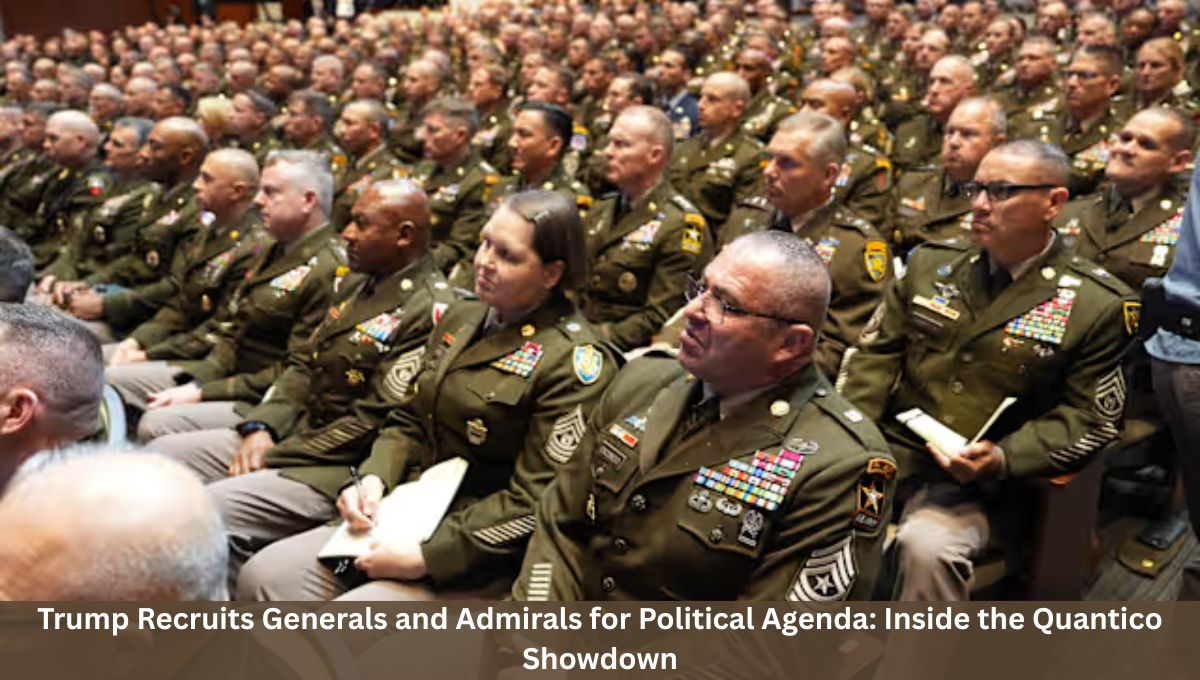
Trump Recruits Generals and Admirals for Political Agenda: Inside the Quantico Showdown amid constitutional concerns and growing militarization. In a dramatic and highly unusual event, US President Donald Trump summoned nearly 800 top military leaders — generals, admirals, and senior officers — to Marine Corps Base Quantico, Virginia, where he delivered a fiery speech that blurred the lines between civilian leadership and military duty.
The gathering, which many analysts have described as unprecedented in scope and tone, was framed by Trump as a national security necessity. Yet the content of his address, paired with Defense Secretary Pete Hegseth’s equally combative remarks, has sparked deep concern about the politicization of the US military.
Trump told the assembled officers that America faces an “enemy from within,” pointing to Democratic-led cities, pro-Palestinian protesters, and what he called “woke culture” in the armed forces. He suggested using major US cities as “training grounds” for military operations, raising alarm among civil liberties advocates and constitutional experts. “We’re under invasion from within,” Trump declared. “No different than a foreign enemy, but more difficult in many ways because they don’t wear uniforms.”
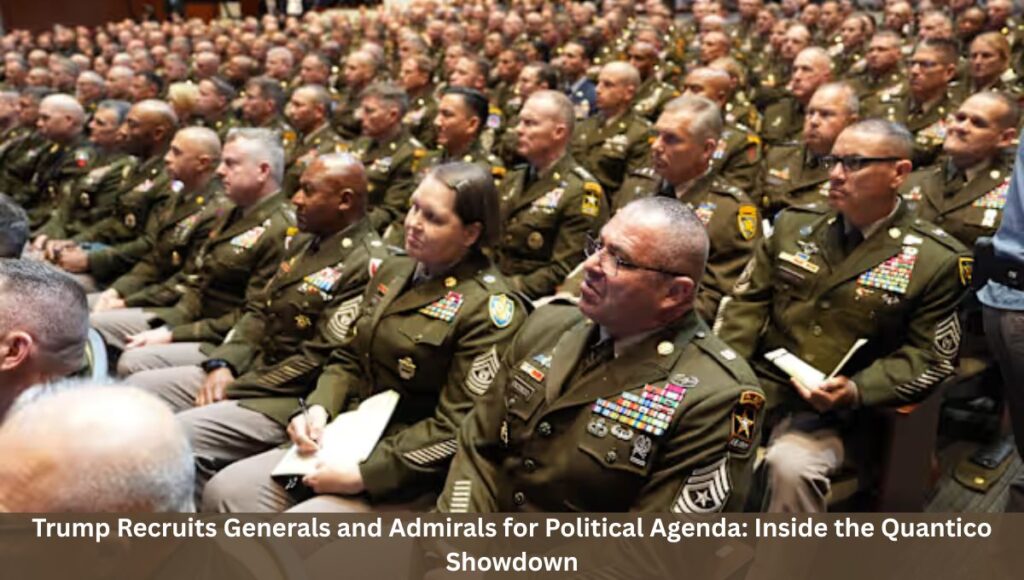
Trump Recruits Generals and Admirals for Political Agenda: Inside the Quantico Showdown
A Judge’s Rebuke and the Shadow of Loyalty Tests
The controversy surrounding Trump’s militarized domestic agenda was foreshadowed earlier this month when a federal judge rebuked the administration for deploying the military in Los Angeles.
In his ruling, the judge included a startling footnote: when Maj. Gen. Scott Sherman, a decorated Iraq War veteran, raised concerns about using troops in MacArthur Park, a senior Department of Homeland Security official allegedly questioned Sherman’s loyalty to the United States.
That episode, critics say, epitomizes the pressure military officers now face: either fall in line with the president’s domestic strategy or risk having their loyalty and patriotism questioned.
The Quantico Gathering: Rally or Briefing?
The Quantico event was called at short notice, with generals and admirals flown in from bases worldwide. Traditionally, such gatherings are reserved for global defense strategy, military readiness, or classified briefings.
Instead, Trump delivered what many described as a campaign-style rally speech, filled with grievances, political attacks, and boasts about his accomplishments.
At times, Trump seemed to test the loyalty of his audience.
- He asked them to endorse his tough posture against protesters: “They spit, we hit.”
- He pressed them to raise hands if they thought Joint Chiefs Chairman Dan Caine was “no good.”
- He half-joked: “If you don’t like what I’m saying, you can leave the room. Of course, there goes your rank. There goes your future.”
The generals, bound by protocol, mostly sat in silence — a silence Trump noted with discomfort. “If you want to applaud, you applaud,” he urged them.
Trump’s Call: Use American Cities as “Training Grounds”
One of the most controversial moments came when Trump proposed that the military use US cities as training grounds.
“We should use some of these dangerous cities as training grounds for our military,” he said, citing Chicago, New York, Los Angeles, and San Francisco.
He added ominously: “We’re going into Chicago very soon. It’s a war too. It’s a war from within.”
Such remarks echoed his earlier deployments of National Guard and Marines to Los Angeles, Washington, DC, Memphis, and Portland. Trump’s approach marks a sharp departure from tradition, since the Posse Comitatus Act of 1878 generally bars the military from law enforcement roles on US soil.
Pete Hegseth’s Culture War in Uniform
Defense Secretary Pete Hegseth, a former Fox News commentator and Trump loyalist, delivered his own 45-minute address to the military brass.
Hegseth’s focus: ending what he called “woke culture” in the armed forces.
Hegseth’s Key Directives:
- End to Diversity and Inclusion Programs: He denounced race- and gender-based promotions, saying, “The era of politically correct leadership ends right now.”
- Male-Level Fitness Standards: All service members, regardless of gender, must meet the highest male physical benchmarks.
- No More “Fat Generals”: He mocked overweight officers, declaring it “completely unacceptable” to see them in the Pentagon.
- Appearance Crackdown: Bans on beards and strict grooming requirements will return.
- Discipline Reforms: He pledged to weaken protections against hazing and overhaul misconduct investigations.
“If the words I’m speaking today are making your heart sink, then you should do the honorable thing and resign,” Hegseth told the silent audience.
Trump’s Political Themes: From Gaza to Ukraine
While the centerpiece of Trump’s speech was domestic unrest, he also touched on international issues:
- Gaza War: Trump claimed he was close to brokering a ceasefire, saying Israel and Arab nations had agreed to his 20-point peace plan, and Hamas had “three or four days” to accept it.
- Ukraine War: He expressed disappointment in Russian President Vladimir Putin, saying, “I thought he would get this thing over with… Are you a paper tiger?”
- Nobel Peace Prize: Trump complained that despite “ending wars,” he would never win the Nobel Peace Prize, which he called a “big insult to America.”
But his focus always circled back to the home front — what he called “the war from within.”
Legal and Constitutional Questions
Trump’s domestic deployments have already drawn legal challenges.
- The 10th Amendment reserves policing powers to the states, not the federal government.
- The Posse Comitatus Act prohibits military involvement in civilian law enforcement unless expressly authorized.
A New York Times–Siena poll found that more Americans fear Trump will use the military to intimidate political opponents than fear rising crime without military intervention.
Experts warn that Trump’s strategy risks militarizing civilian life, undermining public trust in the military, and eroding the constitutional separation between political power and the armed forces.
Revamping the Pentagon: From “Defense” to “War”
Earlier this month, Trump signed an executive order to rename the Department of Defense back to the “Department of War.”
Though the change requires congressional approval, Trump said it reflected his administration’s shift toward a more aggressive posture.
He has also:
- Fired senior officers, including the first woman to lead a military service and the Black chairman of the Joint Chiefs.
- Ordered book removals from military academies.
- Authorized strikes against suspected drug vessels in the Caribbean.
“If you try to poison our people, we will blow you out of existence,” Trump told the generals at Quantico.
Critics Warn of Militarization of American Democracy
The Quantico summit was costly, logistically complex, and fraught with security risks. Critics argue it was less about national defense than about aligning the military with Trump’s political movement.
Historians compare it to dangerous precedents where leaders blurred civilian-military boundaries, warning that America’s tradition of an apolitical military is under threat.
“Tuesday seemed to be about making sure there are no more Maj. Gen. Shermans,” one analyst observed, referring to the officer who dared question Trump’s domestic deployments.
Also Read: Trump Deploys 800 National Guard Troops to Washington Amid ‘Crime Emergency’
Conclusion: A Nation at a Crossroads
Trump’s Quantico speech and Hegseth’s directives mark a turning point in America’s civil-military relationship.
For supporters, it was a bold plan to restore order, strengthen the armed forces, and confront internal threats.
For critics, it was an ominous sign of a president recruiting the military into his political cause, raising questions about democracy, constitutional limits, and the militarization of daily life.
As Trump himself told the silent generals:
“We’re all on the same team. If you don’t like what I’m saying, you can leave… there goes your rank, there goes your future.” Whether the military truly is “on the same team” — or whether its independence can withstand Trump’s pressure — may shape the future of American democracy.