

Pakistan–Afghanistan Ceasefire 2025: What to Know About the Qatar-Mediated Deal after deadly border clashes. After a week of deadly cross-border clashes that left hundreds dead and wounded, Pakistan and Afghanistan have agreed to an immediate ceasefire following marathon negotiations in Doha. The talks were mediated by Qatar and Turkiye, marking a major diplomatic breakthrough aimed at halting escalating hostilities between the two South Asian neighbors.
According to a statement released by Qatar’s Ministry of Foreign Affairs early Sunday, both nations “agreed to the ceasefire and the establishment of mechanisms to consolidate lasting peace and stability between the two countries.” Officials from both sides confirmed that follow-up meetings will be held in the coming days to ensure the truce’s sustainability and verifiable implementation.
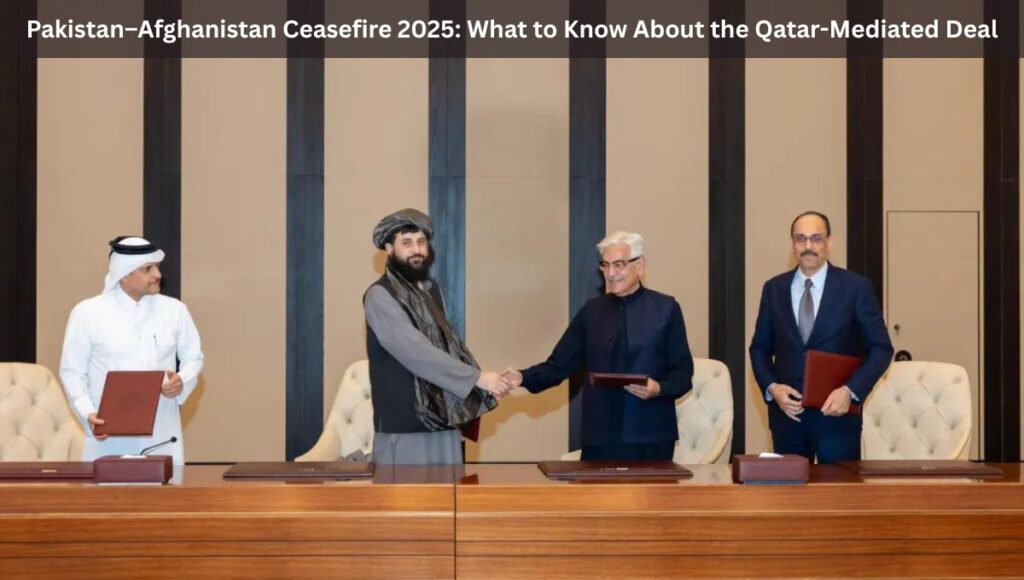
Pakistan–Afghanistan Ceasefire 2025: What to Know About the Qatar-Mediated Deal
A Ceasefire Brokered After Heavy Bloodshed
The announcement came after a week of fierce border fighting that claimed dozens of lives on both sides. The violence—triggered by Pakistan’s airstrikes and retaliatory Taliban attacks—represented the worst confrontation between the two nations since the Taliban regained power in Kabul in 2021.
Qatar’s foreign ministry emphasized that the ceasefire aims to “prevent further loss of life” and “form a foundation for sustainable peace in the region.”
Turkiye, which co-facilitated the Doha negotiations, echoed similar sentiments, urging both countries to commit to restraint and continue dialogue to address security and border concerns.
Also Read: Pakistan–Afghanistan Conflict: 10 Civilians Killed in Ceasefire Breakdown
Pakistan’s Response: “First Step in the Right Direction”
Pakistan’s Deputy Prime Minister and Foreign Minister Ishaq Dar welcomed the truce, calling it “a first step in the right direction.”
In a statement posted on X (formerly Twitter), Dar expressed appreciation for the mediation efforts of Qatar and Turkiye.
“Deeply appreciate the constructive role played by brotherly Qatar and Turkiye. We look forward to the establishment of a concrete and verifiable monitoring mechanism to address terrorism emanating from Afghan soil,” he wrote.
He added that Pakistan’s top priority was to protect its citizens and borders while pursuing peaceful coexistence with Afghanistan.
Afghanistan’s Position: ‘We Are Not in Favour of War’
On the Afghan side, Zabihullah Mujahid, spokesperson for the Taliban government, confirmed that negotiations took place in Doha on Saturday and that the Afghan delegation was led by Defence Minister Mullah Muhammad Yaqoob Mujahid.
Afghanistan’s Taliban administration reiterated that it seeks peace, not confrontation, and accused Pakistan of violating previous ceasefire agreements through airstrikes on Afghan territory.
Taliban Prime Minister Mohammad Hassan Akhund, in a call with his Malaysian counterpart, said:
“Afghanistan is not in favour of war. The recent strikes were initiated by the Pakistani side by violating our territory.”
Fresh Airstrikes Before Ceasefire Announcement
Just hours before the ceasefire was confirmed, Pakistan conducted fresh airstrikes in Afghanistan’s Paktika province, killing at least ten people — including three Afghan cricketers — according to local officials.
The Afghanistan Cricket Board (ACB) confirmed the deaths of players Kabeer Agha, Sibghatullah, and Haroon, who were in the region for a local tournament. The International Cricket Council (ICC) later issued a statement mourning the loss of “three young talents who represented the future of Afghan cricket.”
Afghan officials said the strikes hit residential areas in Argun and Barmal districts, resulting in civilian casualties.
Meanwhile, Pakistani security sources claimed the attacks were aimed at Tehreek-e-Taliban Pakistan (TTP) militants allegedly operating from Afghan soil.
Weeks of Escalation Along the Durand Line
The latest violence marks another chapter in a long history of border tension along the Durand Line, a 2,600-kilometer frontier dividing Pakistan and Afghanistan that has been disputed since British colonial times.
Hostilities erupted earlier this month after Pakistan launched airstrikes in Kabul on October 9, targeting suspected TTP hideouts following attacks on Pakistani soldiers.
In response, Taliban fighters launched a series of cross-border raids, escalating the conflict into full-scale clashes that killed dozens, including civilians. By the time negotiations resumed in Doha, reports estimated nearly 200 Afghans and 60 Pakistani soldiers had been killed.
Taliban Defence Chief’s Emergency Visit to Doha
In an urgent attempt to stop the bloodshed, Taliban Defence Minister Maulvi Muhammad Yaqoob Mujahid flew to Doha on Saturday for what Afghan officials described as “the most critical peace negotiations in recent history.”
The Afghan delegation’s arrival came amid reports of continued Pakistani airstrikes along the border, despite the short-lived 48-hour truce brokered earlier in the week.
Local Afghan media described Pakistan’s strikes as “relentless,” with residents reporting widespread destruction in southeastern provinces. Civil society groups in Kabul have condemned the attacks, calling them “indiscriminate and disproportionate.”
Inside the Doha Talks
According to sources familiar with the negotiations, Pakistan’s delegation was led by Defence Minister Khawaja Muhammad Asif and Intelligence Chief General Asim Malik, while Afghanistan’s side was represented by Defence Minister Yaqoob Mujahid and senior Taliban commanders.
The meeting focused on three core issues:
- Immediate cessation of hostilities along the border.
- Establishment of a monitoring mechanism to verify future ceasefires.
- Commitment to bilateral security cooperation to prevent militant infiltration.
Qatar’s statement noted that both countries agreed to “establish mechanisms to consolidate lasting peace and stability” and would meet again in Turkiye for follow-up verification.
Qatar and Turkiye’s Growing Diplomatic Role
Both Qatar and Turkiye have increasingly positioned themselves as mediators in regional conflicts involving Afghanistan.
Doha, which previously hosted peace talks between the U.S. and the Taliban in 2020, is seen as a trusted neutral facilitator, while Turkiye maintains strategic and economic ties with both Islamabad and Kabul.
In its statement, Qatar’s Ministry of Foreign Affairs said:
“The State of Qatar expresses hope that this important step will contribute to ending tensions on the border between the two brotherly countries and form a solid foundation for sustainable peace in the region.”
Turkiye’s Foreign Minister also commended the outcome, emphasizing Ankara’s commitment to “maintaining regional peace through dialogue rather than confrontation.”
Mutual Accusations Continue Despite Truce
Despite the agreement, both sides continue to blame each other for recent violations.
Pakistan’s Army Chief Field Marshal Asim Munir warned on Saturday that the Afghan regime “must rein in the proxies who have sanctuaries in Afghanistan and are using Afghan soil to perpetrate heinous attacks inside Pakistan.”
Afghan officials, meanwhile, accused Islamabad of spreading “misinformation” and sheltering ISIL (ISIS)-linked fighters who threaten Afghanistan’s internal security. Each country has denied the other’s claims.
Regional Reactions and International Concern
The United Nations and several regional powers, including China and Iran, welcomed the ceasefire announcement.
A UN spokesperson urged both nations to “exercise maximum restraint and ensure the protection of civilians,” while emphasizing the importance of “building on this diplomatic progress to address underlying tensions.”
Analysts say the Doha deal is fragile but could serve as a critical confidence-building measure, especially as Afghanistan continues to struggle with internal instability and Pakistan faces political and economic challenges.
Background: Years of Fragile Relations
Relations between Islamabad and Kabul have been strained since the Taliban’s takeover of Afghanistan in 2021, with Pakistan repeatedly accusing the Taliban of sheltering TTP fighters responsible for deadly attacks inside Pakistan.
The TTP, or Tehreek-e-Taliban Pakistan, announced the end of its ceasefire with Islamabad in November 2022, triggering a sharp rise in violence across Khyber Pakhtunkhwa and Balochistan provinces.
Since then, border tensions have worsened, with both sides accusing the other of harboring militants and violating sovereignty.
Also Read: Analysis: Why Pakistan and the Taliban won’t find it easy to patch up
What Lies Ahead
As the dust settles over the latest clashes, the immediate focus will be on ensuring that the ceasefire holds and evolves into a lasting peace framework.
Diplomats involved in the Doha talks say the next round of discussions—expected to take place in Ankara later this month—will determine whether the fragile truce can be transformed into a sustainable security pact.
Experts warn that without effective monitoring and political will on both sides, the ceasefire could unravel quickly.
For now, however, the Doha agreement offers a glimmer of hope for two nations long trapped in a cycle of violence and mistrust.
Conclusion
The Pakistan–Afghanistan immediate ceasefire stands as a pivotal moment in South Asia’s security landscape, potentially halting one of the region’s most dangerous flashpoints. With Qatar and Turkiye stepping up their mediation roles, the world watches closely to see whether this truce can pave the way for a more stable and peaceful future along the Durand Line.
As both sides prepare for follow-up talks, much depends on whether promises made in Doha can translate into actions on the ground.
Related Posts:
- Pakistan–Afghanistan Ceasefire 2025: Breakthrough…

- Afghanistan–Pakistan War 2025: Inside the 48-Hour Ceasefire

- 5 Major Takeaways from the US Supreme Court's…

- 7 Heartbreaking Facts About Venezuela's Earthquake Disaster

- Trump’s 20-Point Gaza Peace Plan Gains Urgent Global…

- Pakistan–Afghanistan Border Conflict 2025: Ceasefire…
