
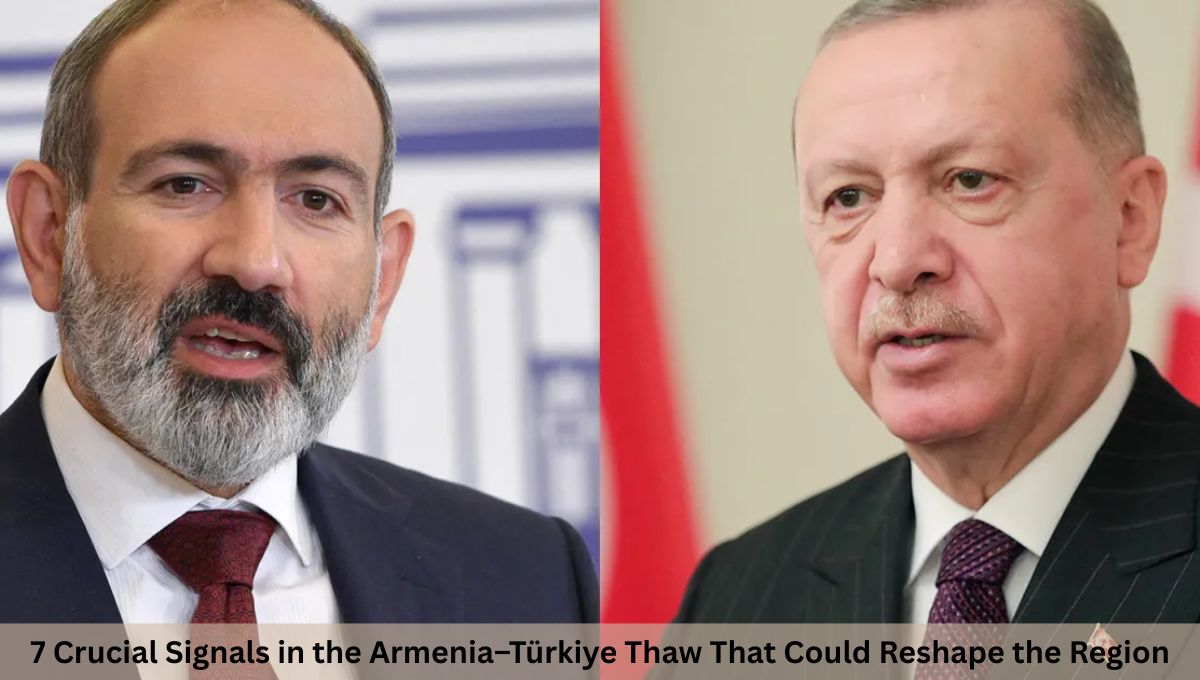
7 Crucial Signals in the Armenia–Türkiye Thaw That Could Reshape the Region through the U.S.-backed TRIPP project. Armenia has signaled renewed optimism over the long-stalled normalization process with Türkiye, welcoming recent remarks by Turkish President Recep Tayyip Erdogan and pointing to tangible steps that could reshape relations across the South Caucasus.
Prime Minister Nikol Pashinyan said the moment had arrived for both symbolic and concrete actions between Ankara and Yerevan, reflecting a broader regional shift that includes advancing peace talks with Azerbaijan and growing U.S. involvement through major infrastructure initiatives.
Taken together, the developments suggest that decades of frozen hostility may be giving way—cautiously but steadily—to pragmatic cooperation.
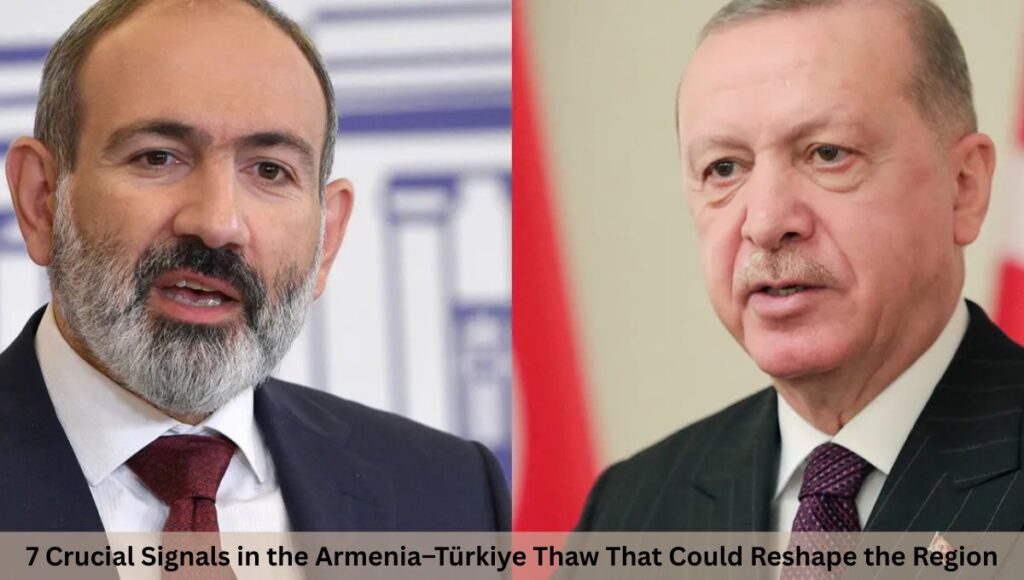
7 Crucial Signals in the Armenia–Türkiye Thaw That Could Reshape the Region
Pashinyan: Time for Concrete and Symbolic Steps
Speaking at a press briefing reported by Armenian state media, Prime Minister Pashinyan welcomed Erdogan’s comments about advancing normalization with Armenia, describing the current phase as an opportunity that should not be missed.
“Within the framework of our bilateral dialogue, the time has come for symbolic—and even non-symbolic, broader, and more concrete—steps to take place,” Pashinyan said.
His remarks came after Erdogan stated in mid-December that Türkiye plans to take “some symbolic steps” starting in early 2026 as part of its normalization process with Armenia, in coordination with parallel progress between Armenia and Azerbaijan.
For Yerevan, the message from Ankara was notable not only for its tone, but also for its timing—coinciding with broader diplomatic movement across the region.
Erdogan Links Armenia–Türkiye Progress to Azerbaijan Peace Talks
President Erdogan framed Türkiye’s engagement with Armenia as part of a wider regional realignment, explicitly linking normalization to the near-completion of a peace agreement between Armenia and Azerbaijan.
“Azerbaijan and Armenia are closer than ever to signing a peace agreement. Parallel to this process, and in dialogue with Azerbaijan, we are also advancing our normalization processes with Armenia,” Erdogan said on December 16.
This linkage underscores Ankara’s long-standing position that progress with Armenia cannot be fully detached from its alliance with Baku. However, Armenian officials increasingly interpret this coordination as an opening rather than a barrier.
Visa Simplification: A Tangible Breakthrough
One of the most concrete outcomes of the normalization process so far is a new agreement simplifying visa procedures for official passport holders.
What the Agreement Includes
Starting January 1, 2026, holders of:
- Diplomatic passports
- Service passports
- Special passports
from both Armenia and Türkiye will be able to obtain free electronic visas (e-visas).
The Armenian Ministry of Foreign Affairs confirmed the move, emphasizing that it reflects a shared commitment to continue normalization without preconditions.
The Armenian government has already circulated a draft decision applying a zero visa fee for eligible Turkish passport holders entering Armenia for stays of up to 21 days.
While limited in scope, the visa agreement is widely seen as the first operational confidence-building measure between the two sides in years.
Why the Visa Deal Matters Beyond Diplomats
Although the agreement applies only to official passport holders, its significance goes beyond bureaucratic convenience.
- It marks the first mutually implemented step since normalization talks began in 2021
- It establishes reciprocity and legal parity between the two countries
- It signals political will rather than rhetorical intent
For a relationship frozen since the early 1990s, even narrowly targeted measures represent meaningful progress.
A Border Closed for Three Decades
Armenia and Türkiye have had no diplomatic relations since Armenia’s independence in 1991. The shared land border has remained closed since 1993, following the first Karabakh war and Ankara’s support for Azerbaijan.
Despite several attempts at rapprochement—including the failed 2009 Zurich Protocols—relations remained hostage to unresolved historical disputes and regional conflicts.
In December 2021, both sides appointed special representatives to restart talks. A year later, they agreed to partially open the border to citizens of third countries, though Armenia says Türkiye has yet to implement that decision.
According to Armenian officials, the Margara border checkpoint is already fully prepared for reopening.
Foreign Minister: Dialogue Must Deliver Results
Armenian Foreign Minister Ararat Mirzoyan has echoed Pashinyan’s call for movement from words to action.
Speaking on Armenian Public Television, Mirzoyan said talks with Türkiye were progressing positively but stressed that symbolic gestures alone were no longer sufficient.
“We need concrete results on the ground,” he said, adding that a symbolic breakthrough could come before the end of the year.
Mirzoyan confirmed that the most recent meeting between special envoys took place at the Margara crossing, focusing on accelerating implementation of earlier agreements.
Economic Cooperation and Azerbaijan Factor
Normalization with Türkiye is unfolding alongside a parallel, and potentially more consequential, process: Armenia’s peace negotiations with Azerbaijan.
Pashinyan welcomed Baku’s recent decision to lift restrictions on the transit of goods to Armenia and expressed hope that this would pave the way for bilateral trade, including Armenian exports to Azerbaijan.
Mirzoyan went further, noting that Armenia is discussing direct trade with Azerbaijan—a concept once politically unthinkable.
“The further we move towards institutionalising peace and overcoming psychological barriers within society, the more realistic such scenarios will become,” he said.
He also acknowledged that purchasing Azerbaijani petrol would be economically beneficial for Armenian consumers, despite calls for boycotts.
TRIPP Project: U.S.-Backed Infrastructure Push
A major pillar of Armenia’s regional strategy is the Trump Route for International Peace and Prosperity (TRIPP) project, being developed with U.S. support.
Prime Minister Pashinyan confirmed that Armenia and the United States are preparing a strategic framework document for the project, which will require formal approval before implementation begins.
Key TRIPP Timelines
- Strategic framework approval: expected in 2026
- On-the-ground construction: second half of 2026
- Initial focus: railway infrastructure
Pashinyan said the railway is currently the priority, though energy infrastructure such as gas or oil pipelines could take precedence depending on circumstances.
Regional Reactions and Geopolitical Implications
Addressing speculation that Russia or Iran oppose the TRIPP project, Foreign Minister Mirzoyan dismissed such claims.
He said Iran had raised questions about infrastructure unblocking, but these were resolved through dialogue.
“Both Armenia and Iran now see opportunities in the unblocking of infrastructure,” Mirzoyan said.
The TRIPP initiative aligns with broader efforts to reopen transport corridors, reduce isolation, and integrate the South Caucasus more closely with global trade routes.
White House Declaration Signals a New Era
In August, Armenia and Azerbaijan signed a declaration at a trilateral summit at the White House alongside U.S. President Donald Trump, pledging to:
- End decades of conflict
- Halt hostilities
- Reopen transportation routes
- Normalize relations
The declaration provided political momentum not only for Armenia–Azerbaijan peace, but also for Armenia–Türkiye normalization, reinforcing the interconnected nature of regional diplomacy.
From Symbolism to Substance
While Armenian officials continue to emphasize the importance of symbolic gestures, the focus has clearly shifted toward measurable outcomes:
- Visa facilitation
- Border reopening
- Trade discussions
- Infrastructure construction
For both Ankara and Yerevan, the challenge lies in balancing domestic sensitivities with regional opportunities.
Why This Moment Matters
The current phase of Armenia–Türkiye normalization is not defined by grand treaties or dramatic announcements, but by incremental steps that build trust and establish habits of cooperation.
After more than 30 years of closed borders and mutual suspicion, even limited agreements—such as free e-visas for diplomats—carry disproportionate political weight.
If sustained, these efforts could unlock broader economic integration, reduce regional tensions, and reshape the South Caucasus from a zone of frozen conflicts into one of cautious connectivity.
Outlook: A Narrow but Real Window
Armenian leaders have made clear that expectations are high—but patience is limited.
With peace talks advancing, U.S.-backed infrastructure projects taking shape, and Türkiye signaling readiness for symbolic action, the coming year may prove decisive.
As Pashinyan put it, the time has come not just for dialogue, but for steps that can be seen, measured, and felt on the ground.
Whether this fragile momentum translates into lasting normalization will depend on how boldly both sides choose to act—and how willing the region is to finally move beyond its past.
Also Read: 6.1-Magnitude Earthquake Rocks Western Türkiye: Buildings Collapse, Dozens Injured
Also Read: Türkiye and Armenia ease visa rules for diplomatic passport holders
Related Posts:
- Trump Hosts Historic Armenia-Azerbaijan Peace Summit…

- 5 Major Takeaways from the US Supreme Court's…

- Turkey Cuts All Trade Ties with Israel, Closes…
- Awkward and Hilarious Moments at Gaza Peace Summit 2025

- 7 Heartbreaking Facts About Venezuela's Earthquake Disaster
- Afghanistan–Pakistan War 2025: Inside the 48-Hour Ceasefire
