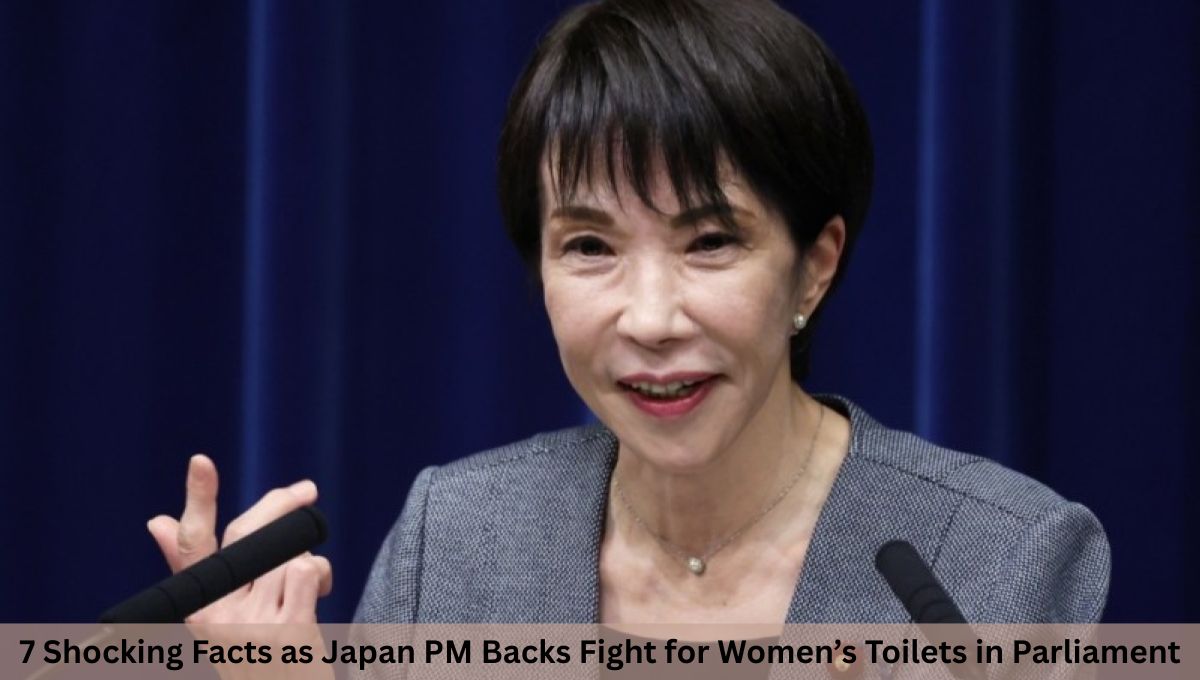
7 Shocking Facts as Japan PM Backs Fight for Women’s Toilets in Parliament amid rising female representation. Japan’s Parliament is facing an unexpected but telling debate — not over foreign policy or economic reform, but over access to women’s toilets.
Prime Minister Sanae Takaichi, Japan’s first female leader, has joined more than 50 women lawmakers in demanding additional women’s restrooms in the National Diet, highlighting how the country’s political infrastructure has failed to adapt to rising female representation.
At the center of the controversy is a stark statistic:
73 female lawmakers are currently served by just two toilet cubicles near the Lower House chamber.
As women’s participation in politics grows, the inadequacy of facilities has become a daily obstacle — and, lawmakers argue, a threat to the smooth functioning of parliamentary proceedings.
7 Shocking Facts as Japan PM Backs Fight for Women’s Toilets in Parliament
A Petition That Exposed a Structural Blind Spot
On December 12, a cross-party group of female members of the House of Representatives submitted a formal petition calling for additional women’s restrooms, particularly near the plenary chamber.
The petition, backed by 58 women lawmakers — nearly 80 percent of all female MPs in the Lower House — described the shortage as a “critical issue” that could interfere with lawmakers’ duties and parliamentary efficiency.
Despite the growing number of women legislators, infrastructure has remained largely unchanged, reflecting a Parliament designed at a time when women were absent from political life altogether.
Two Cubicles, 73 Lawmakers, and Daily Queues
According to lawmakers, congestion outside women’s restrooms is now routine, particularly before key sessions.
“Before the main assembly session, a truly large number of female lawmakers line up in front of the women’s restroom,”
— Yasuko Komiyama, Constitutional Democratic Party (CDP)
Several lawmakers have admitted they sometimes skip using the restroom entirely, fearing they will miss proceedings if they wait in line.
Key Numbers at a Glance
- Women MPs: 73
- Women’s toilets in Lower House: 9
- Women’s cubicles total: 22
- Men’s toilets: 12
- Men’s stalls and urinals: 67
- Women’s toilets near chamber: 1 restroom with 2 stalls
The imbalance is especially pronounced near the Lower House chamber, where male lawmakers have access to multiple facilities while women share a single restroom.
Prime Minister Sanae Takaichi Throws Her Weight Behind the Campaign
Prime Minister Sanae Takaichi, elected last year in a historic milestone for Japan, has openly supported the petition.
Her backing has elevated what might once have been dismissed as a logistical complaint into a national conversation about gender equality, infrastructure, and institutional reform.
Takaichi’s involvement also underscores a broader challenge she faces as Japan’s first woman prime minister: translating symbolic progress into tangible structural change.
Not Just Lawmakers: Staff and Journalists Affected Too
The shortage does not affect lawmakers alone.
Female parliamentary staff, aides, and a growing number of women journalists covering politics are also forced to rely on the same limited facilities.
Komiyama emphasized in social media posts that the issue extends well beyond elected officials, creating congestion throughout the working day.
“This issue affects not only female lawmakers, but also female staff and women journalists working in the Diet,” she wrote.
A Building Designed Before Women Could Vote
The roots of the problem stretch back nearly a century.
The National Diet Building, completed in 1936, predates women’s suffrage in Japan by almost a decade.
At the time of its construction:
- Women had no voting rights
- Female political participation was virtually nonexistent
- Parliament was designed exclusively for male lawmakers
Women gained the right to vote only in 1945, following Japan’s defeat in World War II. The first female MPs were elected in 1946, long after the building’s layout had been finalized.
While minor adjustments have been made over the years, critics argue they have been incremental and insufficient, failing to anticipate the steady rise of women in politics.
Japan’s Gender Gap: A Persistent Challenge
The toilet shortage has become a symbol of broader gender inequality in Japanese society.
Japan ranks 118th out of 148 countries in the World Economic Forum’s Global Gender Gap Index, reflecting disparities in political representation, economic participation, and leadership roles.
Despite recent gains:
- Women hold just under 16% of seats in the Lower House
- Japan lags behind other developed democracies in female political leadership
- Women candidates often report facing sexist remarks and structural barriers
The government has previously pledged to raise women’s representation to 30 percent, but progress toward that goal has been slow.
Historic Election, Limited Infrastructure Change
The October 2024 general election marked a turning point, with a record 73 women elected to the 465-seat Lower House — the highest number in Japan’s history.
However, lawmakers argue that physical infrastructure has not kept pace with political progress.
“Congestion and waiting times have become a daily occurrence,” the petition states, warning that delays could disrupt parliamentary proceedings.
Reluctance to Raise the Issue in Japanese Society
Female lawmakers say the toilet debate reflects a deeper cultural hesitation.
“There is a prevailing reluctance to raise the issue of adding more women’s restrooms in workplaces and schools,”
— Tomoe Ishii, opposition MP
Long lines at women’s restrooms are common across Japan — in offices, train stations, and public venues — yet are often accepted as inevitable rather than addressed as a design flaw.
Analysts note that infrastructure, though seemingly mundane, plays a critical role in workplace equality and productivity.
Committee Response: A Cautious Step Forward
The petition was submitted to Yasukazu Hamada, chairman of the Lower House Rules and Administration Committee.
Hamada has reportedly responded that the committee would “discuss the matter positively,” raising cautious optimism among lawmakers.
Female MPs have urged that new restrooms be installed as early as the next fiscal year, particularly near the main chamber.
Why Toilets Matter in Governance
While the issue may appear minor, lawmakers argue it strikes at the heart of institutional fairness.
- Missed sessions due to restroom queues can affect debates and votes
- Physical discomfort undermines focus and performance
- Unequal facilities reinforce structural inequality
As one lawmaker bluntly stated, “We sometimes have to just hold it.”
A Symbol of Broader Reform Needs
For many observers, the toilet controversy has become a powerful metaphor for Japan’s gender equality challenge.
It illustrates how systems built for male dominance continue to shape daily experiences — even as representation slowly changes.
Prime Minister Takaichi’s support suggests that addressing these issues is no longer optional if Japan is serious about:
- Women’s empowerment
- Political participation
- Modernizing institutions
Looking Ahead: Preparing for a More Equal Parliament
Komiyama summed up the broader goal in a Facebook post:
“I want to raise my voice and prepare for the day when women hold more than 30 percent of parliamentary seats.”
As Japan debates restroom renovations, it is also confronting a larger question:
Can its political institutions evolve fast enough to match social change?
For now, the queues outside Parliament’s women’s restrooms stand as a daily reminder that equality is not only about seats and titles — but about the most basic facilities that allow lawmakers to do their jobs.
Also Read: 7 Powerful Signals Behind Japan’s Record Defence Budget and Debt Debate
Also Read: Takaichi, Trump to Meet in U.S. This Spring
Related Posts:
- Sanae Takaichi Becomes Japan’s First Female Prime…

- Japan 2025: Conservative Powerhouse Sanae Takaichi…

- 12 Explosive Shifts as Japan’s Iron Lady Takaichi…

- 7 Explosive Reasons Japan’s Winter Election Could…

- 7 Alarming Signals in the China–Japan Clash Over PM…

- 7 Alarming Signs China–Japan Tensions Are Spiraling…