

Pakistan–Afghanistan Ceasefire 2025: Breakthrough Deal Reached in Doha — a new hope for border peace. In a major diplomatic breakthrough, Pakistan and Afghanistan have agreed to an immediate ceasefire after days of intense border clashes that killed dozens on both sides.
The announcement came early Sunday following talks in Doha, mediated jointly by Qatar and Turkiye, aimed at ending the worst outbreak of hostilities between the South Asian neighbours since the Taliban took power in Kabul in 2021.
The Qatari Ministry of Foreign Affairs confirmed that both sides had reached an agreement to stop all military operations and establish a mechanism to consolidate lasting peace and stability. “The two sides agreed to an immediate ceasefire and the establishment of mechanisms to consolidate lasting peace and stability between the two countries,” Qatar’s Ministry of Foreign Affairs said in a statement.
“They also agreed to hold follow-up meetings in the coming days to ensure the sustainability of the ceasefire and verify its implementation in a reliable and sustainable manner.” Qatar expressed optimism that this latest round of diplomacy could “end tensions on the border between the two brotherly countries and form a solid foundation for sustainable peace in the region.”
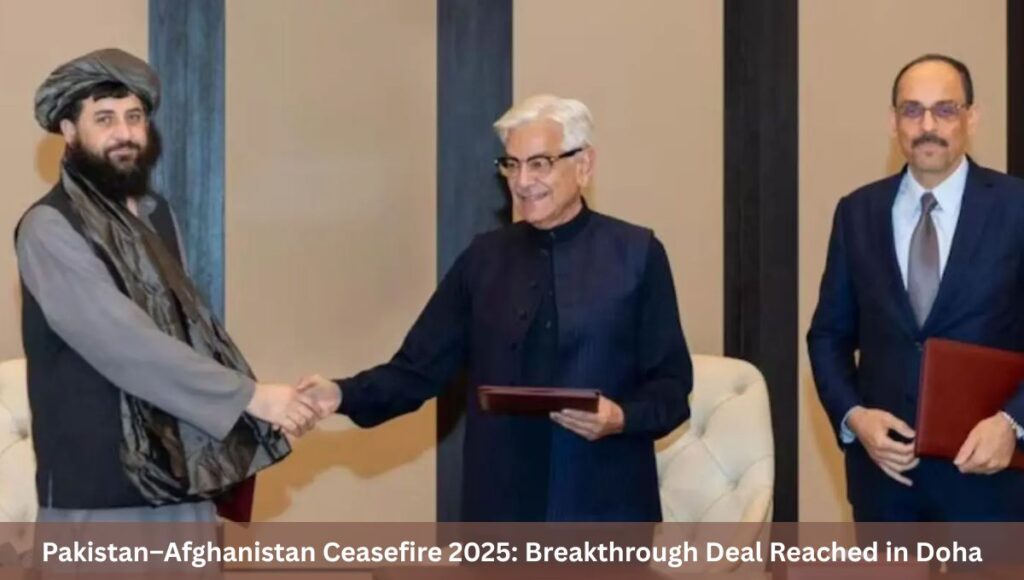
Pakistan–Afghanistan Ceasefire 2025: Breakthrough Deal Reached in Doha
A Fragile But Crucial Pause in Hostilities
The ceasefire follows a week of fierce and deadly clashes along the disputed 2,600-kilometre Durand Line, the porous border separating the two nations. The fighting, triggered by a series of Pakistani airstrikes on Afghan territory, prompted retaliatory attacks by Taliban fighters on Pakistani border posts.
According to security and provincial officials, air raids and artillery exchanges left dozens dead and hundreds injured, including civilians. On Saturday alone, at least ten people, including three Afghan cricketers, were killed in Pakistani airstrikes on Afghanistan’s southeastern Paktika province.
The Afghanistan Cricket Board (ACB) confirmed the deaths, expressing deep sorrow over the loss of young athletes who were participating in a regional tournament. The International Cricket Council (ICC) later issued a statement mourning the players, naming them as Kabeer Agha, Sibghatullah, and Haroon, describing their deaths as a “tragic loss to Afghan cricket and to the sport as a whole.”
Ishaq Dar: “First Step in the Right Direction”
Welcoming the breakthrough, Pakistan’s Deputy Prime Minister and Foreign Minister Ishaq Dar described the Doha agreement as “a first step in the right direction.”
“Deeply appreciate the constructive role played by brotherly Qatar and Turkiye,” Dar wrote on X (formerly Twitter).
“We look forward to the establishment of a concrete and verifiable monitoring mechanism, in the next meeting to be hosted by Turkiye, to address the menace of terrorism emanating from Afghan soil towards Pakistan.”
Dar emphasized the need to prevent further bloodshed, saying it was “important to put all efforts in place to prevent any further loss of lives.”
Afghanistan’s Response: “We Are Not in Favour of War”
From the Afghan side, Taliban spokesperson Zabihullah Mujahid confirmed that Kabul’s delegation, led by Defence Minister Mullah Muhammad Yaqoob Mujahid, participated in the negotiations in Doha.
Mujahid said that Afghanistan remained committed to dialogue and accused Pakistan of violating previous truces. “As promised, negotiations with the Pakistani side will take place today in Doha,” Mujahid said before the meeting.
Later, he added that Afghanistan was not in favour of war and urged both nations to “resolve issues through dialogue, not through violence.”
Afghan Prime Minister Mohammad Hassan Akhund echoed the sentiment in a call with his Malaysian counterpart, saying the fresh violence had been “initiated by the Pakistani side by violating Afghanistan’s territory.”
The Role of Qatar and Turkiye in the Mediation
This latest ceasefire deal is the second truce brokered by Qatar in a week, underscoring Doha’s increasingly important role as a regional mediator.
Qatar, which has long hosted Taliban political representatives, is seen as one of the few nations with direct communication channels to both Kabul’s Taliban government and Islamabad.
Turkiye joined the mediation effort amid mounting concerns over the humanitarian toll of the conflict and the potential for broader destabilization in the region.
Turkish diplomats are expected to host the next round of verification meetings to design a joint monitoring mechanism for the ceasefire’s implementation.
Doha’s foreign ministry described the talks as “constructive and forward-looking,” while Turkiye called the agreement a “critical development for peace in South Asia.”
Cross-Border Clashes: Escalation and Fallout
Tensions between Pakistan and Afghanistan surged in early October when Pakistan launched a series of airstrikes targeting what it described as militant strongholds belonging to the Tehreek-i-Taliban Pakistan (TTP) inside Afghan territory.
Islamabad accused the Taliban of harbouring insurgents responsible for a string of deadly attacks on Pakistani soil. On Friday, a suicide bombing near the border killed seven Pakistani soldiers and wounded 13 others, prompting Pakistan’s army to retaliate with airstrikes in Afghanistan’s Paktika province.
The Taliban accused Pakistan of killing civilians and violating Afghan sovereignty. Pakistan’s Army Chief, Field Marshal Asim Munir, condemned the attacks on Pakistani troops and warned that Islamabad “will not tolerate cross-border terrorism.”
“The Afghan regime must rein in the proxies who have sanctuaries in Afghanistan and are using Afghan soil to perpetrate heinous attacks inside Pakistan,” Munir said during a cadet graduation ceremony on Saturday.
Afghanistan rejected those claims, alleging that Pakistan itself was harbouring ISIL (ISIS)-linked fighters and “spreading misinformation” about the situation inside Afghanistan.
Doha: The Diplomatic Middle Ground
The choice of Doha as the venue reflects Qatar’s evolving role as a neutral platform for conflict resolution. Over the past decade, Qatar has successfully hosted U.S.–Taliban talks, Sudan peace discussions, and various hostage negotiation efforts.
Its ability to maintain relations with all sides — Western powers, the Taliban, and regional governments — has positioned it as a reliable facilitator in crises that require delicate diplomacy.
Analysts note that this ceasefire marks one of the few moments of direct, high-level dialogue between Islamabad and the Taliban government since the fall of Kabul in August 2021.
“Doha has once again demonstrated its diplomatic leverage,” said a South Asia analyst in a regional policy brief. “But the real challenge will be implementation — ensuring the ceasefire holds in practice, not just on paper.”
Next Steps: Verification and Monitoring Mechanism
Both countries have agreed to hold follow-up meetings in the coming days to establish a joint verification system ensuring compliance with the ceasefire terms. The meetings, according to the Qatari statement, will be hosted by Turkiye and involve military and diplomatic representatives from both sides.
This mechanism is expected to address not only border violence but also mutual accusations of harbouring militants — an issue that has remained at the core of the Pakistan–Afghanistan dispute for years.
“We look forward to establishing a verifiable monitoring mechanism,” said Ishaq Dar, noting that Pakistan was “ready to cooperate on all fronts to achieve lasting stability.”
Afghanistan’s Defence Minister Mullah Yaqoob Mujahid said his side was committed to transparency.
“We are committed to ensuring that the ceasefire is respected and that no group will be allowed to exploit the situation,” he said in a brief statement after the talks.
Civilian Toll and Humanitarian Concerns
As the guns fall silent — at least temporarily — humanitarian organizations have renewed calls for restraint and protection of civilians.
According to Afghan provincial officials, the airstrikes that preceded the ceasefire killed at least 17 civilians, including women and children, and injured over two dozen. Entire villages near Argun and Barmal districts in Paktika province were reportedly destroyed.
Health workers in the region said hospitals were “overwhelmed” and called for international assistance. “We have limited supplies, and dozens of families are displaced,” said a hospital official in Argun.
The UN Assistance Mission in Afghanistan (UNAMA) has yet to issue an official statement but previously urged both nations to “prioritize civilian safety and uphold international humanitarian obligations.”
Regional Reactions and Global Context
The ceasefire has drawn cautious optimism from regional powers. Iran, China, and Saudi Arabia — all of whom maintain diplomatic engagement with both Kabul and Islamabad — welcomed the development, urging both nations to “translate the truce into long-term stability.”
The United Nations Secretary-General also expressed support for Qatar’s mediation efforts, calling them “a vital step toward reducing tensions in South Asia.”
Diplomatic sources in Islamabad indicated that the United States had been kept informed of the Doha talks through back channels but was not directly involved in the mediation.
Analysts: ‘Ceasefire Fragile, But Necessary’
Security experts say the Doha ceasefire could mark the beginning of a broader peace process, provided both sides honour their commitments. However, they warn that mutual mistrust, particularly over militant sanctuaries, could quickly derail the agreement.
“Pakistan wants verifiable action against the TTP, while the Taliban want recognition and respect for Afghanistan’s sovereignty,” said Ayesha Siddiqa, a defence analyst based in Islamabad. “The challenge lies in balancing these competing demands without reigniting the violence.”
For ordinary citizens along the border, the ceasefire represents a temporary respite from fear. “We hope this one lasts,” said a resident of Kurram district in Pakistan’s Khyber Pakhtunkhwa province. “We’ve seen too many ceasefires break in days.”
Outlook: Fragile Peace or Foundation for Dialogue?
The Doha talks may have produced a tangible outcome — a formal ceasefire — but questions remain over how long the peace will last. The absence of international observers and the deep-rooted mistrust between the two nations pose significant challenges to verification.
Still, the involvement of Qatar and Turkiye adds a layer of credibility and diplomatic pressure that could help prevent an immediate breakdown. For now, both nations appear committed to avoiding another escalation, with follow-up meetings expected within the week.
Whether this ceasefire evolves into a sustainable peace framework or dissolves amid renewed violence will determine the trajectory of Pakistan–Afghanistan relations in the months ahead. As one diplomat in Doha summarized: “This ceasefire is fragile, but it’s a start — and in this region, sometimes a start is the most we can hope for.”
Also Read: Trump’s Bold Claim: ‘Easy’ to Solve Pakistan–Afghanistan Conflict 2025
Also Read: Afghanistan pulls out of cricket series after it says Pakistan air strike killed local players
Related Posts:
- Pakistan’s Bold Airstrikes in Kabul: Af-Pak Crisis…

- Pakistan–Afghanistan Border Conflict 2025: Ceasefire…

- Pakistan–Afghanistan Ceasefire 2025: What to Know…

- Afghanistan–Pakistan War 2025: Inside the 48-Hour Ceasefire

- 7 Major Developments as Pakistan-Afghanistan Peace…
- Afghanistan–Pakistan Border Clashes 2025: Key Facts…
