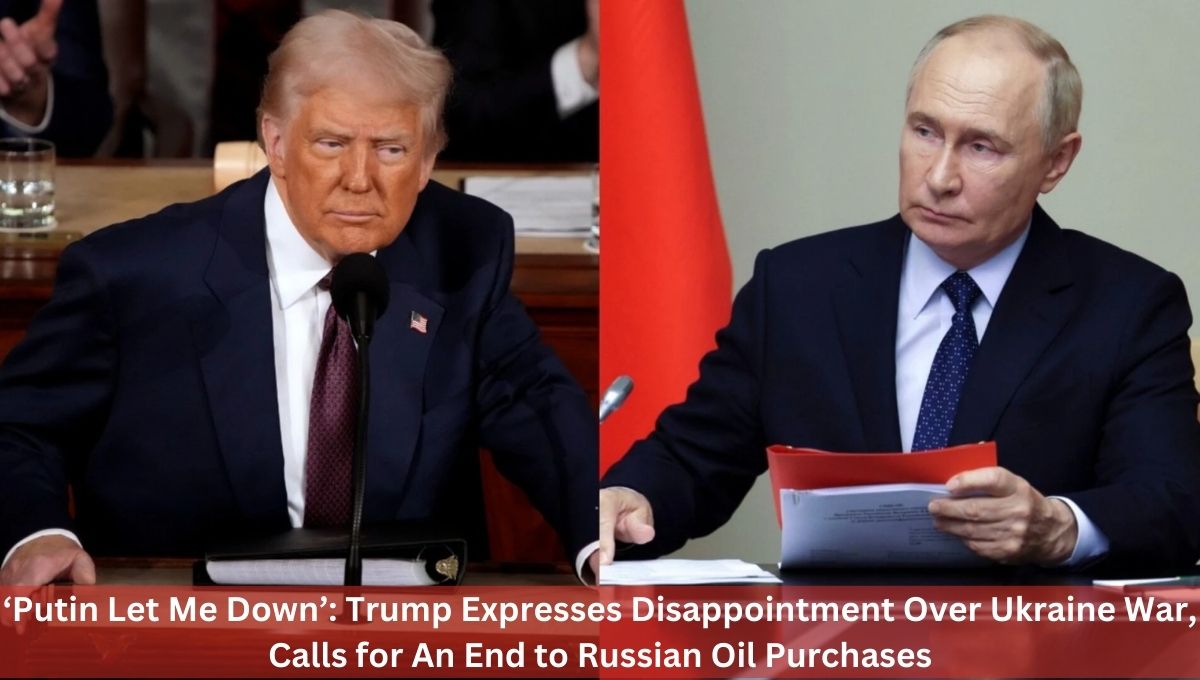
‘Putin Let Me Down’: Trump Expresses Disappointment Over Ukraine War, Calls for An End to Russian Oil Purchases and admits he thought it would be the ‘easiest’ conflict to solve. US President Donald Trump, during his official visit to the United Kingdom, admitted that the ongoing Russia-Ukraine war has proven far more difficult to resolve than he initially believed.
Speaking alongside British Prime Minister Keir Starmer at Chequers, Trump expressed disappointment in Russian President Vladimir Putin, saying the Russian leader had “really let me down.” Trump, who has long emphasized his personal relationship with Putin, acknowledged that he once thought the conflict in Ukraine would be the “easiest” to resolve.
But with the war now stretching into its fourth year since the full-scale invasion of February 2022, the US President admitted his expectations had not matched reality. “The one that I thought would be easiest would be because of my relationship with President Putin, but he’s let me down. He’s really let me down,” Trump said.
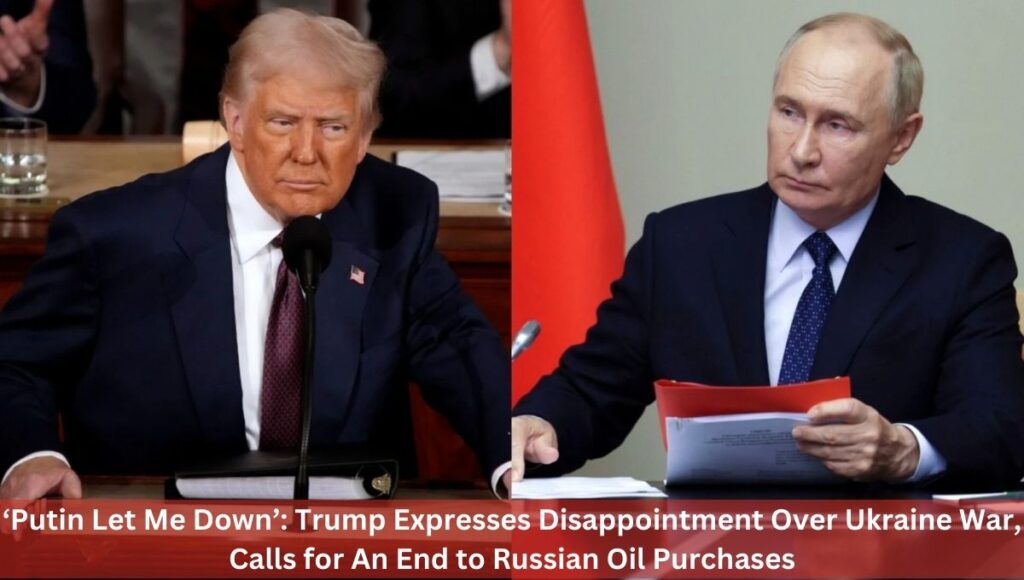
‘Putin Let Me Down’: Trump Expresses Disappointment Over Ukraine War, Calls for An End to Russian Oil Purchases
Trump’s Changing Tone on Putin
For years, Trump has been seen as maintaining a warmer stance toward Putin compared to previous US leaders. His belief that his relationship with Moscow could ease global tensions was central to his earlier foreign policy remarks.
However, the tone shifted at the joint press conference with Starmer, where Trump criticized Putin for prolonging the war and causing enormous casualties.
“He’s killing many people, and frankly, Russian soldiers are being killed at a higher rate than Ukrainian soldiers. But, yeah, he’s let me down. I don’t like to see death,” Trump said.
Despite his sharp criticism, Trump added that the war “does not directly affect the United States,” a remark that drew attention both in Washington and across Europe.
The Alaska Summit and Failed Peace Efforts
Trump’s frustration comes just weeks after his high-profile Alaska summit with Putin. The meeting, billed as a potential breakthrough in ending the war, concluded without any formal agreement or ceasefire.
Since then, hostilities have only intensified. Earlier this month, Russian missile strikes injured dozens in Kharkiv, while Moscow accused Kyiv of launching one of the largest drone assaults on Russian territory since the war began.
The Alaska summit was intended to build on Trump’s campaign promise that he could end the Ukraine war “within 24 hours” if elected. Instead, it underscored the limits of diplomacy when trust between Kyiv and Moscow remains virtually nonexistent.
Trump: “War is a Different Thing”
During the press conference, Trump reflected on how conflicts often defy expectations:
“War is a different thing. Things happen that are the opposite of what you thought. You think you’ll have an easy time, then it turns out harder.”
He contrasted the Ukraine conflict with what he claimed were seven other international disputes his administration had managed to resolve. Trump did not specify all seven but insisted that most were previously considered “unsolvable.”
Starmer Pushes Trump on Ukraine
British Prime Minister Keir Starmer, hosting Trump at Chequers, emphasized the need for stronger transatlantic coordination in pressuring Russia.
“In recent days, Putin has shown his true face, mounting the biggest attack since the invasion began with yet more bloodshed, yet more innocents killed, and unprecedented violations of NATO airspace,” Starmer said.
Starmer urged Trump to use his influence with Putin and stressed that Europe must step up military support for Ukraine, particularly in the areas of air defense and long-range strike capabilities.
Also Read: UK ready to use frozen Russian assets to fund Ukraine war effort
New Weapons for Ukraine
Meanwhile, Ukrainian President Volodymyr Zelenskyy confirmed that Kyiv would soon receive additional Western weapons, including Patriot missiles and HIMARS rocket launchers, under a new funding package coordinated with NATO allies.
Through the Prioritised Ukraine Requirements List (PURL), Ukraine has secured more than $2 billion in financing for these advanced systems. The announcement came as Russian forces made further territorial gains in eastern Ukraine.
Oil Diplomacy: Trump’s Pressure Tactic on Putin
One of Trump’s central messages in London was his call for European nations, as well as countries like India and China, to stop buying Russian oil.
“If the price of oil comes down, Putin will have no choice but to drop out of that war,” Trump said. “Very simply, Russia settles when oil prices fall. We’re drilling more than anyone else in the world. We’re doing a lot.”
The US President has already imposed 50% tariffs on Indian imports, with 25% specifically targeting New Delhi’s continued purchases of Russian crude. Trump has argued that such trade indirectly fuels Moscow’s war machine.
Also Read: Trump Urges EU to Slap 100% Tariffs on China and India to Pressure Russia Amid Ukraine War
Trump’s Claim: The War Wouldn’t Have Happened Under Him
At several points in the press conference, Trump reiterated his longstanding claim that the war would not have broken out if he had been president in 2022.
“This was a thing that would have never happened had I been president. It didn’t happen for four years when I was in office,” he said.
He added that although he believes the conflict does not directly impact US national security, he feels “an obligation to settle the war in Ukraine” due to its humanitarian consequences and destabilizing impact on Europe.
Europe’s Dependence on Russian Energy
Starmer, echoing Trump’s criticism, admitted that some European countries remain overly reliant on Russian energy supplies.
“I think it is a challenge. There are a number of European countries which are too reliant on energy from Russia,” Starmer said.
While Europe has reduced its purchases of Russian gas and oil since 2022, some nations continue to import energy through indirect channels. Trump’s message was clear: without a unified Western front cutting off Putin’s revenue streams, peace will remain elusive.
Mounting Casualties and Humanitarian Toll
According to UN estimates, the Russia-Ukraine war has claimed over 10,000 civilian lives since 2014, with millions displaced. While precise battlefield losses remain contested, Western intelligence assessments suggest Russia has sustained higher troop fatalities than Ukraine.
Recent Russian strikes on civilian areas have underscored the humanitarian crisis, while Kyiv’s drone attacks on Russian infrastructure show the war’s escalation beyond Ukraine’s borders.
Trump’s Balancing Act
Trump’s remarks highlight the delicate balance he faces. On one hand, he wants to maintain his reputation as a dealmaker who can end wars. On the other, he is confronting the limits of his relationship with Putin and the realities of a grinding conflict that shows no signs of immediate resolution.
His criticism of Putin marks a rhetorical shift but also signals frustration with stalled diplomacy after the Alaska summit. Meanwhile, his push to weaponize oil markets reflects a mix of economic leverage and foreign policy strategy.
Looking Ahead
Trump closed the press conference with cautious optimism, saying he hoped for “good news soon” regarding Ukraine. Still, he acknowledged the war remains far from over and continues to test Western unity.
For Starmer, the meeting with Trump reinforced Britain’s role as a key ally in pressing both Washington and Europe to do more. For Ukraine, the promises of new weapons and diplomatic pressure may help, but the path to peace remains uncertain.
Conclusion
Donald Trump’s public admission that “Putin has let me down” is one of the strongest critiques he has leveled at the Russian leader since the war began. It reflects not only disappointment in a failed diplomatic effort but also recognition of the mounting costs of the Ukraine conflict—human, political, and strategic.
As Trump leans on oil diplomacy and pressures allies to cut off Moscow’s revenue streams, the question remains: can his personal ties with Putin still pave the way for peace, or has the war already reshaped their relationship beyond repair?