Bagram holds strategic importance for the US as Donald Trump Wants Bagram Air Base Back From Taliban to Counter China: Full Details. United States President Donald Trump has reignited the Afghanistan debate, declaring that his administration is actively working to regain control of Bagram Air Base from the Taliban. The announcement, made during a joint press conference with UK Prime Minister Keir Starmer, has sent ripples across global capitals, signaling the possibility of a US return to Afghanistan four years after the chaotic 2021 withdrawal.
Trump cited Bagram’s strategic location near China as the key motivation behind the push, calling its abandonment under President Joe Biden a “total disaster.”
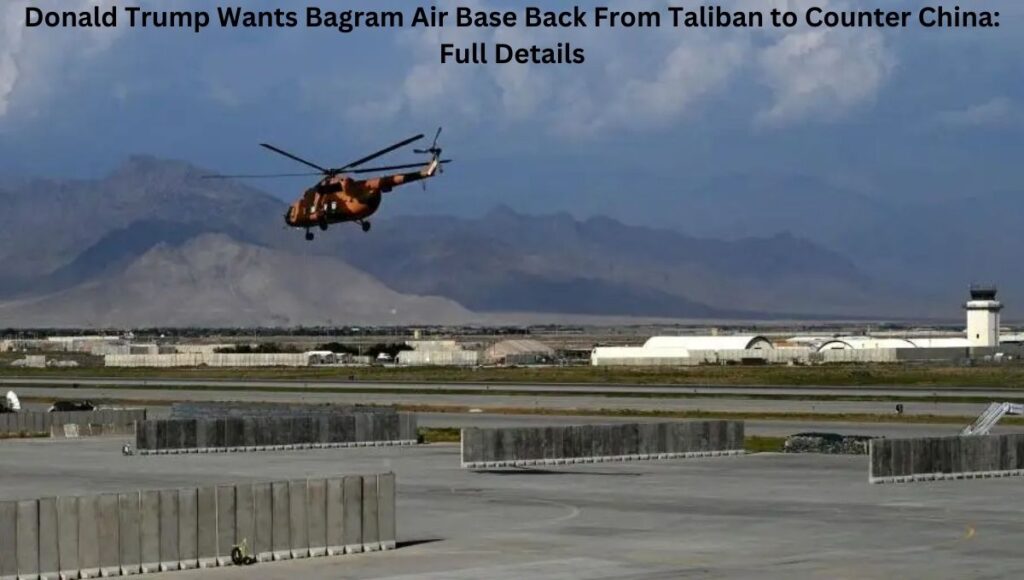
Donald Trump Wants Bagram Air Base Back From Taliban to Counter China: Full Details
Bagram Air Base: A Strategic Prize
Located about 44 kilometers north of Kabul, Bagram Air Base served as the heart of US military operations during the two-decade-long war in Afghanistan.
- It hosted cargo aircraft, fighter jets, helicopters, and served as a logistics and intelligence hub.
- Its 3,600-meter runway could accommodate heavy bombers and massive transport planes.
- Trump even went so far as to say, “You can land a planet on it,” underscoring its size and capability.
The base’s significance lies not just in Afghanistan but in its geographical proximity to China. According to Trump, Bagram is “an hour away from where China makes its nuclear weapons,” making it a vital outpost for surveillance and deterrence.
Trump’s Criticism of Biden’s Afghanistan Exit
Trump has repeatedly blasted Joe Biden’s handling of the 2021 withdrawal, accusing him of gifting military equipment and bases to the Taliban.
“They left all that equipment behind… They should have taken every screw, every bolt, every nail. Instead, the Taliban now parade with American weapons every year,” Trump said.
He called the hasty exit “the most embarrassing moment in the history of our country.”
While the Doha Agreement of 2020, negotiated during Trump’s first term, had set the terms for withdrawal, Trump maintains he would have kept Bagram under US control, even with a reduced military footprint.
Breaking News: Are US Troops Returning to Afghanistan?
During his press conference with PM Starmer, Trump hinted that the US is actively negotiating with the Taliban to take back Bagram:
“We’re trying to get it back, by the way. That could be a little breaking news. We’re trying to get it back because they need things from us. We want that base back.”
This raises a stunning possibility: American troops may return to Afghanistan, reversing the Biden-era policy of complete disengagement.
Taliban’s Response: Denials and Caution
The Taliban’s defense ministry currently controls Bagram Air Base. Officials have denied claims that China has taken over the facility, dismissing Trump’s remarks as “emotional statements.”
Spokesperson Zabihullah Mujahid said in March:
“They should refrain from making emotional statements based on unsubstantiated information.”
Despite the denials, the Taliban remain in a delicate balancing act. They seek legitimacy and international recognition, while maintaining ties with China, Pakistan, Russia, and Iran. A US attempt to retake Bagram would put them in a highly difficult position.
Also Read: Taliban Rejects President Trump’s Bagram Air Base Demand
Why Trump Wants Bagram Back
1. Countering China
Trump’s primary justification revolves around China’s nuclear facilities in Xinjiang, which he claims are within striking and surveillance distance of Bagram.
“One of the reasons we want the base is, as you know, it’s an hour away from where China makes its nuclear weapons.”
2. Rare Earths and Minerals
Afghanistan is rich in rare earth elements, critical for high-tech industries. US intelligence sources suggest that Trump sees Bagram as a potential staging ground to secure access to these resources.
3. Counterterrorism Operations
The resurgence of ISIS-K in Afghanistan makes Bagram attractive as a counterterrorism hub for drone operations and special forces missions.
4. Diplomatic Leverage
Reopening a small US presence could allow Washington to establish a diplomatic foothold in Kabul, something the Biden administration abandoned in 2021.
Trump’s Quiet Push Inside His Administration
According to CNN sources, Trump has been privately pressuring his national security officials since March 2025 to find ways to regain Bagram.
The discussions reportedly involve:
- Surveillance capabilities against China.
- Re-establishing a US military footprint in Central Asia.
- Preventing Afghanistan from becoming a safe haven for terrorists again.
Officials acknowledge that any such move would require a troop presence, despite Trump’s earlier insistence on ending America’s “forever wars.”
What Would a US Return Mean for Global Geopolitics?
🔹 Impact on China
A US comeback at Bagram would directly challenge Beijing’s Belt and Road projects in the region, as well as its nuclear facilities near Xinjiang.
🔹 Pakistan’s Dilemma
Pakistan, a key Taliban backer and China’s ally, would see its influence diluted if the US regains a foothold in Afghanistan. Islamabad celebrated the 2021 withdrawal as a strategic victory; a reversal would be a major setback.
🔹 Taliban Under Pressure
The Taliban would face enormous pressure to balance relations with:
- The US (seeking concessions for aid and recognition)
- China (seeking economic investment)
- Pakistan (seeking continued influence)
- Russia and Iran (seeking to undermine US influence)
This could fracture the Taliban’s fragile coalition and embolden rival groups.
🔹 Rise of ISIS-K
Analysts warn that renewed great-power competition in Afghanistan could create space for ISIS-K and other extremist groups to expand.
Trump’s Rhetoric: “We Gave It For Nothing”
Trump’s frustration over Bagram has become a recurring theme in his speeches.
On Air Force One, he described the air base as:
“One of the most powerful bases in the world in terms of runway strength and length… You can land anything on there. You can land a planet on top of it.”
He insists that Biden “gave it to the Taliban for nothing.”
Looking Back: The Chaotic 2021 Withdrawal
The US left Bagram in July 2021 after nearly 20 years of operations. In the process:
- 900 C-17 cargo loads of equipment were removed.
- 16,000 pieces of equipment were destroyed.
- Billions of dollars’ worth of military hardware fell into Taliban hands.
A State Department after-action review in 2023 concluded that abandoning Bagram was a critical mistake, leaving Kabul Airport as the only evacuation route during the fall of Kabul.
Could Trump Actually Get Bagram Back?
While Trump insists that the Taliban “need things from us,” the reality is far more complex.
- The Taliban have not signaled willingness to hand over the base.
- Any US troop redeployment would require Congressional approval and public support.
- International reaction, particularly from China, Pakistan, and Russia, would be hostile.
Still, Trump’s determination suggests that Bagram may once again become central to US foreign policy.
Also Read: Trump wants Bagram back. But could the Afghan base really counter China?
Conclusion: A New Era of Geopolitical Tensions?
Donald Trump’s push to retake Bagram Air Base highlights the shifting priorities of his second presidency: countering China’s rise while reasserting US military power abroad.
Whether the plan succeeds remains uncertain, but the implications are profound:
- A possible return of US troops to Afghanistan.
- Renewed great-power rivalry in South and Central Asia.
- A Taliban regime caught in a geopolitical storm.
If Trump gets his way, Bagram could once again become the epicenter of America’s presence in the region —a dramatic reversal of the Biden administration’s policy and a move that could reshape the balance of power between Washington, Beijing, and Kabul.
Related Posts:
- Trump Warns Afghanistan: ‘Bad Things’ If Bagram Air…
- Taliban Rejects President Trump’s Bagram Air Base Demand
- US President Donald Trump Fuels Third-Term…

- Trump to Host 2026 G20 Summit at His Florida Golf…

- 9 Explosive Revelations as Trump Declares His Health…

- What’s Next for Donald Trump After Court Rules His…