In response to his renewed push, Taliban Rejects President Trump’s Bagram Air Base Demand. The Taliban has firmly rejected former US President Donald Trump’s demand to return control of the Bagram Air Base in Afghanistan, asserting that Afghanistan is a fully sovereign nation governed by its own people.
Trump’s renewed push to regain the sprawling military facility comes four years after the chaotic US withdrawal that handed control of the base to the Taliban. In response, Taliban officials warned that any hostility would trigger the “strongest” response, highlighting the base’s continued symbolic and strategic significance in the region.
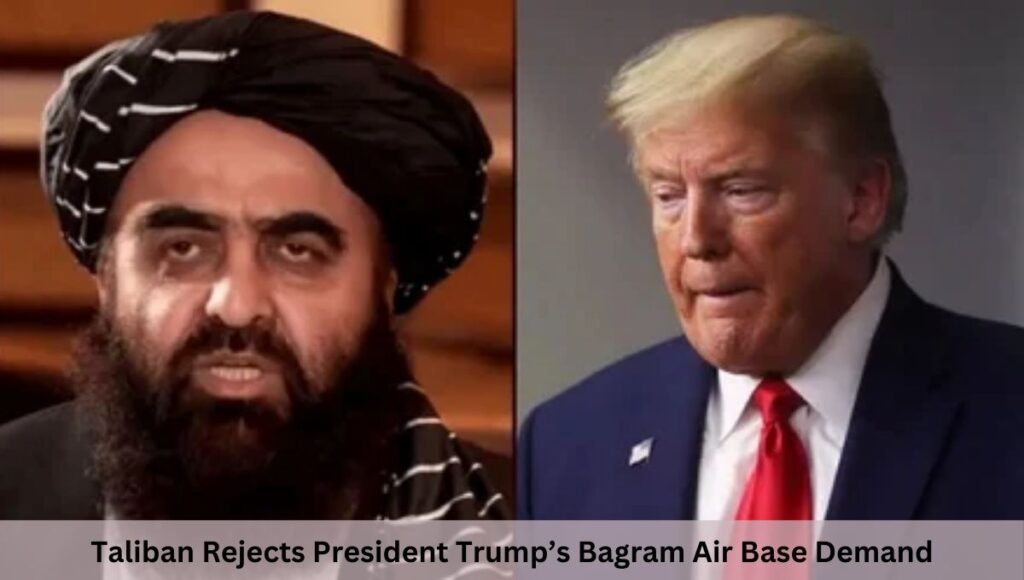
Taliban Rejects President Trump’s Bagram Air Base Demand
Taliban Officials Speak Out: Afghan Sovereignty Above All
On Sunday, Chief of Staff of the Armed Forces Fasihuddin Fitrat addressed Trump’s demand at a public event in Kabul, as reported by Bloomberg:
“Afghanistan is fully independent, governed by its own people, and not dependent on any foreign power. We do not fear any bully or aggressor.”
Fitrat also underscored the impossibility of any agreement to cede even an inch of Afghan soil:
“Recently, some people have said that they have entered negotiations with Afghanistan for taking back Bagram Air Base. A deal over even an inch of Afghanistan’s soil is not possible. We don’t need it.”
Trump’s Warning on Bagram Air Base
Trump’s comments on Truth Social reflected his long-standing interest in regaining Bagram:
“If Afghanistan doesn’t give Bagram Airbase back to those that built it, the United States of America, BAD THINGS ARE GOING TO HAPPEN!!!”
The former president has used the base as a point of criticism against his successor, Joe Biden, alleging that the withdrawal left American weaponry and military assets in Taliban hands.
Bagram Air Base, located approximately 64 km (40 miles) from Kabul, was the largest US military facility in Afghanistan during the 20-year war that followed the September 11, 2001 attacks.
What Is Bagram Air Base?
Bagram Air Base served as a central hub for US military operations in Afghanistan after the Taliban was ousted post-9/11. The sprawling base, with runways longer than many international airports, hardened shelters, hospitals, and fuel depots, became a critical operational and logistical hub.
According to media reports, the base also had fast-food outlets like Burger King and Pizza Hut, retail stores, and even a massive prison complex, where thousands were detained without charge or trial during the US “war on terror.”
Also Read: Trump Warns Afghanistan: ‘Bad Things’ If Bagram Air Base Not Returned to US
Historical Significance
Bagram’s strategic importance dates back to the 1950s, when it was built by the Soviet Union and expanded in 1976. During the Soviet invasion of Afghanistan (1979–1988), it served as the central base for operations. Later, it became the focal point of the US war on terror (2001–2021).
Its twin 3-kilometre-long runways allowed fighter jets and heavy cargo aircraft to operate efficiently, while its proximity to Iran, Pakistan, China’s Xinjiang province, and Central Asia made it a vital point for surveillance and signal intelligence.
Bagram as a Miniature US Town
Under US control, Bagram was transformed into a self-contained military city, complete with medical facilities, retail outlets, and recreational amenities. Troops had access to electronics stores, clothing shops, and Afghan handicrafts, making the base functionally similar to a domestic US military installation.
The base also housed a prison complex, notorious for detaining suspected insurgents and terrorists. Its facilities were considered advanced compared to many regional military installations.
Strategic Importance for the US
Bagram Air Base’s location gives it unique geopolitical leverage. It sits near China’s nuclear test facilities at Lop Nur in western Xinjiang. According to Trump, this proximity is a critical factor behind the US interest in regaining control:
“It’s an hour away from where China makes its nuclear weapons.”
While the exact distance is closer to two hours, the base provides a strategic southern launch point for intelligence gathering, surveillance, and potential military operations targeting nuclear facilities or missile silos in Western China.
Also Read: Why Trump wants Bagram Air Base to be returned to the US by Afghanistan
Counterforce Capabilities
US military planners have long considered Bagram vital for “counterforce” operations: the ability to target an adversary’s nuclear arsenal preemptively.
Stealth bombers like the B-2 Spirit or the B-21 Raider, capable of carrying Massive Ordnance Penetrators (MOPs), could theoretically launch missions from Bagram to neutralize strategic targets in China or other regional adversaries.
This aligns with Cold War-era strategies when the US and USSR engaged in a nuclear counterforce vs. countervalue arms competition. Bagram could, in theory, play a similar role in modern strategic planning.
Trump’s Motivation: Strategic Influence in Asia
During a UK press conference with Prime Minister Keir Starmer, Trump hinted at the strategic significance of Bagram beyond Afghanistan:
“We’re trying to get it back because they need things from us… it’s an hour away from where China makes its nuclear weapons.”
Trump’s comments signal his broader concern over China’s rapidly expanding nuclear arsenal, which now includes hundreds of intercontinental ballistic missiles (ICBMs) housed in silos across Xinjiang, Gansu, and Inner Mongolia.
China’s Nuclear Expansion
Over the last decade, China has undertaken an unprecedented nuclear modernization program, including:
- ICBM silos in remote western regions
- Development of air, sea, and land-based nuclear delivery systems
- Expansion of mobile and submarine-launched ballistic missiles (SLBMs)
Bagram’s strategic location allows the US to monitor, gather intelligence, and potentially respond to China’s nuclear capabilities, though logistical and diplomatic challenges remain.
Taliban’s Rejection and Strategic Autonomy
Despite US interest, the Taliban’s stance is unequivocal. Afghanistan is sovereign, and the Taliban will not cede territory. Fasihuddin Fitrat emphasized that:
“Ceding even an inch of our soil to anyone is out of the question and impossible.”
Taliban Supreme Leader Mullah Hibatullah Akhundzada has also condemned Trump’s demands, stating that Afghanistan’s independence and territorial integrity are paramount.
Taliban Diplomacy and International Relations
Though the Taliban lacks formal international recognition, it has established ties with China and Russia and continues to advocate for broader engagement.
The Bagram airbase remains both a symbol of sovereignty and a bargaining chip in potential diplomatic discussions with the US or other global powers.
Trump vs. Biden: Criticism Over US Withdrawal
Trump has repeatedly criticized Joe Biden’s handling of the Afghanistan withdrawal, arguing that it was chaotic and humiliating. He claims the loss of Bagram emboldened adversaries like Vladimir Putin and reduced US influence in the region.
“We were going to leave Afghanistan with strength and dignity. We were going to keep Bagram Air Base, one of the biggest air bases in the world. We gave it to them for nothing.”
Bagram Air Base Today: Infrastructure and Legacy
Currently, the base remains under Taliban control and retains much of its Cold War and post-9/11 infrastructure, including:
- Two long runways capable of supporting bombers and cargo aircraft
- Hardened aircraft shelters and logistical storage
- Medical and detention facilities
- Retail amenities catering to military personnel
Its historical use as a prison has left a complex legacy, with thousands of detainees held without trial or charge under US operations.
Strategic Calculations for the Future
Trump’s desire to reclaim Bagram reflects both symbolic and operational calculations:
- Countering China’s nuclear growth
- Reasserting US influence in Central Asia
- Potentially using the base as leverage in broader regional diplomacy
However, the Taliban’s firm refusal underscores the limits of US influence without local cooperation, highlighting the challenges of military basing in sovereign countries.
Potential Diplomatic Solutions
While the US and Taliban have no formal diplomatic relations, discussions have occurred through intermediaries, including hostage negotiations. Some analysts have proposed episodic access or counterterrorism coordination cells as potential compromises.
However, the Taliban’s insistence on sovereignty suggests that any return to US military control would require significant concessions or incentives, which remain unclear.
Historical Lessons from Bagram
Bagram’s history reflects Afghanistan’s role as a geopolitical chessboard:
- Built by the Soviet Union in the 1950s
- Used during the Soviet occupation (1979–1988)
- Expanded by the US during the post-9/11 occupation
- Currently under Taliban control since 2021
Its story mirrors the broader struggles of Afghanistan, caught between superpowers and enduring decades of foreign intervention.
Conclusion: The Geopolitical Impasse
The Taliban’s unequivocal rejection of Trump’s Bagram demand reaffirms Afghanistan’s sovereignty and signals that US ambitions will face significant resistance. Meanwhile, the base remains a strategic linchpin for US regional influence, particularly regarding China’s nuclear capabilities and Central Asian security dynamics.
As Trump and US policymakers weigh options, the question remains whether diplomatic engagement or military posturing will define the next chapter of the Bagram saga. For now, the Taliban stands firm, emphasizing independence, control over its territory, and the rejection of foreign coercion.