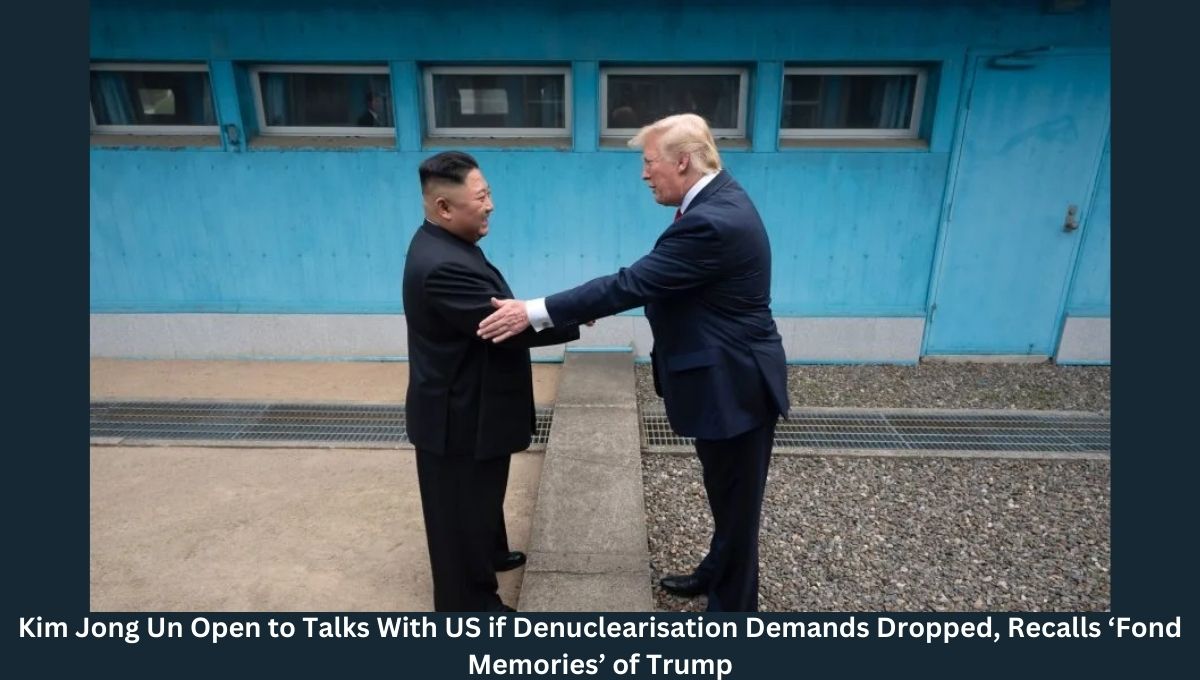
North Korea’s Kim Jong Un Open to Talks with US if Denuclearisation Demands Dropped, Recalls ‘Fond Memories’ of Trump. North Korea’s leader Kim Jong Un has signaled that he is open to renewed talks with the United States—but only if Washington abandons its longstanding demand for denuclearisation. In a wide-ranging speech at the Supreme People’s Assembly in Pyongyang, Kim declared that while he is willing to pursue “peaceful coexistence,” his country will never negotiate away its nuclear arsenal.
Kim also made unusually warm remarks about Donald Trump, recalling his past encounters with the former US president and describing them as positive. His comments come at a time of renewed international debate over how to deal with North Korea, particularly as tensions rise between Pyongyang, Washington, and Seoul.
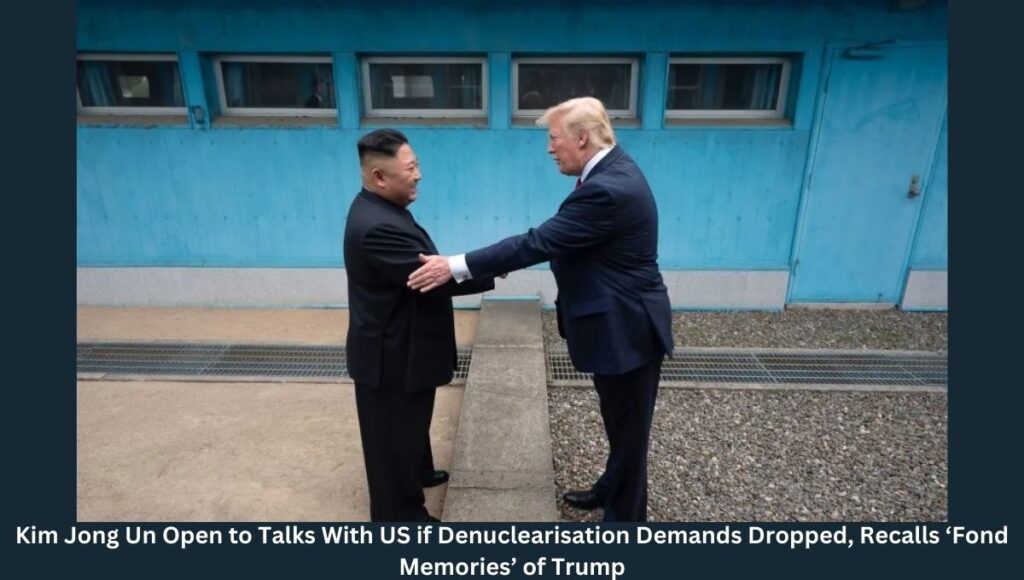
Kim Jong Un Open to Talks With US if Denuclearisation Demands Dropped, Recalls ‘Fond Memories’ of Trump
Kim Jong Un’s Condition for Talks: No Denuclearisation
In his Sunday speech, Kim was explicit: talks with the US could only resume if Washington drops what he called its “absurd obsession” with denuclearisation.
“If the United States drops the absurd obsession with denuclearising us and accepts reality, and wants genuine peaceful coexistence, there is no reason for us not to sit down with the United States,” Kim was quoted as saying by KCNA.
This is not the first time North Korea has drawn a red line around its nuclear program. Pyongyang has consistently framed nuclear weapons as a matter of national survival and sovereignty. For Kim, abandoning them is non-negotiable.
‘Fond Memories’ of Trump: An Unusual Gesture
In his remarks, Kim offered rare personal praise for US President Donald Trump, whom he met three times between 2018 and 2019.
“Personally, I still have fond memories of US President Trump,” Kim said.
Trump himself has often spoken positively about Kim, describing him as “smart” and even suggesting the two shared a unique bond during their high-profile summits in Singapore, Hanoi, and at the Korean Demilitarized Zone (DMZ).
The Hanoi summit of 2019, however, ended abruptly without a deal, largely over the US insistence on denuclearisation in exchange for sanctions relief.
That collapse marked the last significant diplomatic engagement between Washington and Pyongyang.
The South Korean Factor: Lee Jae-myung’s ‘Realistic’ Approach
Kim’s comments also come against the backdrop of a new diplomatic push from South Korea’s President Lee Jae-myung, who took office in June. Lee has been vocal about finding a “realistic” approach to North Korea’s nuclear issue, suggesting that instead of pursuing full denuclearisation immediately, the international community should aim to cap further expansion of Pyongyang’s arsenal.
In an interview with the BBC, Lee explained:
“So long as we do not give up on the long-term goal of denuclearisation, I believe there are clear benefits to having North Korea stop its nuclear and missile development.”
In a separate conversation with Reuters, Lee acknowledged that North Korea is currently adding an estimated 15 to 20 nuclear weapons per year to its stockpile. He argued that sanctions, which have been in place for nearly two decades, have failed to stop Pyongyang’s weapons buildup and instead hardened its resolve.
Also Read: North Korea’s Kim open to talks with Trump, as South’s Lee backs nuke freeze
Kim Yo Jong’s Criticism of US-South Korea Military Drills
While Kim signaled openness to US talks, his sister Kim Yo Jong reiterated Pyongyang’s hardline stance against joint military drills between Washington and Seoul. She denounced them as “reckless” rehearsals for invasion.
The military exercises have long been a sticking point in inter-Korean and US-North Korea relations. For Pyongyang, they are evidence that Washington and Seoul ultimately seek regime change.
Kim’s Position on Sanctions: A Point of Defiance
One of the strongest themes in Kim’s address was the rejection of sanctions. The North Korean leader dismissed the idea of trading nuclear concessions for economic relief, insisting sanctions have only made his country more resilient.
“There will never be, and will never ever be for eternity, any negotiations with enemies of exchanging some things out of some obsession with lifting sanctions,” Kim said.
He framed the sanctions as a “learning experience”, claiming they had built endurance and strength within the country despite well-documented food shortages and humanitarian concerns.
North Korea’s Nuclear Arsenal: A Survival Strategy
Kim also defended his nuclear program as a “matter of survival.” He listed what he described as grave threats from the United States and South Korea, citing regular military drills that he argued were evolving into nuclear war exercises.
For Kim, nuclear weapons are not merely a bargaining chip—they are central to the regime’s survival. This aligns with North Korea’s 2022 constitutional amendment, which declared its nuclear state status as “irreversible.”
Also Read: North Korea Tells Trump to Accept Its Nuclear Status
Trump’s Potential Role in Future Talks
Interestingly, both Kim Jong Un and South Korean President Lee Jae-myung pointed to Donald Trump as a possible player in breaking the diplomatic stalemate.
Lee suggested that Trump’s personal rapport with Kim could help create the conditions for talks. “It was necessary to create the right conditions to bring the North back to the table and Trump has a key role to play in those efforts,” Lee told Reuters.
Trump, for his part, has hinted at his interest in meeting Kim again. At a White House meeting last month, he said:
“Someday, I’ll see him. I look forward to seeing him. He was very good with me.”
The possibility of a renewed Trump-Kim meeting looms as Trump prepares to attend the Asia-Pacific Economic Cooperation (APEC) summit in South Korea later this year. Though North Korea is not a member of APEC, Trump could potentially visit the DMZ again, creating an opportunity for another face-to-face exchange.
The Geopolitical Backdrop: Beijing and Moscow’s Role
Kim’s comments come shortly after his visit to Beijing, where he appeared alongside Chinese President Xi Jinping and Russian President Vladimir Putin at a military parade marking the 80th anniversary of World War II’s end.
This trilateral show of unity underscores how Pyongyang leans on Beijing and Moscow for diplomatic cover against Western pressure. Both China and Russia have been reluctant to enforce harsher sanctions on North Korea, effectively shielding Kim from deeper international isolation.
Arms Race Concerns: SIPRI Warning
The Stockholm International Peace Research Institute (SIPRI) has warned that the world is entering a new nuclear arms race, with all nine nuclear-armed states—including North Korea, the US, Russia, and China—expanding or modernizing their arsenals.
North Korea’s pledge to “exponentially” boost its nuclear stockpile only adds to these concerns. Experts estimate Pyongyang currently holds between 50 to 70 nuclear warheads, with production accelerating.
North Korea’s Hostility Toward the South
Despite Lee Jae-myung’s outreach, Kim Jong Un dismissed the idea of dialogue with Seoul.
“We make it clear that we will not deal with them in any form,” Kim said, declaring South Korea the “principal enemy.”
In recent years, North Korea has blown up inter-Korean rail links and border infrastructure, symbolically severing ties with the South. This reflects Pyongyang’s long-standing strategy of treating Washington, rather than Seoul, as the only negotiating counterpart of consequence.
Conclusion: A Familiar Deadlock with a Personal Twist
Kim Jong Un’s latest remarks reinforce what has been clear for years: North Korea will not give up its nuclear weapons. Yet, by invoking his “fond memories” of Trump, Kim added a personal twist that could signal a tactical opening.
The question for Washington—and Trump in particular—is whether engagement without denuclearisation on the table is worthwhile, or whether it would simply legitimize Pyongyang’s nuclear state status. For now, the nuclear impasse remains unchanged.
But Kim’s words suggest he may be willing to test the waters of diplomacy once again—on his own terms.