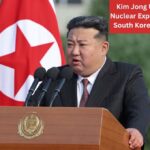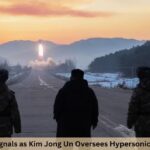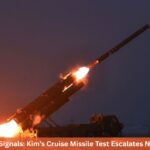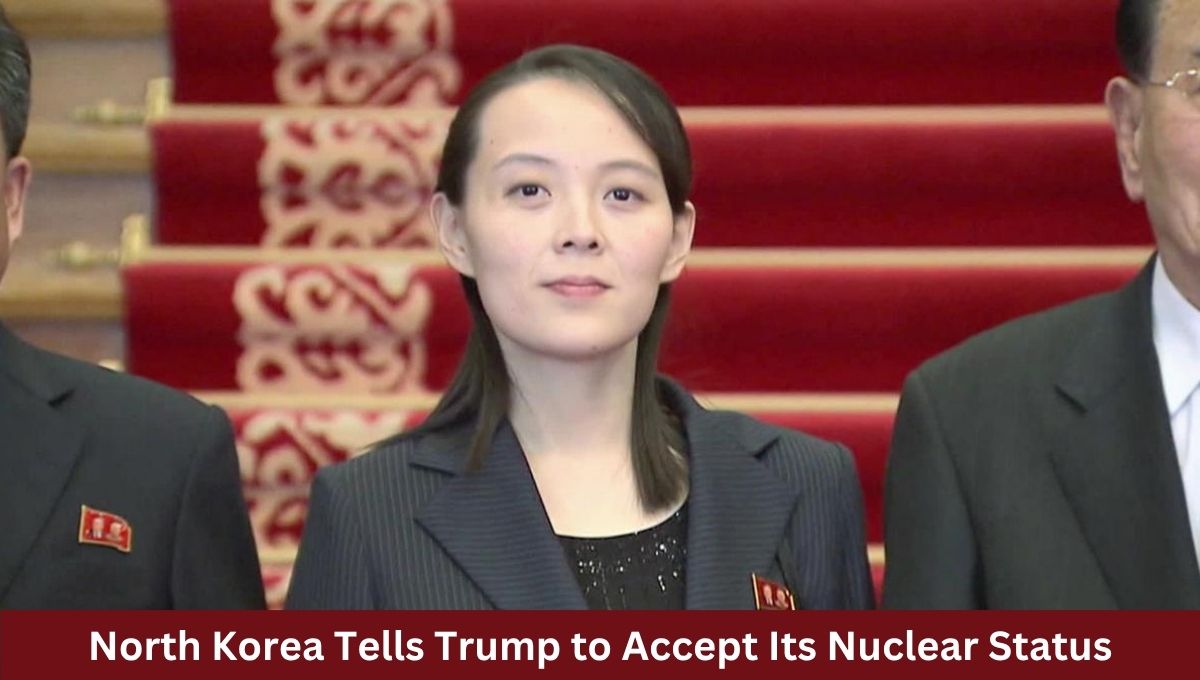
In a strongly worded message, North Korea Tells Trump to Accept Its Nuclear Status. Pyongyang declares nuclear status as non-negotiable. North Korea has declared that its nuclear status is now an irreversible reality. According to a report from the Korean Central News Agency (KCNA), Kim Yo Jong, the powerful sister of North Korean leader Kim Jong Un, made clear that any future U.S.-North Korea dialogue would have to begin with the recognition of North Korea as a nuclear weapons state.
She emphasized that if the U.S. attempts to rely on the personal relationship between Kim Jong Un and former President Donald Trump as a basis for renewed talks on denuclearization, it would be seen as a “mockery.” “If the U.S. fails to accept the changed reality and persists in the failed past, the DPRK-U.S. meeting will remain as a ‘hope’ of the U.S. side,” Kim Yo Jong said.
North Korea Tells Trump to Accept Its Nuclear Status
Personal Diplomacy Isn’t Enough
Despite tensions, Kim Yo Jong conceded that the personal rapport between Kim Jong Un and Donald Trump remains “not bad.”
However, she stressed that friendly ties would not alter North Korea’s fundamental position: the country is a nuclear-armed state and will not dismantle its nuclear arsenal.
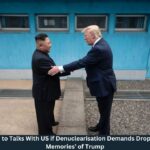
Her statement signals a clear departure from the mood during the Trump presidency, when the two leaders met three times in Singapore (2018), Hanoi (2019), and the DMZ (2019).
Although those meetings marked an unprecedented level of engagement, they failed to produce a lasting agreement on North Korea’s nuclear program.
A Changed Geopolitical Environment
Kim Yo Jong pointed out that both North Korea’s nuclear capabilities and the global geopolitical landscape have evolved significantly since the Trump-Kim summits.
She warned that any efforts to “deny the position of the DPRK as a nuclear weapons state… will be thoroughly rejected.”
This stance represents a serious blow to the long-held U.S. objective of a denuclearized Korean Peninsula.
North Korea has made it legally and politically clear that its nuclear arsenal is non-negotiable and integral to its national identity and security.
Strengthening Ties With Russia
North Korea’s declaration comes amid a broader shift in its international alignments.
In a separate KCNA report, Pyongyang confirmed the resumption of direct passenger flights between Moscow and Pyongyang the first such flights in decades.
This resumption reflects “daily-growing many-sided visits and contact” between North Korea and Russia.
The two nations have strengthened ties recently, particularly as North Korea has supplied munitions and possibly troops for Russia’s war in Ukraine.
In return, Moscow is believed to be offering economic aid and potentially military technology.
These developments suggest that Pyongyang may no longer feel it needs engagement with the West as it once did.
Trump’s Stance Unchanged
Despite North Korea’s sharp rhetoric, Trump appears open to rekindling dialogue.
According to a White House official, Trump remains committed to the goals he pursued during his first term chiefly, a fully denuclearized North Korea.
“The president retains those objectives and remains open to engaging with Leader Kim to achieve a fully de-nuclearised North Korea,” the official told Reuters.
At their first summit in Singapore, Trump and Kim signed a joint statement pledging to work toward the complete denuclearization of the Korean Peninsula.
However, subsequent talks collapsed, most notably at the 2019 Hanoi summit, where the two leaders clashed over the pace and scope of sanctions relief.
South Korea Reiterates Commitment to Denuclearization
In response to Kim Yo Jong’s statement, South Korea reaffirmed its alliance with the United States and its shared goal of full denuclearization of the North.
South Korea’s Foreign Ministry spokesperson Lee Jae-woong stated, “The ROK and the U.S. are aligned in their goal of achieving the complete denuclearization of North Korea.”
He also emphasized that Seoul and Washington will “continue close communication and coordination on all aspects of North Korea policy, including dialogue between Washington and Pyongyang.”
Foreign Minister Cho Hyun is scheduled to meet U.S. Secretary of State Marco Rubio on July 31 to discuss North Korea among other regional issues.
Hints at Arms Control Talks?
While Kim Yo Jong’s tone was defiant, she did suggest a possible shift in diplomatic approach.
Her comment that confrontation between nuclear-armed states is “not beneficial to either side” has led some analysts to speculate about a possible openness to arms control negotiations, even if full disarmament is off the table.
Jenny Town, a North Korea expert at the Stimson Center, noted that “if negotiations are possible, it won’t be about denuclearization. It must be framed differently.”
This could involve discussions on arms limitations, confidence-building measures, or reducing military tensions rather than the complete dismantling of Pyongyang’s nuclear arsenal.
Experts See Possible Opening for Phased Approach
Some analysts argue that a phased denuclearization strategy might still be on the table.
Nam Sung-wook, former head of South Korea’s Institute for National Security Strategy, believes North Korea could consider freezing or partially rolling back its nuclear activities in exchange for tangible incentives such as sanctions relief or humanitarian aid.
Kim Yeol Soo, a South Korean defense analyst, also advocates for exploring mutual security guarantees and gradual arms reductions as more realistic objectives than total disarmament.
However, both experts agree that mistrust between Washington and Pyongyang is high, and any future agreement would require robust enforcement mechanisms and bipartisan support in the U.S.
APEC Summit: High Stakes or Symbolic Theater?
Looking ahead, attention is turning to the upcoming Asia-Pacific Economic Cooperation (APEC) summit in South Korea.
Some observers speculate that Trump if re-elected might attempt another high-profile meeting with Kim Jong Un to revive diplomatic momentum.
Kim Yo Jong has scoffed at such speculation, calling the idea of a summit invitation a “daydream.”
Still, North Korea has a history of using surprise diplomacy to reset narratives. A dramatic appearance at APEC, whether by Kim Jong Un or a senior envoy, could serve both strategic and symbolic purposes.
Kim Yo Jong: North Korea’s Diplomatic Voice
Kim Yo Jong continues to rise as the primary voice of North Korea’s foreign policy. A senior official in the ruling Workers’ Party and the closest adviser to her brother, she frequently delivers policy statements on Pyongyang’s behalf.
Her increasingly public role signals both her political strength and North Korea’s strategic messaging shift.
She is now widely seen as the de facto spokesperson on U.S. and South Korean affairs, with real power to influence decisions at the highest level.
Conclusion: A Diplomatic Deadlock with No Easy Exit
North Korea’s demand for recognition as a nuclear weapons state represents a seismic shift in its approach to international diplomacy. It has codified its nuclear status into law and declared that disarmament is no longer up for discussion.
The U.S. and South Korea remain committed to denuclearization, but they now face a stark reality: North Korea is entrenched in its nuclear posture, and the old frameworks for negotiation no longer apply.
While the door to talks may not be entirely closed, it now opens only to a very different kind of diplomacy one that acknowledges North Korea’s nuclear capabilities while seeking to manage, rather than eliminate, the threat. With geopolitical tensions rising and alliances shifting, the coming months could prove critical in determining whether the Korean Peninsula moves toward confrontation or cautiously explores a new diplomatic path.
Also Read: North Korea Slams Trump’s $175 Billion ‘Golden Dome’ Missile Shield as “Nuclear War in Space”
Also Read: North Korea dashes hopes for US talks, says dialogue depends on ‘changed reality’