7 Alarming Signals as Kim Jong Un Oversees Hypersonic Missile Tests amid geopolitical crisis. North Korean leader Kim Jong Un has overseen a new round of hypersonic missile test flights, reinforcing Pyongyang’s long-standing narrative that its expanding weapons programme is a defensive necessity in an increasingly unstable global environment.
According to the Korean Central News Agency (KCNA), the tests were conducted to evaluate operational readiness and strengthen the country’s nuclear deterrent amid what Kim described as a “recent geopolitical crisis” and “complicated international circumstances.”
The announcement, carried by state media on Monday, came a day after South Korea and Japan reported detecting multiple ballistic missile launches from near Pyongyang.
The timing of the tests—just hours before South Korean President Lee Jae Myung departed for a high-profile summit with Chinese President Xi Jinping—has heightened regional anxiety and renewed debate over North Korea’s strategic intentions.
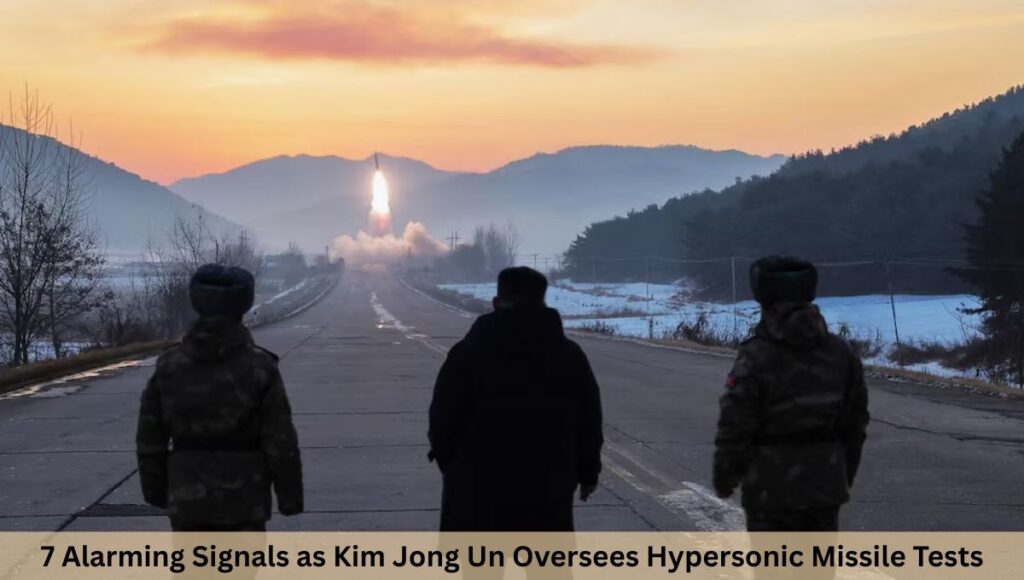
7 Alarming Signals as Kim Jong Un Oversees Hypersonic Missile Tests
What KCNA Said About the Missile Drills
KCNA reported that Sunday’s launch involved a hypersonic weapon system designed to assess combat readiness, improve the operational skills of missile units, and evaluate the overall effectiveness of North Korea’s war deterrent.
The missiles reportedly struck targets approximately 1,000 kilometres away in waters east of the Korean Peninsula.
Kim, who personally observed the drill, was quoted as saying that the test confirmed the completion of “a very important technology task for national defence.”
He stressed the need for continuous upgrades to military capabilities, with particular emphasis on offensive weapon systems.
According to KCNA, Kim underscored that maintaining and expanding a “strong and reliable nuclear deterrent” is an essential strategic priority given the current international climate.
The statement aligns with Pyongyang’s consistent portrayal of its weapons development as a response to external threats rather than an act of aggression.
Hypersonic Missiles and Why They Matter
Hypersonic missiles, which typically travel at speeds exceeding Mach 5 and are capable of manoeuvring during flight, are viewed as particularly destabilising because they can evade or overwhelm conventional missile defence systems.
If fully operational, such weapons could significantly complicate interception efforts by the United States and its allies, including South Korea and Japan.
Analysts note that North Korea has been pursuing hypersonic technology for several years, conducting a series of tests aimed at improving speed, accuracy, and manoeuvrability.
While Pyongyang claims steady progress, many foreign experts remain sceptical about whether the missiles tested so far truly meet hypersonic performance benchmarks.
Nevertheless, even incremental advances could enhance North Korea’s deterrence posture by increasing uncertainty for adversaries and reducing confidence in existing defence systems.
Link to US Strikes on Venezuela
The latest missile tests followed a sharply worded North Korean statement condemning recent US military action in Venezuela, including the reported capture of President Nicolas Maduro.
Pyongyang described the operation as a “serious encroachment of sovereignty” and accused Washington of demonstrating its “rogue and brutal nature.”
For North Korea’s leadership, the events in Venezuela appear to have reinforced long-standing fears of regime change driven by US military power.
Pyongyang has repeatedly cited similar examples—ranging from Iraq and Libya to more recent conflicts—to justify its insistence on maintaining a credible nuclear deterrent.
Hong Min, a senior analyst at the Korea Institute for National Unification in Seoul, said the hypersonic missile test was an apparent response to the US strikes.
Based on images released by state media, Hong assessed that the missile used was likely the Hwasong-11, a system first unveiled during a military parade in October.
Signalling Deterrence Ahead of Key Diplomacy
The timing of the missile launches has drawn particular scrutiny because they coincided with South Korean President Lee Jae Myung’s state visit to China.
Lee’s trip, which includes a summit with President Xi Jinping, is expected to focus on economic cooperation as well as regional security, including North Korea’s nuclear programme.
South Korea’s military said North Korea fired several ballistic missiles from near Pyongyang towards the sea off its east coast at around 7:50 a.m. local time on Sunday.
Japanese authorities confirmed that the missiles had already fallen, and no immediate damage was reported.
Lee’s office has indicated that he intends to urge China to play a “constructive role” in promoting peace on the Korean Peninsula.
Beijing remains North Korea’s most important ally and economic lifeline, giving it unique leverage—at least in theory—over Pyongyang’s behaviour.
South Korea, Japan, and US Reactions
Seoul and Tokyo were quick to condemn the missile launches. South Korea’s presidential office said it convened an emergency security meeting and called on North Korea to halt “provocative acts that violate United Nations Security Council resolutions.”
Japan’s Defence Minister Shinjiro Koizumi said the launches posed a threat to regional and international security, adding that Tokyo had lodged a strong protest with Pyongyang.
US Indo-Pacific Command said in a statement that the launches did not pose an immediate threat to US personnel, territory, or allies, but confirmed that Washington was consulting closely with Seoul and Tokyo.
‘We Are Different From Venezuela’ Message
Some analysts believe North Korea’s actions were intended to send a broader strategic message. Lim Eul-chul, a professor at the Institute for Far Eastern Studies in Seoul, argued that the missile launches signalled Pyongyang’s determination to deter any external intervention by demonstrating its readiness to respond with what he described as “aggressive deterrence.”
In this context, the tests may also have been aimed at China, underscoring North Korea’s desire to maintain strategic autonomy and discourage Beijing from aligning too closely with South Korea’s denuclearisation agenda.
Bong Youngshik, a visiting professor at Yonsei University, suggested that developments in Venezuela would be deeply unsettling for Kim Jong Un.
“After seeing what’s happening in Venezuela right now, the person who would be most afraid is Kim Jong Un,” he said, highlighting why Pyongyang continues to prioritise nuclear and missile capabilities.
Hwasong-11 and North Korea’s Weapons Pipeline
The missile believed to have been tested—the Hwasong-11—has featured prominently in North Korea’s recent military displays.
Analysts say the system is designed to combine speed, manoeuvrability, and precision, making it a key component of Pyongyang’s evolving strike capabilities.
In recent weeks, North Korea has also test-fired what it described as long-range strategic cruise missiles and newly developed anti-aircraft missiles.
State media has released photographs showing apparent progress on the country’s first nuclear-powered submarine, signalling ambitions to develop a more survivable second-strike capability.
Together, these developments suggest a coordinated effort to modernise North Korea’s arsenal across multiple domains, from land-based missiles to naval platforms.
Preparing for the Workers’ Party Congress
Observers widely believe that the recent surge in weapons testing and factory inspections is linked to the upcoming Ninth Congress of the ruling Workers’ Party, scheduled for later this year.
The congress, the first in five years, is expected to set out major policy goals and could offer clues about Pyongyang’s future approach to diplomacy and security.
Kim has recently visited munitions factories and reportedly called for more than doubling the production capacity of tactical guided weapons. Such statements point to an emphasis on mass production and readiness, rather than symbolic demonstrations alone.
The congress may also serve as a platform for Kim to articulate a revised strategy toward the United States, particularly after years of stalled talks and escalating sanctions.
The State of US–North Korea Relations
Relations between Washington and Pyongyang remain effectively frozen. Diplomatic efforts following high-profile summits earlier in Kim’s tenure have failed to produce lasting agreements, and both sides accuse the other of bad faith.
North Korea has consistently rejected calls for unilateral denuclearisation, insisting that any progress must be accompanied by security guarantees and sanctions relief.
The United States, for its part, maintains that meaningful talks cannot resume without concrete steps toward dismantling North Korea’s nuclear programme.
Against this backdrop, missile tests—especially of advanced systems like hypersonic weapons—serve as both a bargaining chip and a warning.
China’s Delicate Balancing Act
China finds itself in a complex position as tensions rise on the Korean Peninsula. While Beijing opposes North Korea’s nuclear weapons development, it is also wary of instability or regime collapse on its border.
During Lee Jae Myung’s visit, South Korea is expected to press China to use its influence to bring Pyongyang back to the negotiating table.
However, experts caution that Beijing’s leverage is often overstated and that North Korea has become increasingly resistant to external pressure, even from its closest ally.
Regional Security Implications
The repeated testing of ballistic and hypersonic missiles underscores the persistent volatility of Northeast Asia’s security environment.
Each launch prompts military alerts, diplomatic protests, and renewed debate over missile defence systems and deterrence strategies.
For South Korea and Japan, North Korea’s advances reinforce arguments for closer security cooperation with the United States.
For Washington, they highlight the challenge of deterring a nuclear-armed state that sees its arsenal as essential to regime survival.
What Comes Next
As North Korea continues to test and refine its weapons systems, attention will remain focused on the Workers’ Party Congress and any signals it provides about Pyongyang’s long-term intentions.
Whether Kim Jong Un uses the occasion to double down on confrontation or leave the door open to renewed diplomacy remains an open question.
What is clear is that the combination of global geopolitical shocks, regional diplomatic manoeuvring, and North Korea’s relentless weapons development has created a volatile mix.
The latest hypersonic missile tests are not an isolated event but part of a broader strategy aimed at ensuring that Pyongyang is never caught unprepared in a rapidly changing world.
For now, North Korea’s message appears unambiguous:
in an era of perceived threats and shifting alliances, it intends to rely on advanced military power—and particularly a credible nuclear deterrent—to safeguard its survival.
Also Read: 7 Powerful Signals as Kim Jong Un’s Daughter Enters Succession Spotlight
Also Read: North Korea tests hypersonic missiles, says nuclear forces ready for war
Related Posts:
- 9 Strategic Signals: Kim’s Cruise Missile Test…
- South Korea Fired Warning Shots as North Korean…

- Kim Jong Un Vows Rapid Nuclear Expansion Amid…
- Russia Warns US, Japan, South Korea Over North Korea…

- 7 Urgent Takeaways as North Korea Launches Ballistic Missile
- 9 Defining Signals as Kim Unleashes Nuclear Power…