North Korea raises global alarm bells as Kim Jong Un Vows Rapid Nuclear Expansion Amid US-South Korea Military Drills. Leader Kim Jong Un declared on Monday that the country would pursue a “rapid expansion of nuclearization”, directly linking the move to what he described as hostile and provocative US-South Korea military exercises.
The remarks, delivered during Kim’s inspection of his country’s most advanced naval destroyer, underscored Pyongyang’s refusal to accept denuclearization talks and highlighted the regime’s determination to expand its arsenal even as South Korea’s new President Lee Jae Myung calls for dialogue.
The announcement comes just days before a scheduled summit between US President Donald Trump and South Korean President Lee Jae Myung in Washington, where North Korea’s nuclear weapons program will be a top agenda item.
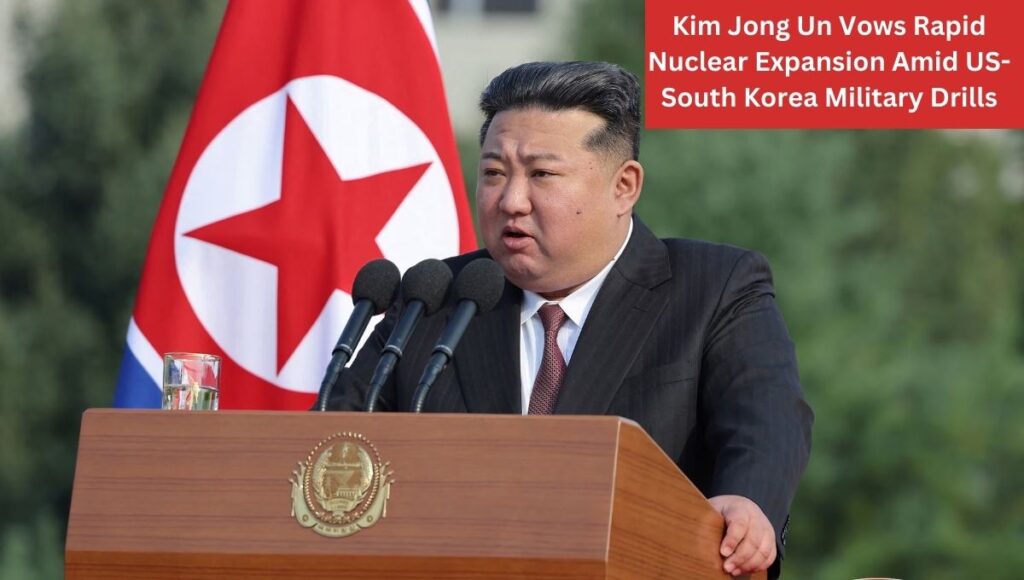
Kim Jong Un Vows Rapid Nuclear Expansion Amid US-South Korea Military Drills
North Korea Slams US-South Korea Joint Drills
The immediate trigger for Kim’s fiery comments was the kickoff of Ulchi Freedom Shield, the 11-day annual US-South Korea joint military exercise.
This year’s drills involve 21,000 troops, including 18,000 South Koreans, and focus on countering nuclear and missile threats from the North.
Washington and Seoul have repeatedly described the drills as defensive in nature. But Pyongyang denounced them as rehearsals for invasion and a deliberate show of force designed to destabilize the Korean Peninsula.
“Comrade Kim Jong Un affirmed that the US–Korea combined military exercises…constitute a clear expression of intent to be most hostile and confrontational toward the DPRK,” state media KCNA quoted him as saying.
Kim further argued that the exercises have grown more provocative by including a “nuclear element”, demanding that the North respond with “proactive and overwhelming countermeasures.”
Kim Links Security Environment to Nuclear Buildup
During his visit to the western port of Nampo, Kim inspected the 5,000-ton Choe Hyon-class destroyer a warship designed to carry nuclear-capable ballistic and cruise missiles.
Standing aboard the vessel, Kim said the “security environment around the DPRK is getting more serious day by day” and declared that his country must “make a radical and swift change in existing military theory and practice.”
This, he said, required nothing less than the “rapid expansion of nuclearization.”
Analysts say Kim’s remarks represent more than routine propaganda. “Through this move, North Korea is demonstrating its refusal to accept denuclearization and the will to irreversibly upgrade nuclear weapons,” said Hong Min of the Korea Institute for National Unification.
Ulchi Freedom Shield 2025: Scaled But Symbolic
South Korea’s Defense Ministry announced that while the scale of Ulchi Freedom Shield remains similar to 2024, 20 out of 40 field training events have been rescheduled for September.
Officials framed the change as part of President Lee’s broader effort to ease tensions with the North.
But experts remain skeptical about whether Pyongyang will view the adjustments as a conciliatory gesture. Instead, North Korea appears to be exploiting the exercises as justification for its military buildup.
“The prevailing situation requires us to undertake a decisive and rapid change,” Kim insisted.
Kim’s visit to the Choe Hyon destroyer was more than symbolic. The warship, unveiled earlier this year, is designed to support nuclear-capable weapons systems and bolster North Korea’s ability to project power beyond its borders.
The destroyer is expected to enter active service in 2026. It features systems capable of handling antiair and anti-naval missions, as well as ballistic and cruise missiles with nuclear strike capacity.
North Korea has already unveiled a second destroyer, the Kang Kon, though its launch was marred by technical failures. A third destroyer is currently under construction and slated for completion by October next year.
By showcasing these vessels, Kim signaled that North Korea’s nuclear ambitions are no longer confined to land-based missile silos but extend to the sea expanding the regime’s ability to launch preemptive or retaliatory strikes.
South Korea’s Response: Defensive Nature of Drills
South Korea’s Unification Ministry responded swiftly to Kim’s claims, reiterating that the joint drills with the US are “defensive in nature, aimed at protecting the lives and safety of the people.”
A senior ministry official dismissed Pyongyang’s allegations of war preparations, saying: “We once again make clear that there is no intent to attack North Korea or heighten tensions on the Korean Peninsula.”
President Lee Jae Myung has called for a “nuclear-free Korean Peninsula” and expressed willingness to revive inter-Korean dialogue. But so far, Kim has rebuffed his outreach.
Echoes of the 2018 Inter-Korean Agreement
Lee has also suggested restoring the 2018 inter-Korean military agreement, which created buffer zones and no-fly zones along the border.
That agreement collapsed in 2024 amid escalating tensions, including Pyongyang’s launches of trash-filled balloons and Seoul’s resumption of frontline propaganda campaigns.
Reviving the pact would mark a return to confidence-building measures, but Pyongyang’s recent rhetoric makes such progress unlikely.
Nuclear Arsenal Estimates and Future Risks
Independent assessments suggest that North Korea’s nuclear stockpile, while limited compared to major powers, is steadily growing.
A Federation of American Scientists report estimated that Pyongyang may have produced enough fissile material for up to 90 nuclear warheads, though it has likely assembled closer to 50 weapons.
Kim’s emphasis on a “radical expansion” implies an ambition to significantly raise those numbers.
With naval destroyers capable of deploying nuclear weapons, the North’s nuclear triad land, sea, and potentially air is becoming more robust.
A Political Message to Trump and Lee
Experts believe Kim’s remarks were timed to send a direct signal ahead of the upcoming Trump-Lee summit in Washington.
“This is less about direct provocation and more about sending a message,” said Hong Min. “By showcasing naval nuclear capabilities now, Kim underscores his rejection of denuclearization before the allies announce their joint stance.”
Indeed, Kim’s comments came just days after Lee expressed hopes for dialogue on Liberation Day. Kim’s rebuff suggests Pyongyang sees little incentive in talks unless its nuclear status is recognized.
Lessons from Ukraine and Beyond
South Korean and US military planners say Ulchi Freedom Shield 2025 incorporates lessons from conflicts in Ukraine and the Middle East, particularly regarding drones, GPS jamming, and cyberattacks.
By referencing nuclear components, Kim is signaling that North Korea sees parallels between its security environment and other global flashpoints.
The emphasis on naval nuclear platforms suggests a long-term strategy of deterrence and survivability.
North Korea’s Strategic Alignment with Russia
Tensions on the Korean Peninsula are compounded by North Korea’s growing ties with Moscow.
Since Russia’s invasion of Ukraine, Kim has expanded military cooperation with the Kremlin, including arms transfers and political support.
By deepening this partnership, Pyongyang gains diplomatic cover and potential technological assistance, further complicating Washington and Seoul’s efforts to rein in its nuclear program.
Kim’s “Irreversible” Nuclear Will
At the heart of Kim’s remarks lies a blunt refusal to entertain denuclearization. KCNA quoted him as declaring that “important measures for the accelerated growth of national defense capabilities will certainly continue to be taken.”
This framing is consistent with Pyongyang’s long-held position: nuclear weapons are not a bargaining chip but a permanent feature of its defense strategy.
For Washington and Seoul, this raises the stakes ahead of the Trump-Lee summit. While both leaders are expected to reaffirm their commitment to denuclearization, the reality is that North Korea is moving in the opposite direction.
Also Read: North Korea Tells Trump to Accept Its Nuclear Status
Regional Security Implications
Kim’s vow of rapid nuclear expansion has wide-reaching implications:
- Japan and South Korea may accelerate their own defense programs, including missile defense and conventional deterrence.
- China faces a delicate balance, as it opposes both a nuclear North Korea and increased US military presence in the region.
- The US may need to expand extended deterrence commitments, possibly including the redeployment of strategic assets.
The Korean Peninsula, already one of the world’s most militarized regions, risks sliding into a new arms race.
Conclusion: Rising Tensions Before a Crucial Summit
Kim Jong Un’s fiery rhetoric and unveiling of nuclear-capable warships represent a clear warning: North Korea is doubling down on its nuclear ambitions, not backing away.
While President Lee Jae Myung has extended an olive branch and President Trump prepares to host him in Washington, Pyongyang’s message is unmistakable its nuclear path is irreversible.
As the Trump-Lee summit nears, the world will be watching to see whether diplomacy can carve out space for de-escalation, or whether Kim’s vow of rapid nuclear buildup locks the Korean Peninsula into a new and dangerous era.
Also Read: North Korea says its 2nd attempt to launch a spy satellite has failed, vows another try