Ukraine’s NATO Membership vs. Security Guarantees: What Lies Ahead? Explained. The future of Ukraine’s security remains one of the most pressing questions in global politics. As Russia’s full-scale invasion enters its fourth year, the debate is intensifying: should Ukraine be granted full NATO membership, or will it only receive Article 5–style security guarantees from the West?
In recent days, NATO Secretary General Mark Rutte, U.S. President Donald Trump, Ukrainian President Volodymyr Zelensky, and key European leaders have weighed in. Their comments suggest Ukraine is unlikely to join NATO in the near future, but instead may receive legally binding security guarantees that resemble NATO’s collective defense principle.
This article breaks down the latest developments, the political dynamics inside NATO, Trump’s diplomacy with Russia and Ukraine, and what it all means for Kyiv’s long-term survival.
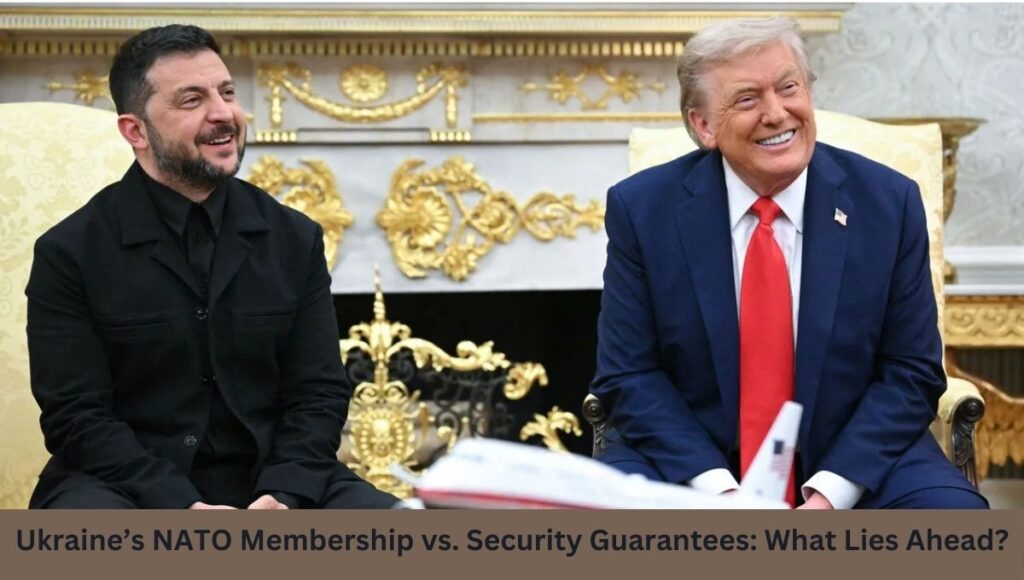
Ukraine’s NATO Membership vs. Security Guarantees: What Lies Ahead?
What is NATO’s Article 5 and Why It Matters for Ukraine
At the heart of this debate lies Article 5 of NATO’s founding treaty. Article 5 states that an attack on one NATO member is considered an attack on all, obligating allies to take collective action including the use of armed force.
For Ukraine, an Article 5–style arrangement would mean that any future Russian invasion would trigger a direct military response from the United States and Europe.
In practice, this would provide deterrence similar to NATO membership without officially admitting Ukraine into the Alliance.
However, NATO Secretary General Mark Rutte has clarified: “What we are discussing here is not NATO membership, what we are discussing here is Article 5 type of security guarantees for Ukraine.”
Why NATO Membership for Ukraine is Not on the Table
Despite Ukraine’s constitutional commitment to joining NATO, membership is blocked by political realities:
- United States Opposition – The Biden and Trump administrations have made clear that admitting Ukraine while the war is ongoing would risk direct war with Russia.
- European Concerns – Countries like Germany, France, and even newer NATO entrants such as Finland and Sweden fear escalation.
- Russian Red Lines – Moscow has long portrayed NATO expansion as a threat to its security. Granting Kyiv membership would, in Russia’s view, cross the ultimate red line.
Thus, while NATO leaders continue to state that Ukraine has an “irreversible path into NATO”, the current negotiations focus instead on security guarantees.
Security Guarantees: What They Mean for Ukraine
The concept of “Security Guarantees” is emerging as a middle ground.
According to Zelensky and Trump, these would:
- Commit the U.S. and European countries to defend Ukraine if Russia attacks again.
- Include a $90 billion package of U.S. weapons, such as aircraft and air defense systems.
- Potentially be formalized on paper within 10 days, according to Zelensky’s latest briefing.
- Avoid the need to place NATO troops on the ground in Ukraine while still offering protection.
Essentially, this would be NATO-style protection without NATO membership a compromise designed to deter Russia while preventing an all-out confrontation.
Trump, Putin, and Zelensky: Diplomacy at the White House
A dramatic twist came when Donald Trump revealed that he had personally spoken with Russian President Vladimir Putin, arranging for a possible trilateral summit with Zelensky.
At a press conference, Trump said: “When it comes to security, there’s going to be a lot of help. They [Europe] are a first line of defense because they’re there, but we’ll help them out.”
Zelensky described the White House talks as his “best meeting” with Trump so far, noting that security guarantees would be “formalized on paper within the next 7 to 10 days.”
European leaders, including Emmanuel Macron, Friedrich Merz, Alexander Stubb, and Keir Starmer, joined Trump in Washington to show solidarity and push for guarantees.
Ceasefire or Peace Deal? Disagreement Over Next Steps
The Washington summit did not produce a peace deal. Key sticking points remain:
- Ceasefire First? – France and Germany argue that a ceasefire is necessary before negotiations. Trump and Putin suggest talks can proceed while fighting continues.
- Territorial Concessions – Putin is demanding Ukraine cede parts of Donbas and Crimea. Zelensky has rejected these demands, though hinted territorial issues could be discussed directly with Putin.
- Referendum Clause – Zelensky insists any territorial concession must be approved by a referendum inside Ukraine.
As one European diplomat put it: “Momentum is not peace. We still need proof Russia will honor its word.”
Marco Rubio and the U.S. Position on Security Guarantees
U.S. Secretary of State Marco Rubio confirmed that Washington is working with both European and non-European allies to design a system of security guarantees.
Rubio stressed that:
- Guarantees would have to be in place after a peace deal.
- They would likely include Western defense commitments and military aid.
- Negotiations are still “a work in progress.”
He also expressed caution about new sanctions on Russia, warning they could derail fragile talks.
NATO Membership vs. Security Guarantees: Key Differences
| NATO Membership | Security Guarantees |
| Permanent protection under Article 5 | Temporary or conditional agreement |
| Automatic collective defense by all 32 NATO allies | Select coalition of U.S. + European allies |
| Political integration into NATO structures | Ukraine remains outside the alliance |
| Russia views as direct provocation | Possible compromise Russia might tolerate |
Thus, while NATO membership remains Kyiv’s ultimate goal, security guarantees are the “next best option” in the short to medium term.
European Leaders Push for Guarantees
European leaders are backing the idea of security guarantees but remain cautious about the details:
- France’s Emmanuel Macron: insists Europe must be included in any deal, warning against bilateral U.S.-Russia dominance.
- Germany’s Friedrich Merz: supports a ceasefire first but acknowledges security guarantees are essential.
- Finland’s Alexander Stubb: strongly advocates for Article 5–style protection, saying it is the only credible deterrent.
Their presence in Washington highlighted Europe’s desire to shape the post-war settlement.
Putin’s Demands and the Question of Land Concessions
A major obstacle is Russia’s territorial demands. Putin has insisted Ukraine must formally cede Donbas and Crimea.
Reports suggest Moscow has floated land swap deals or arrangements along current frontlines.
However, Zelensky has rejected these offers outright, noting that Ukrainian territory is not negotiable without public consent.
Still, some U.S. officials believe that strong security guarantees could make it politically easier for Ukraine to accept limited concessions.
The Role of U.S. Weapons and Military Aid
Part of the proposed guarantees includes a $90 billion U.S. weapons package. Zelensky has confirmed this includes:
- Fighter jets
- Advanced air defense systems
- Long-range strike weapons
- Expanded drone cooperation
Additionally, Trump reportedly agreed that the U.S. would purchase Ukrainian drones once exports reopen a move designed to boost Ukraine’s economy and defense industry.
Security Guarantees: A “Game-Changing” Proposal?
Trump’s envoy Steve Witkoff called the security guarantees “game-changing.” He claimed that during the Alaska summit, Putin agreed to accept Western guarantees for Ukraine’s defense, even suggesting legislative commitments in Russia not to invade again.
If true, this would mark the first Russian acknowledgment of Ukraine’s right to Western protection since 2022.
The Big Unanswered Questions
Despite progress, huge uncertainties remain:
- Will Russia honor any deal? Putin has a history of violating agreements.
- Will NATO commit troops if Ukraine is attacked again? Guarantees may fall short of full NATO obligations.
- What happens if Ukraine rejects territorial concessions? Peace talks could collapse.
- Will Trump’s approach differ from Europe’s? European leaders demand a ceasefire first; Trump wants talks immediately.
These unanswered questions mean that while momentum for a settlement exists, peace is far from guaranteed.
Conclusion: Ukraine’s Future Between NATO and Security Guarantees
For Ukraine, NATO membership remains the ultimate prize but one that appears distant. Instead, security guarantees backed by the U.S. and Europe are emerging as a practical, short-term substitute.
Zelensky has welcomed the guarantees as a “major step forward”, but the details and Russia’s willingness to accept them will determine whether they truly protect Ukraine or simply delay another war. As talks continue in Washington and beyond, one fact is clear: Ukraine’s future security will be shaped not only in Kyiv and Moscow, but in Washington, Brussels, and the broader Western alliance.
Also Read: Will Ukraine Get NATO Membership or Just Security Guarantees? Explained
Related Posts:
- Will Ukraine Get NATO Membership or Just Security…
- 7 Crucial Security Guarantees Ukraine Wants After…
- 5 Blunt Warnings: Why NATO’s Rutte Says Europe Can’t…
- Zelensky in Washington: Trump, European Leaders Push…
- 7 Defining Signals: Zelensky’s Bold Election Offer…
- 7 Explosive Lines as Zelensky’s Christmas Message…