Ukraine’s Security at a Crossroads: Will Ukraine Get NATO Membership or Just Security Guarantees? Explained. Ukraine has been under relentless Russian bombardment since February 2022. With peace talks inching forward, the most pressing question remains: will Ukraine join NATO, or will it receive only security guarantees from the alliance?
Thank you for reading this post, don't forget to subscribe!NATO Secretary General Mark Rutte recently confirmed that while membership is not on the table, Article 5–style assurances collective defense obligations modeled on NATO’s founding principle are being explored. These guarantees could shield Ukraine from future aggression without pulling NATO directly into the war.
This article breaks down the difference between NATO membership and security guarantees, why NATO leaders remain divided, and what security assurances could mean for Ukraine’s long-term stability.
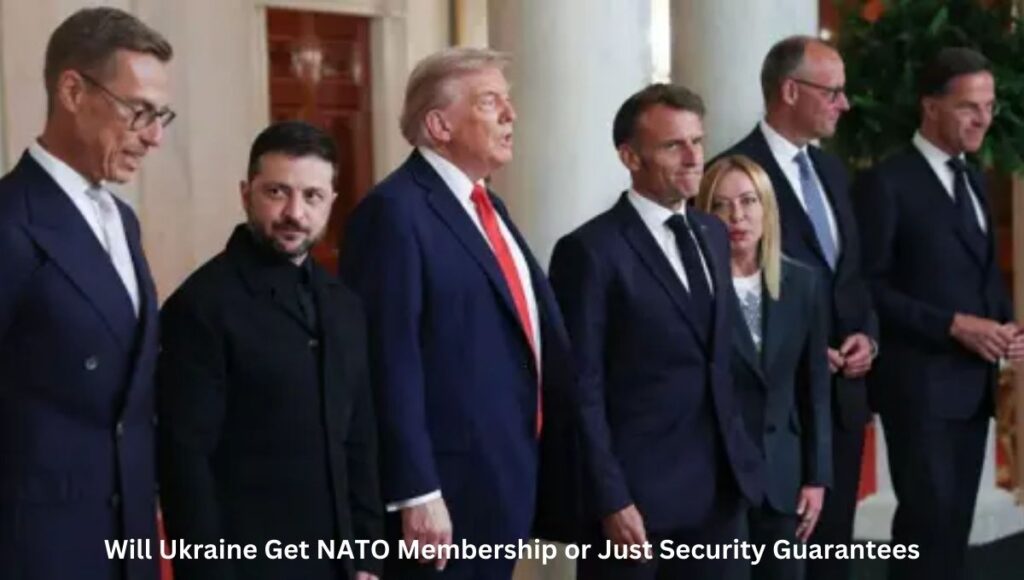
Will Ukraine Get NATO Membership or Just Security Guarantees? Explained
What NATO’s Article 5 Really Means
At the heart of NATO is Article 5 of the Washington Treaty, the clause that defines collective defense. It states:
“The Parties agree that an armed attack against one or more of them in Europe or North America shall be considered an attack against them all… they will assist the Party or Parties so attacked by taking forthwith such action as it deems necessary, including the use of armed force.”
This principle has only been invoked once in NATO’s history after the September 11, 2001 attacks in the United States.
If Ukraine were granted Article 5–style assurances, any new Russian attack would compel NATO allies to respond.
However, this would not be the same as full NATO membership, which formally integrates Ukraine into the alliance and its command structures.
NATO Membership vs. Security Guarantees
Why NATO Membership Is Off the Table for Now
Despite Kyiv’s constitutional commitment to NATO accession, Mark Rutte made it clear: Ukraine’s NATO membership is not under discussion at present.
Several reasons explain this hesitation:
- Risk of escalation: Admitting Ukraine while it is at war with Russia could drag NATO into direct conflict with a nuclear power.
- Unprecedented precedent: NATO has never admitted a country in active conflict.
- U.S. reluctance: President Donald Trump has categorically ruled out Ukrainian membership.
Security Guarantees as the Alternative
Instead, NATO is exploring Article 5–style guarantees. These would not make Ukraine a member but would ensure:
- Military support (weapons, intelligence, logistics)
- Air and naval protection from neighboring NATO states
- Long-term defense commitments to deter future Russian attacks
This “middle path” allows NATO to strengthen Ukraine’s security without crossing Moscow’s red line.
Security Guarantees for Ukraine: What They Could Mean
President Volodymyr Zelensky has repeatedly stressed that security guarantees are the foundation of any peace deal. Without them, Russia could regroup and strike again within years.
Potential guarantees include:
- Air defense patrols from Poland and Romania
- Naval security operations in the Black Sea
- Training missions to rebuild Ukraine’s army
- Intelligence-sharing and advanced weapons supply pipelines
The Coalition of the Willing, spearheaded by the UK and France with support from over 30 nations, is developing the framework for these commitments.
Why Ukraine Won’t Get NATO Membership Now
U.S. and European Resistance
While countries like Poland and the Baltic States favor fast-tracking Ukraine’s NATO membership, others most notably the United States, Slovakia, Germany, and Italy oppose it during wartime.
Donald Trump’s position is firm: “No U.S. troops in Ukraine.” His administration is willing to consider air support, but NATO enlargement remains a red line.
Even NATO supporters like Emmanuel Macron and Keir Starmer admit that security guarantees are the realistic path forward for now.
The Membership Dilemma
Ukraine’s NATO membership is a long-term aspiration. Yet NATO’s 75-year history shows it avoids admitting countries embroiled in conflicts. With Russia openly threatening nuclear escalation, the risks are too high.
NATO’s Current Membership
NATO today includes 32 member states, from its 12 founding members in 1949 to its newest entrants: Finland (2023) and Sweden (2024).
Ukraine aspires to join their ranks, but no precedent exists for a country joining while locked in open war. NATO leaders fear this would trigger automatic collective defense, dragging the alliance into direct conflict with Russia.
The Coalition of the Willing
Who They Are
The Coalition of the Willing, led by the UK and France, brings together more than 30 nations working to design post-war security guarantees for Ukraine.
What They’re Proposing
- Air cover from NATO bases in Poland and Romania
- Black Sea maritime security
- Weapons supply lines
- Military training and logistics support
The Limits of the Coalition
Deploying enough ground troops to cover Ukraine’s 1,000 km frontline is impractical. Moreover, Moscow has categorically rejected NATO forces on Ukrainian soil, no matter what flag they operate under.
Russia’s Opposition
Russia has consistently rejected NATO’s involvement in Ukraine. Moscow insists it deserves its own “security guarantees” to halt NATO expansion an argument flatly rejected by Western leaders.
Some analysts believe Moscow might tolerate limited guarantees if paired with recognition of its occupied territories, but President Zelensky has dismissed this as unacceptable, saying Ukraine will not accept partition.
Trump’s Stance: No U.S. Boots on the Ground
Donald Trump remains a decisive figure in shaping NATO’s Ukraine policy. His stance includes:
- No U.S. ground troops in Ukraine
- Possible U.S. air support for European allies
- Emphasis on European responsibility for Ukraine’s defense
In Trump’s words: “We’re willing to help them, especially by air, because nobody has what we have.”
This suggests Washington may provide air defense and surveillance but stop short of full-scale military engagement.
U.S. Air Support: A Possible Guarantee
If the U.S. delivers on Trump’s signals, security guarantees could include:
- Advanced air defense systems
- Surveillance and reconnaissance flights
- No-fly zone enforcement
However, these measures carry escalation risks, especially if NATO aircraft clash directly with Russian planes.
NATO Military Planning Underway
According to Reuters, U.S. and European military planners are already drafting scenarios for Ukraine’s post-war defense. Options include:
- Multinational forces in Ukraine (under U.S. command, not NATO’s)
- Coordinated air support
- Expanded training missions
Upcoming NATO meetings will refine these plans, testing feasibility and allied commitment.
Alternatives to Ground Troops
Since Russia refuses NATO troops in Ukraine, alternatives gaining traction include:
- Air power from neighboring states
- Black Sea naval deterrence
- Long-range missile deliveries
- Sanctions and economic tools
These options aim to give Ukraine a credible deterrent without risking full NATO-Russia confrontation.
The Dilemma: Strong but Acceptable Guarantees
Designing guarantees that deter Russia without collapsing peace talks remains NATO’s biggest challenge.
Former Defense Secretary Ben Wallace warned: “Putin shows no sign of stopping. Until Europe and the U.S. make him want to change, little will be achieved.”
The Coalition of the Willing provides flexibility, but analysts warn it is still more political aspiration than military reality.
Has Ukraine Ever Had Security Guarantees?
Not effectively. While the 1994 Budapest Memorandum promised respect for Ukraine’s sovereignty, Russia violated it by annexing Crimea in 2014 and invading in 2022.
Past OSCE monitoring missions lacked enforcement mechanisms. This history explains why Zelensky demands enforceable guarantees this time.
Will Russia Accept Any Guarantees?
The Kremlin rejects NATO troops and insists on limiting Ukraine’s military. Moscow also wants recognition of occupied territories, conditions Kyiv cannot accept.
Some analysts fear Russia will test any guarantees, probing NATO resolve much like it has tested ceasefires before.
Conclusion: Ukraine’s Uncertain Path
Ukraine’s future lies at the heart of Europe’s security order. NATO membership remains Kyiv’s long-term ambition, but for now, security guarantees appear the only viable option. The coming months will determine whether the Coalition of the Willing and U.S. air power can turn abstract assurances into real deterrence.
For Ukraine, the stakes could not be higher: credible guarantees may spell the difference between lasting peace and another devastating war.
Also Read: NATO Chief Warns BRICS of 100% Tariffs Over Russian Trade
Related Posts:
- Ukraine’s NATO Membership vs. Security Guarantees:…

- 7 Crucial Security Guarantees Ukraine Wants After…
- 5 Blunt Warnings: Why NATO’s Rutte Says Europe Can’t…
- NATO’s Got Daddy Issues: Trump, Rutte, and the…
- Zelensky in Washington: Trump, European Leaders Push…

- 7 Crucial Developments as Zelenskyy Says US Security…