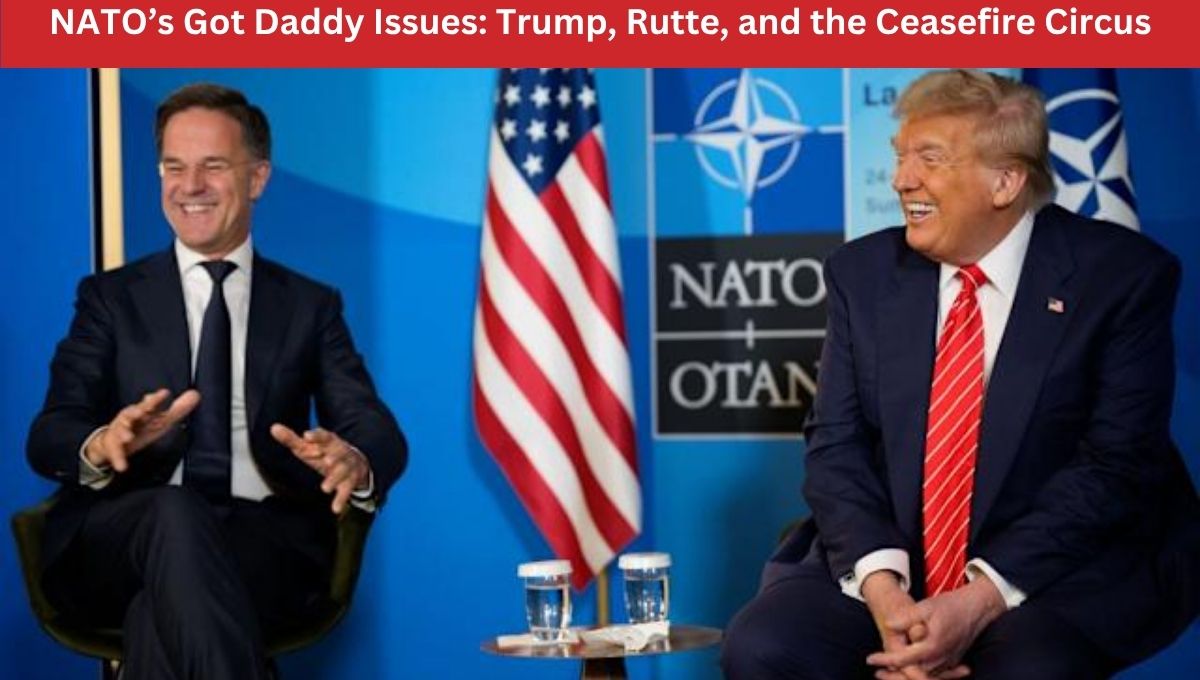
At The Hague, NATO’s Got Daddy Issues: Trump, Rutte, and the Ceasefire Circus. What was meant to be a serious summit addressing global security took a bizarre and humorous turn when NATO Secretary General Mark Rutte found himself clarifying that he did not call US President Donald Trump “daddy.”
The remark, made during a joint appearance amid discussions on Iran and Israel, quickly lit up the internet and drew a mix of laughter, clarification, and even an official White House video featuring Usher’s 2010 hit, “Hey Daddy (Daddy’s Home).”
As NATO allies debated weighty topics like Middle East security, defense spending, and the role of the US in future conflicts, the unexpected “daddy” comment gave the summit a theatrical twist. But behind the humor were deeper questions about Trump’s leadership, NATO’s dependence on the US, and how global diplomacy often hinges on tone as much as policy.
NATO’s Got Daddy Issues: Trump, Rutte, and the Ceasefire Circus
Mark Rutte: “I Didn’t Call Trump Daddy”
The viral drama began when Mark Rutte, during a joint press conference with Trump, made a remark using the word “daddy” that many interpreted as a reference to Trump.
“And I said, that sounds a little bit like a small child asking his daddy, ‘Hey, are you still staying with the family?’ So in that sense, I used ‘daddy,’ not that I was calling President Trump daddy,” Rutte clarified in a follow-up interview with Reuters.
His clarification came after media outlets ran with headlines suggesting the NATO chief had actually called Trump “daddy.”
Rutte explained the analogy was meant to reflect the way European nations often seek assurance from the US about its commitment to NATO, especially under Trump’s America-first approach.
Trump, Israel, and Iran: The Schoolyard Fight Analogy
During the same press conference, President Trump compared the Iran-Israel conflict to two children fighting in a schoolyard.
“They’ve had a big fight, like two kids in a schoolyard. You know, they fight like hell, you can’t stop them. Let them fight for about two–three minutes, then it’s easy to stop them,” Trump said.
Rutte responded with a smile: “And then daddy has to sometimes use strong language to get them to stop.”
The remark, clearly made in jest and in reference to Trump’s earlier use of strong expletives in describing the Iran-Israel tensions, quickly went viral.
“Daddy’s Home”: White House Joins the Fun
Never one to miss a media moment, the White House posted a video Thursday on its official X account (formerly Twitter), featuring footage of Trump arriving at the NATO summit set to Usher’s “Hey Daddy (Daddy’s Home).”
The post was cheekily captioned: “Daddy’s home… Hey, hey, hey, Daddy. President Donald J. Trump attended the NATO Summit in The Hague, Netherlands.”
This unusual display of social media theatrics suggested the administration was embracing the viral moment and using it to project strength, charm, and command presence in the global spotlight.
Rutte: “A Bit of a Question of Taste”
When asked whether using the term “daddy” was undignified for a NATO chief, Rutte stood firm, brushing off the suggestion.
“No, I don’t think so,” he said. “I think it’s a bit of a question of taste.”
Rutte has been nicknamed the “Trump Whisperer” in diplomatic circles for his unique ability to connect with the unpredictable former president.
His hosting efforts at the summit including shortening the schedule and arranging for Trump to stay at the royal palace were seen as part of a carefully crafted plan to keep the summit running smoothly.
Rutte Praises Trump’s Strike on Iran
Beyond the viral moment, Rutte praised Trump’s military decisions, especially the airstrikes on Iran’s nuclear facilities, which took place days before the summit.
“The fact that he took this decisive action, very targeted, to make sure that Iran would not be able to get its hands on a nuclear capability I think he deserves all the praise,” said Rutte, calling Trump a “good friend” of more than ten years.
Rutte’s comments came amid ongoing debate in Washington over the effectiveness of the strikes. While Trump claims the attacks “completely obliterated” Iran’s nuclear program, early US intelligence reports say the damage was moderate and temporary, delaying Iran’s progress by only a few months.
Trump Reacts to “Daddy” Remark With Humor
Asked about Rutte’s comments, Trump laughed off the moment.
“He did it very affectionately though ‘Daddy, you’re my daddy,’” Trump joked, prompting chuckles from the press and Secretary of State Marco Rubio, who stood behind him.
Later, Trump compared the Iran strike to the end of World War II, noting: “I don’t want to use an example of Hiroshima, I don’t want to use an example of Nagasaki, but that was essentially the same thing. That ended that war. This ended the war.”
The comment added to the surreal tone of the summit, blending battlefield decisions with pop culture and father-figure humor.
The Trump-Rutte Dynamic: Humor Meets Diplomacy
Rutte’s tone throughout the summit highlighted a broader strategy: humor and familiarity as tools of diplomacy.
Observers noted that while the NATO chief may have sparked headlines with his “daddy” remark, he also kept Trump engaged and cooperative a priority for European leaders who continue to rely heavily on US military support.
The Dutch leader’s approach earned praise from some quarters, who saw it as an effective way to balance ego management with serious policy work.
Critics, however, warned that diplomacy should not turn into performance art, especially when nuclear threats and regional stability are on the table.
Ceasefire in the Middle East, But Questions Remain
While the summit ended with continued affirmations of NATO unity and a fragile ceasefire between Israel and Iran, questions remain about the long-term effectiveness of Trump’s strike on Iran’s nuclear infrastructure.
US intelligence sources say the underground nuclear facilities survived, enriched uranium was likely moved beforehand, and Iran could resume its program within months.
Yet Rutte’s praise for Trump’s action suggests that, at least within NATO, decisiveness even if temporary has diplomatic value.
A Viral Moment, A Serious Message
The “daddy” episode may have dominated headlines, but it also underscored deeper themes:
- How leaders manage each other’s personalities
- The importance of maintaining alliances in uncertain times
- The power of communication style in diplomacy
As social media continues to shape global perception, even a light remark can become a defining moment of a high-stakes international summit.
Conclusion: Diplomacy in the Age of Memes
From Rutte’s now-famous “daddy” comment to the White House’s embrace of viral culture, the 2025 NATO summit will be remembered not only for military strategy and ceasefire negotiations, but also for its meme-worthy moments.
In an age where geopolitics and pop culture collide daily, leaders are learning to navigate both war rooms and newsfeeds with humor, precision, and a bit of showmanship.
Also Read: Trump Claims Ceasefire Victory at NATO Summit Amid Growing Alliance Tensions
Also Read: How ‘Daddy’ talk and Trump and Rutte’s bromance stole the NATO spotlight