
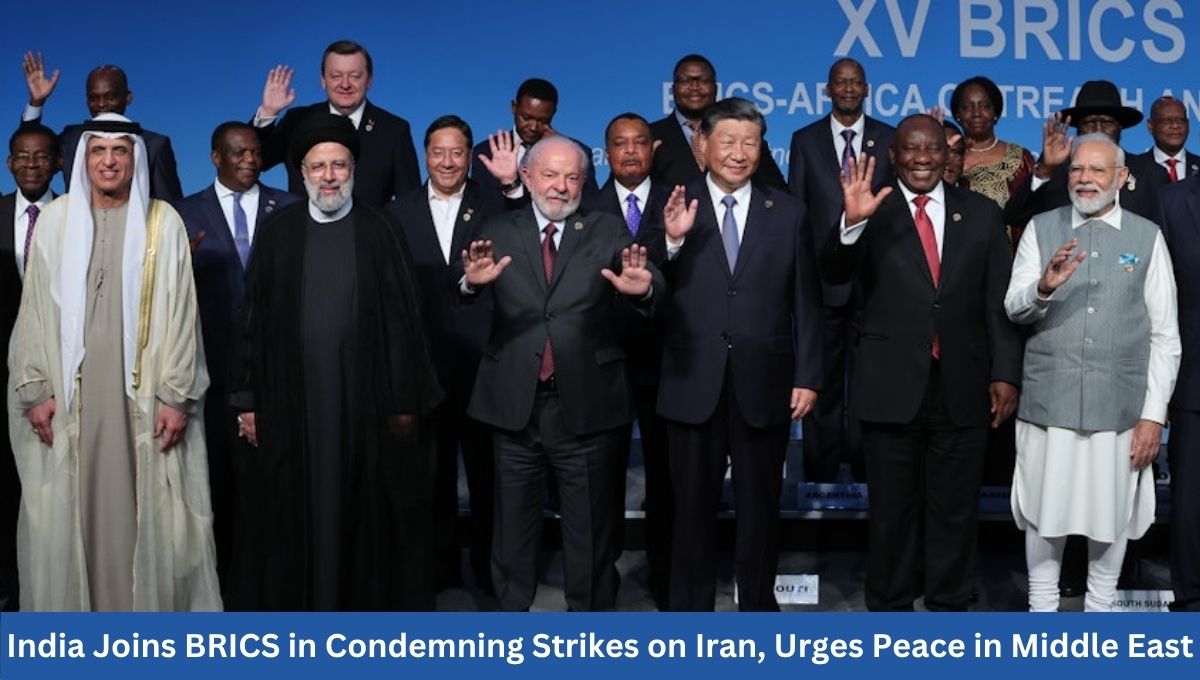
Supporting Israel-Iran truce, India Joins BRICS in Condemning Strikes on Iran, Urges Peace in Middle East. In a significant diplomatic alignment, India joined fellow BRICS nations in voicing grave concern over recent military strikes on Iran, marking a departure from its earlier position within the Shanghai Cooperation Organisation (SCO). The BRICS joint statement, issued Tuesday, did not name Israel or the United States but firmly condemned the attacks as a violation of international law and the United Nations Charter.
This development comes in the wake of a volatile 12-day conflict between Iran and Israel, which also drew in the United States through coordinated airstrikes on Iranian nuclear facilities. The BRICS statement highlights the escalating risks to global security, the economy, and the Middle East’s fragile peace, while urging all parties to pursue diplomacy.
India Joins BRICS in Condemning Strikes on Iran, Urges Peace in Middle East
BRICS Calls Strikes a Violation of International Law
The BRICS group comprising Brazil, Russia, India, China, South Africa, Egypt, UAE, Ethiopia, Indonesia, and Iran issued a statement that read:
“We express grave concern over the military strikes against the Islamic Republic of Iran since 13 June 2025, which constitute a violation of international law and the Charter of the United Nations.”
Although the statement did not explicitly name Israel or the US, it was widely interpreted as a veiled reference to their involvement.
This diplomatic nuance made it possible for India, which had distanced itself from a recent SCO statement directly criticizing Israel, to align with the BRICS consensus.
India’s Balancing Act Between BRICS and Israel
Just a week earlier, India disassociated itself from a more direct condemnation of Israel by the SCO.
Officials said that while India conveyed its broader position to other SCO members, it did not participate in the discussions that led to the statement. In contrast, the BRICS declaration offered more diplomatic flexibility.
It avoided naming the aggressors while emphasizing the need for peace, respect for international law, and protection of nuclear and civilian infrastructure principles in line with India’s foreign policy stance.
Ceasefire Holds After Intense Conflict
The BRICS statement comes after Iran and Israel agreed to a ceasefire on Tuesday, ending nearly two weeks of hostilities. The conflict saw over 900 fatalities in Iran and at least 28 deaths in Israel, according to initial reports.
The United States, under President Donald Trump, supported Israel by launching airstrikes on three major Iranian nuclear sites Fordow, Natanz, and Isfahan on June 21.
Trump described the action as a “military success,” but a preliminary US intelligence report suggested the damage was only temporary.
Both Iran and Israel have claimed victory. Iran said its missile retaliation forced the ceasefire by penetrating Israeli defenses, while Israel said it crippled Iran’s nuclear program.
BRICS Statement: Call for Dialogue and De-escalation
The BRICS declaration emphasized the urgent need to “break the cycle of violence” in the Middle East.
“We call on all parties to engage through existing channels of dialogue and diplomacy, with a view to de-escalating the situation and resolving their differences through peaceful means.”
The statement cautioned that unpredictable consequences of continued conflict could endanger international peace, global economic stability, and regional security.
Nuclear Concerns Take Center Stage
One of the strongest aspects of the BRICS statement was its warning against the targeting of peaceful nuclear installations during armed conflict.
“We express serious concern over any attacks against peaceful nuclear installations that are carried out in violation of international law and relevant resolutions of the International Atomic Energy Agency (IAEA).”
The statement also highlighted the critical importance of nuclear safeguards and the need to protect people and the environment from nuclear risks, even during war.
BRICS Reiterates Support for Diplomatic Solutions
Amid mounting tensions, BRICS reiterated its backing for diplomatic initiatives to address the complex challenges of the Middle East.
It also advocated for adherence to international humanitarian law, stressing the need to safeguard civilian lives and infrastructure.
“Guided by the principles enshrined in the United Nations Charter, BRICS remains committed to promoting international peace and security and to fostering diplomacy and peaceful dialogue as the only sustainable path toward long-term stability in the region.”
BRICS Pushes for a Nuclear Weapons-Free Middle East
The joint statement concluded with a powerful call for the establishment of a nuclear weapons-free zone in the Middle East: “We also reaffirm the necessity of establishing a zone free of nuclear weapons and other weapons of mass destruction in the Middle East, in line with relevant international resolutions.”
This aligns with long-standing calls from various UN bodies and regional initiatives aimed at non-proliferation and disarmament in the conflict-prone region.
China, Brazil Endorse BRICS Role in Peacebuilding
Chinese foreign ministry spokesperson Guo Jiakun said on Wednesday that BRICS is committed to global peace and fairness, calling the joint statement a constructive move for de-escalation.
“China stands ready to work with other BRICS countries to continue efforts for a peaceful and stable Middle East,” Guo added.
Brazil, which currently holds the rotating BRICS presidency, played a pivotal role in drafting and releasing the statement.
The Brazilian foreign ministry emphasized BRICS’ mission as a force for peace, justice, and multilateral cooperation.
Global Significance of BRICS Unity
With its expanded membership, BRICS now represents:
- Nearly 50% of the world population
- Approximately 40% of global GDP
- About 26% of international trade
The BRICS bloc’s unified stance on such a volatile and high-stakes issue underscores its growing influence on the world stage.
Unlike traditional Western-led organizations like NATO or the G7, BRICS presents a multipolar alternative, advocating for diplomatic pluralism and non-interventionism.
India’s Role: A Strategic Middle Path
India’s alignment with the BRICS statement, while carefully avoiding explicit criticism of Israel or the US, highlights New Delhi’s nuanced foreign policy.
As a country with strategic partnerships in both the West and the Global South, India continues to walk a delicate diplomatic tightrope.
By backing a broad-based call for peace and legal norms, India is reinforcing its position as a responsible global actor, invested in multilateralism, diplomacy, and regional stability.
Conclusion: BRICS Emerges as a Voice for Peace
As the Middle East teeters on the edge of deeper instability, the BRICS bloc has sent a clear message: armed conflict must not violate international law, and peaceful dialogue must remain the first and best option.
With India on board, the BRICS statement gains further weight offering a unified, yet balanced response to a dangerous escalation. While the ceasefire between Iran and Israel appears to be holding, the road to lasting peace will require sustained diplomatic efforts, with BRICS likely playing a central role in shaping future outcomes.
Also Read: Trump Warns 10% Tariff on Countries Backing BRICS ‘Anti-American Policies’
Also Read: Iran-Israel war: Will India need to pick a side?
Related Posts:
- China Hosts SCO Summit 2025 and Military Parade as…

- Xi and Putin Unite at SCO Summit as China Pushes…

- Rajnath Singh Slams Pakistan at SCO Meet, Calls for…

- Putin in China for SCO Summit 2025: Russia and China…

- PM Modi, Xi Jinping, Putin Will Join 20 World…

- The Hongqi L5: State Car in Which PM Modi Travelled…
