

After declaring Iran-Israel ceasefire, Trump Says Gaza Ceasefire ‘Very Close’ as Hostage Crisis and Aid Deaths Mount. As Gaza’s war enters its 21st month, U.S. President Donald Trump declared Wednesday that a ceasefire agreement is “very close,” citing new momentum from the recent Iran-Israel truce. Yet, on the ground, violence and suffering persist.
Dozens of Palestinian civilians were killed this week near aid centers, while internal Israeli dissent and international mediation efforts escalate pressure on both Hamas and the Netanyahu government to end the fighting.
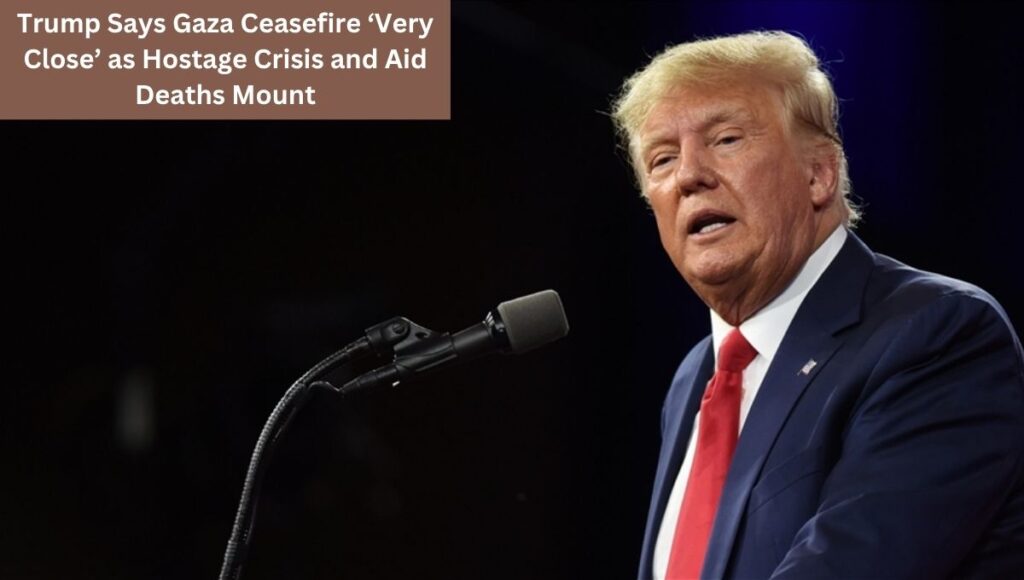
Trump Says Gaza Ceasefire ‘Very Close’ as Hostage Crisis and Aid Deaths Mount
Trump Optimistic Amid Deadlock in Talks
Speaking ahead of the NATO summit in Brussels, Trump said: “I think great progress is being made on Gaza… I spoke to Steve Witkoff, and he told me Gaza is very close.”
Witkoff, Trump’s special envoy, has reportedly been in close coordination with mediators from Qatar and Egypt, who have renewed their push for a truce following the successful de-escalation between Israel and Iran just days earlier.
However, despite Trump’s upbeat tone, the situation remains tense. A senior Hamas official told the BBC that talks are ongoing but no new ceasefire proposal has been received.
An Israeli official echoed the assessment, saying “serious disagreements remain unresolved.”
Hostages Remain Core Obstacle to Ceasefire
The fate of hostages remains central to ceasefire negotiations. Israel resumed its offensive in Gaza on March 18 after Hamas rejected a 60-day truce proposal.
The plan included a phased release of 50 Israeli hostages 20 of whom are believed to be alive but was labeled “totally unacceptable” by Hamas.
The Hostages and Missing Families Forum, representing relatives of those still held in Gaza, said in a statement: “The war in Gaza has run its course. It is being conducted with no clear purpose and no concrete plan.”
According to the Israeli military, 49 hostages remain in Gaza, including 27 confirmed dead.
Gaza Aid Chaos: 549 Dead Near Distribution Sites
As ceasefire negotiations drag on, humanitarian conditions in Gaza have reached catastrophic levels.
The Gaza Health Ministry reported that at least 45 Palestinians were killed on Wednesday alone, including civilians queueing for food near distribution centers operated by the Gaza Humanitarian Foundation (GHF).
Backed by Israel and the U.S., GHF claims to have delivered 44 million meals since May 26, offering an alternative to traditional UN-led aid programs. But it has drawn widespread condemnation.
According to health officials, over 549 people have died and more than 4,000 injured near GHF aid sites since late May. Witnesses allege Israeli forces opened fire on crowds or launched strikes near aid zones.
“These aid points are not aid points. These are death points,” said Abu Mohammed, a Gaza resident whose relatives were killed waiting in line.
UN and UNICEF Condemn “Weaponization of Food”
The United Nations and aid organizations have accused Israel and GHF of turning food into a weapon of war.
Thameen Al-Keetan, a spokesman for the UN human rights office, stated: “Denying access to food and life-sustaining services constitutes a war crime. GHF’s militarized operations violate international humanitarian principles.”
James Elder, a UNICEF representative, added: “So long as a population is denied food, people are being offered this lethal choice. It cannot improve under current conditions.”
Médecins Sans Frontières also accused Israeli forces of increasing their West Bank operations, undermining peace efforts in Gaza.
Qatar and Egypt Renew Mediation Push
Qatar has confirmed it is in contact with all parties and reaffirmed its commitment to ceasefire efforts.
Qatari Foreign Ministry spokesman Majed Al Ansari told CNN: “There was momentum created by the Iran-Israel ceasefire. Now is the time for President Trump to act. We believe he is sincere about it.”
Despite these diplomatic efforts, the situation remains fragile, with no consensus yet between Hamas and Israel.
GCC Blasts Israeli Escalation in Gaza
The Gulf Cooperation Council (GCC) issued a strong condemnation of Israel’s continued military operations during an emergency meeting in Doha.
The statement denounced “the killing of civilians,” criticized the prevention of humanitarian aid, and called on the United States to pressure Israel to end the assault.
Muslim Imran, Director of the Asia Middle East Center for Research and Dialogue, commented: “GCC nations now see Israel as a destabilizing colonial power. Even states with diplomatic ties to Israel are deeply concerned.”
Rising Civilian and Military Casualties
Gaza’s death toll has surpassed 56,000, according to the Hamas-run health ministry, a figure the UN has called credible. The vast majority of these victims are civilians, including children and aid-seekers.
Meanwhile, on Tuesday, seven Israeli soldiers were killed during a reconnaissance mission in Khan Younis after their armored vehicle was hit by an explosive. This brings the Israeli military death toll to 441 since the war began.
The deaths triggered criticism within the Israeli government. Coalition member Moshe Gafni of the United Torah Judaism party said: “I still don’t understand why we are fighting there. Soldiers are getting killed all the time.”
At the funeral of one of the soldiers, Staff Sergeant Ronel Ben-Moshe, a fellow soldier said: “I have seen so many kids like me die. It’s time for it to stop.”
Netanyahu Under Mounting Domestic Pressure
Israeli Prime Minister Benjamin Netanyahu faces growing calls from opposition leaders, coalition members, and the public to end the war.
Opposition leader Yair Golan, head of the Democrats party, said on X (formerly Twitter): “This is the moment to close that front as well. To bring the hostages home. To end the war.”
Analysts believe the recent Iran-Israel ceasefire may force Israel to reassess its strategy in Gaza, especially under intensifying international and domestic scrutiny.
Palestinian Authority and BRICS Join Ceasefire Chorus
The Palestinian Authority, which governs parts of the West Bank, welcomed the Iran-Israel ceasefire and demanded it be extended to Gaza.
A statement from President Mahmoud Abbas’s office read: “We demand the completion of this step by achieving a ceasefire that includes the Gaza Strip.”
The BRICS bloc Brazil, Russia, India, China, and South Africa also issued a joint call for a truce, urging the U.S. to pressure Israel into accepting humanitarian relief terms.
West Bank Escalation Adds to Tensions
While Gaza remains the focal point, violence continues to spread in the West Bank. On Tuesday, Palestinian Prime Minister Mohammad Mustafa convened a cabinet meeting in Ramallah to discuss ceasefire efforts and the humanitarian crisis.
The Cabinet called for a ceasefire that would produce “tangible and just outcomes” and demanded a “complete cessation of Israeli aggression.”
Is a Ceasefire Imminent?
Despite Trump’s optimism and renewed mediation efforts, a formal Gaza ceasefire remains elusive. No new proposals have emerged, hostilities continue, and key demands especially around hostage releases remain unresolved.
Still, diplomatic momentum from the Iran-Israel ceasefire, growing global outrage over civilian deaths, and unprecedented domestic pressure on Israel’s leadership have created a potential opening.
Whether through U.S. pressure, Qatari mediation, or BRICS engagement, the coming days may prove critical. Until then, the humanitarian toll continues to rise with no guaranteed end in sight.
Also Read: Israeli Military Denies Orders to Fire on Gaza Aid Seekers as UN Labels US-Backed Operation ‘Deadly’
Also Read: Trump-backed Gaza aid sites temporarily close after dozens killed in shootings
Related Posts:
- Trump’s 20-Point Gaza Peace Plan Gains Urgent Global…

- Dramatic Moments Behind Trump’s Gaza Peace Push and…

- 5 Powerful Highlights as Trump Lands Second Nobel…

- Trump’s Historic Gaza Ceasefire Deal 2025: A…

- Trump’s Breakthrough Gaza Ceasefire Deal 2025: Key Insights

- Trump’s Historic Gaza Ceasefire Deal 2025 - Powerful…
