

President Xi Jinping’s preferred Limousine, The Hongqi L5: State Car in Which PM Modi Travelled at SCO Summit 2025. When Prime Minister Narendra Modi landed in Tianjin, China, for the Shanghai Cooperation Organisation (SCO) Summit 2025, headlines were not just about diplomacy and speeches. Much of the attention fell on his ride the Hongqi L5, China’s most prestigious limousine and President Xi Jinping’s state car of choice.
This was not a mere detail of protocol. The sight of PM Modi chauffeured in the Hongqi a vehicle steeped in Chinese history, symbolism, and national pride spoke volumes about China’s message to the world and India’s willingness to embrace cultural sensitivity at a delicate diplomatic moment. The Hongqi is not just another luxury car. It is the “Red Flag” of Chinese engineering, political identity, and technological ambition.
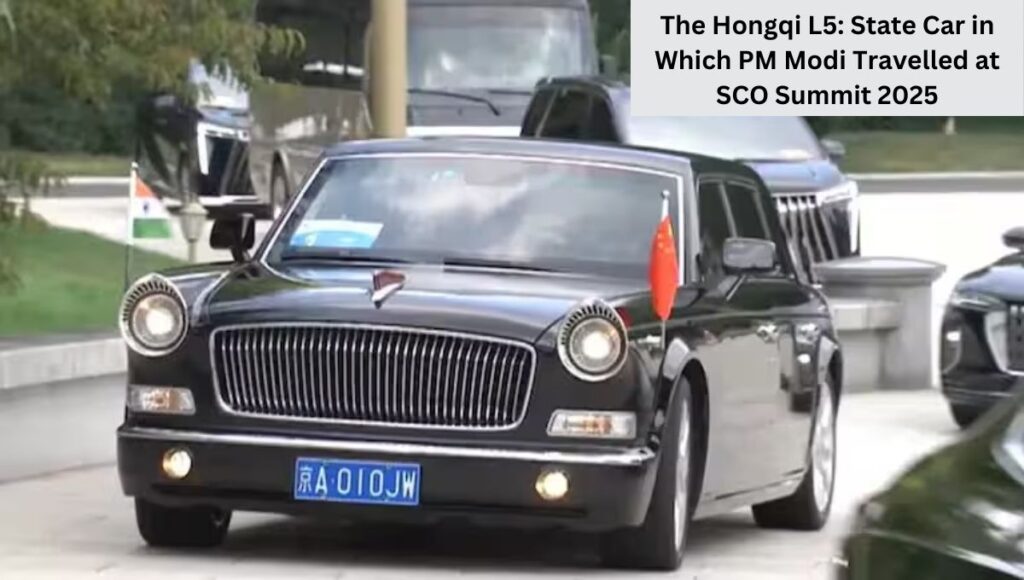
The Hongqi L5: State Car in Which PM Modi Travelled at SCO Summit 2025
What Is Hongqi?
The word Hongqi (红旗), pronounced Hong-chi, translates directly to “Red Flag” in Mandarin. It is manufactured by First Automobile Works (FAW) Group, China’s oldest passenger car maker, founded in 1958.
From its inception, Hongqi was envisioned as a “Made in China dream car” designed, built, and reserved exclusively for Communist Party leadership.
For decades, ordinary Chinese citizens rarely encountered a Hongqi outside parades, military events, or convoys carrying national leaders and foreign dignitaries.
It was never just a car. It was a rolling symbol of political legitimacy and pride.
Origins and Evolution of Hongqi
The Hongqi story is deeply tied to the history of modern China:
- 1958: The first model, CA72, debuted with a fan-shaped grille symbolizing prosperity.
- 1963–1980: The CA770 became the official state limousine, customized in armoured variants for Mao Zedong and visiting world leaders.
- 1981: Production paused as China leaned on Western technology and foreign cars.
- 1995–2006: Hongqi tried comebacks by rebadging foreign models like the Audi 100 and Lincoln Town Car.
- 2006–2010s: The HQ3, based on the Toyota Crown, failed to make a mark.
- 2013–2015: The L5 limousine was launched, re-establishing Hongqi as the ultimate Chinese state car.
- 2018 onwards: FAW relaunched Hongqi as a luxury identity for China, introducing SUVs, EVs, and ultra-luxury series like the Golden Sunflower.
Today, Hongqi has expanded from being an elite state car into a global luxury brand, marketed as China’s answer to Rolls-Royce and Mercedes-Benz.
Features of the Hongqi L5
The Hongqi L5 is the flagship model, often described as the “Chinese Rolls-Royce.” It combines classical design with cutting-edge engineering, wrapped in symbolism.
Key Specifications:
- Engine: 6.0-litre V12, producing 400+ horsepower.
- Performance: 0–100 km/h in about 8.5 seconds; top speed ~210 km/h.
- Size & Weight: Over 5.5 metres long and 3 tonnes heavy.
- Luxury Interior: Leather upholstery, fine wood, jade inlays, and Chinese cultural motifs.
- Comfort: Heated, ventilated, and massaging rear seats with entertainment systems.
- Technology: All-wheel drive, adaptive cruise control, 360-degree cameras, advanced safety sensors.
- Price: Around 5 million yuan (~₹7 crore).
- Exclusivity: Each L5 is hand-built.
The car is designed to be imposing on the outside and serene on the inside, embodying Chinese tradition and modern sophistication.
Why Xi Jinping Prefers Hongqi
Chinese President Xi Jinping has repeatedly chosen Hongqi over Western luxury brands. His reasons reflect both political symbolism and practical considerations:
- National Pride: Hongqi represents self-reliance and Chinese innovation.
- Symbolism: Choosing Hongqi sends a message of independence from Western luxury goods.
- Security: The Hongqi N701, Xi’s armoured version, is compared to the U.S. President’s Cadillac “Beast.”
- Continuity: Hongqi has been linked with Chinese leaders since Mao Zedong.
When Xi visited Mahabalipuram in 2019 for talks with PM Modi, he rode in a Hongqi L5, reinforcing the car’s role as a tool of diplomacy.
Modi Travels in Hongqi at SCO Summit 2025
For Prime Minister Modi, travelling in the Hongqi L5 in Tianjin carried symbolism far beyond comfort.
It represented:
- Respect for China’s traditions — accepting Hongqi as state transport.
- Diplomatic warmth — signalling goodwill by sharing Xi’s preferred ride.
- Soft power — allowing China to showcase Hongqi as a prestige symbol to the world.
At a time when India and China are cautiously working to de-escalate border tensions, such gestures matter.
Hongqi’s Global Comeback
In the past decade, Hongqi has evolved from a ceremonial car into a rising global brand.
- Sales Growth: From 33,000 units in 2018 to over 411,000 in 2024.
- Product Expansion: Launch of the Golden Sunflower luxury series, EVs, and QM7 minibuses.
- Overseas Push: Plans for 1,000 outlets across Europe, Middle East, Southeast Asia.
This growth reflects China’s ambition: to shift from being a manufacturing hub to a luxury leader on the world stage.
Xi Jinping’s Call at SCO Summit 2025
The SCO Summit in Tianjin was not just about luxury cars. President Xi used the platform to outline his vision for a new world order.
Xi’s Key Points:
- Condemned “bullying behavior” in global politics.
- Criticized U.S. tariffs under Donald Trump.
- Pushed for multilateralism, fairness, and justice.
- Proposed an SCO Development Bank and security centre.
- Highlighted that the SCO’s combined GDP nears $30 trillion.
Xi positioned the SCO as a counterweight to Western-led alliances like NATO, appealing to the Global South.
India-China Relations at the Summit
The summit also signaled a rare thaw in India-China relations.
- PM Modi said ties were moving in a “meaningful direction.”
- Xi emphasized the border issue should not define bilateral ties.
- Both leaders pledged to resume border talks.
- Agreements included resuming direct flights, restarting visa issuance, and reviving Kailash Mansarovar Yatra.
The symbolism of Modi riding in the Hongqi, combined with these agreements, indicated cautious rapprochement.
Modi-Putin Meeting in Tianjin
On the sidelines, PM Modi also met Russian President Vladimir Putin.
Agenda:
- Strengthening energy cooperation.
- Balancing bilateral trade.
- Reducing barriers for Indian exports to Russia.
Significance:
- India is carefully balancing ties with Russia and China, despite U.S. pressure.
- Putin is expected to visit India in December 2025 for the annual summit.
This trilateral India, Russia, China underlines the growing weight of the SCO bloc in global politics.
Handshakes, Hugs, Smiles: Modi, Putin, Xi Bonhomie
The SCO Summit 2025 turned into a stage of powerful optics.
- Modi and Putin greeted with a handshake and hug, reflecting personal rapport.
- Xi joined them for animated conversation, smiles, and laughter.
- The moment echoed a similar BRICS Summit in 2018.
These images underscored solidarity among the three Eurasian powers, even as the U.S. turned up pressure with tariffs and sanctions.
Also Read: India at the SCO Summit: One Platform, Multiple Messages
The Modi-Xi Meeting: A Step Forward
PM Modi’s 50-minute bilateral with Xi was the highlight.
Key takeaways:
- Both pledged to resolve border differences peacefully.
- Agreed on mutual trust, respect, and sensitivity.
- Committed to resuming trade, flights, visas, pilgrimages.
- Cooperation pledged in counter-terrorism and fair trade.
This was Modi’s first China visit in seven years, after tensions following the 2020 Galwan clashes.
SCO Summit 2025: Optics That Matter
Beyond speeches, visuals defined the summit:
- Modi, Putin, Xi together, projecting unity.
- Pakistan’s PM Shehbaz Sharif standing alone in group photos, highlighting isolation.
- India’s strategic autonomy visibly reaffirmed.
Such optics reinforced the shifting centre of gravity in Eurasia, with SCO powers leaning closer.
Modi Invites Xi to BRICS Summit 2026
During talks, PM Modi invited Xi Jinping to the BRICS Summit 2026 in India. Xi accepted warmly, showing readiness to build on recent thaw.
Top 10 Takeaways from Modi-Xi Engagement
- India and China reaffirmed they are partners, not rivals.
- Direct flights to resume soon.
- Kailash Mansarovar Yatra to restart.
- Border disengagement efforts recognized.
- Xi reiterated India and China are “friends and good neighbours.”
- Commitment to long-term stability in ties.
- Agreement on reopening border trade.
- Economic cooperation viewed as mutually beneficial.
- People-to-people exchanges to be rebuilt.
- Strategic reset could reshape India-U.S. dynamics.
Hongqi: More Than Just a Car
The Hongqi L5 encapsulates China’s transformation:
- From isolation to global ambition.
- From dependency to self-reliance.
- From national prestige to global luxury recognition.
For Xi, it is a statement of sovereignty and power.
For Modi, riding in it at the SCO Summit was a gesture of respect and pragmatism.
Conclusion: What This Means for Global Politics
The Tianjin SCO Summit 2025 marked more than a diplomatic gathering. It revealed:
- India-China reset after years of frost.
- India-Russia resilience despite U.S. sanctions.
- China-Russia partnership projecting strength.
- Global South solidarity challenging Western dominance.
The image of PM Modi in the Hongqi L5 Xi Jinping’s state limousine perfectly captured the moment: a mix of symbolism, diplomacy, and geopolitical realignment. The car was not just transport. It was a statement of history, ambition, and future direction.
Also Read: California Governor Gavin Newsom Mocks Donald Trump with PM Modi, Putin, Xi Jinping SCO Summit Video
Related Posts:
- China Hosts SCO Summit 2025 and Military Parade as…
- Meet Xiao He: Humanoid Robot Assisting Journalists…

- Putin in China for SCO Summit 2025: Russia and China…
- PM Modi, Xi Jinping, Putin Will Join 20 World…
- ‘Dragon and Elephant Must Come Together’: PM Modi…
- Xi and Putin Unite at SCO Summit as China Pushes…
