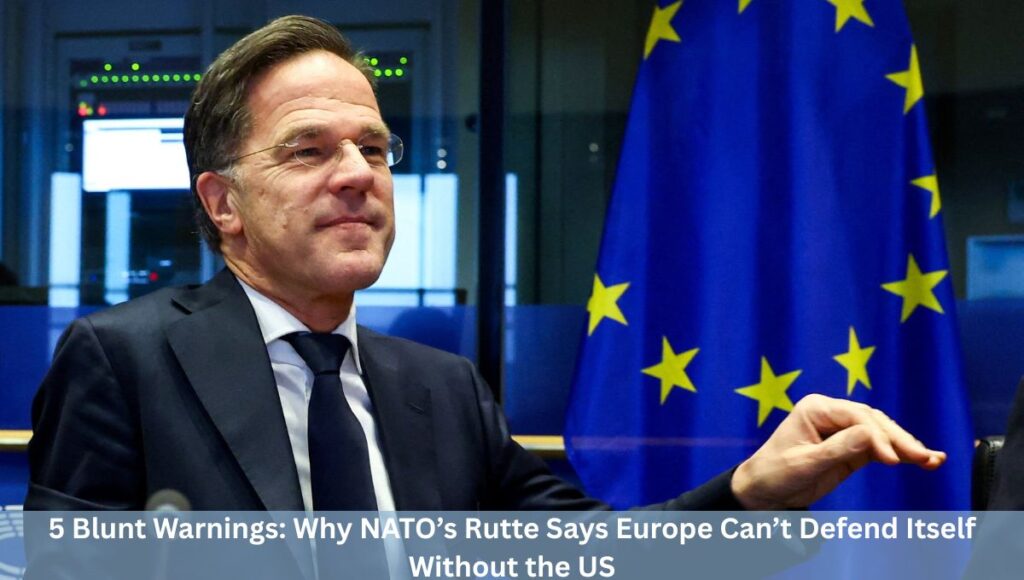
5 Blunt Warnings: Why NATO’s Rutte Says Europe Can’t Defend Itself Without the US, triggering a fierce debate. NATO Secretary General Mark Rutte has ignited a major political and strategic debate across Europe after bluntly declaring that the continent cannot defend itself without the United States.
Speaking before lawmakers at the European Parliament on Monday, Rutte dismissed growing calls for European strategic independence, saying that any belief Europe could stand alone militarily was unrealistic.
“If anyone thinks here again, that the European Union, or Europe as a whole, can defend itself without the US – keep on dreaming. You can’t,” Rutte said.
The remarks come at a moment of heightened tension within NATO, following a turbulent diplomatic episode involving Greenland, renewed pressure from US President Donald Trump, and intensifying debates inside Europe about defence spending, sovereignty, and reliance on Washington.
5 Blunt Warnings: Why NATO’s Rutte Says Europe Can’t Defend Itself Without the US
Why Rutte’s Comments Matter
Rutte’s statement goes to the heart of a long-running and increasingly urgent question:
Can Europe truly defend itself without American military backing?
The issue has gained momentum as:
- The United States has repeatedly demanded higher European defence spending
- Trump has openly questioned the costs of protecting Europe
- Calls for “strategic autonomy” have grown louder in France and Brussels
- Security concerns have escalated in Eastern Europe and the Arctic
By saying “keep on dreaming,” Rutte did not merely express an opinion — he drew a hard line in a debate that is already dividing Europe’s political leadership.
Greenland Tensions and the US Factor
Rutte’s comments came just days after President Donald Trump scrapped tariffs on European allies, claiming he had reached a framework agreement with NATO regarding Greenland’s future.
Greenland, a semi-autonomous territory of Denmark, has become a flashpoint after Trump renewed his controversial interest in acquiring the strategically located Arctic island.
Trump’s threats — including punitive trade measures — alarmed European leaders and pushed NATO to intervene diplomatically.
Rutte confirmed that he and Trump had agreed on two “workstreams” to manage the crisis and prevent a deeper rupture between the US and Europe.
The ‘Two Workstreams’ Explained
1. NATO Takes the Lead in Arctic Defence
According to Rutte, the first workstream places NATO at the center of Arctic security, expanding the alliance’s role in the region.
“One workstream is for NATO collectively, to take more responsibility for the defence of the Arctic,” Rutte told European lawmakers.
The objective is to counter Russian and Chinese expansion — both militarily and economically — as melting ice opens new shipping lanes and access to resources.
Rutte openly praised Trump for forcing attention onto the Arctic, even while acknowledging that defending the US president would irritate many European lawmakers.
2. US–Denmark–Greenland Talks Without NATO
The second workstream involves direct talks between the United States, Denmark, and Greenland — talks in which NATO has no formal role.
Rutte stressed that he has no mandate to negotiate on behalf of Denmark, and insisted he would not interfere in the trilateral discussions.
This clarification was aimed at pushing back against criticism that NATO had enabled or legitimised Trump’s ambitions over Greenland.
Why Greenland Matters So Much
Greenland is the world’s largest island, located between North America and the Arctic, making it strategically vital.
Key reasons for US interest include:
- Missile early-warning systems
- Monitoring Russian and Chinese naval movements
- Control of Arctic shipping routes
- Access to rare earth minerals
During the Cold War, the US even considered placing nuclear weapons on the island, a plan abandoned due to technical challenges and Danish opposition.
Today, the Arctic is once again a frontline in great-power competition.
Europe’s Defence Spending Dilemma
Rutte argued that Europe’s current military posture makes independence from the US unrealistic.
At NATO’s summit in The Hague last year, European allies (except Spain) and Canada agreed to Trump’s demand to raise defence spending to:
- 3.5% of GDP on core defence
- 1.5% of GDP on security-related infrastructure
- Total: 5% of GDP by 2035
But Rutte warned that even this would not be enough if Europe wanted to “go it alone.”
“If you really want to do it alone, forget 5%. It will be 10%,” he said.
The Nuclear Question
Perhaps the most controversial part of Rutte’s speech was his blunt reference to nuclear deterrence.
Europe, he said, would have to build its own nuclear capability if it severed reliance on the US.
“You would lose the ultimate guarantor of our freedom, which is the US nuclear umbrella. That costs billions and billions of euros,” Rutte warned.
Without America, Europe would face:
- Enormous financial costs
- Political resistance to nuclear expansion
- Years — if not decades — of capability gaps
Backlash Across Europe
Rutte’s remarks immediately triggered strong reactions — particularly in France, the leading champion of European “strategic autonomy.”
France Pushes Back
French Foreign Minister Jean-Noël Barrot publicly rejected Rutte’s position:
“Europeans can and must take charge of their own security. It is the European pillar of NATO.”
Deputy European Affairs Minister Benjamin Haddad echoed the sentiment, pointing out that Europe is already the largest donor to Ukraine, not the US.
“Europeans are not weak. We have the tools. We have the instruments,” Haddad said.
‘Trump Is Not My Daddy’
Former European Council President Charles Michel delivered one of the sharpest rebukes, mocking Rutte for his perceived deference to Trump.
“Europe will defend itself. And Donald Trump is not my daddy,” Michel wrote.
French MEP Nathalie Loiseau went further, calling Rutte’s intervention “disgraceful” and accusing him of trying to impress Trump at Europe’s expense.
European Commission’s Cautious Response
The European Commission sought to strike a more measured tone.
Chief spokesperson Paula Pinho said the focus should be on making Europe:
- More resilient
- Less dependent
- Gradually more autonomous
She pointed to Europe’s reduced dependence on Russian fossil fuels as proof that strategic shifts are possible over time.
Commission President Ursula von der Leyen has also teased a new European security strategy, with special attention to the Arctic.
Rutte Defends the Transatlantic Alliance
Despite the backlash, Rutte doubled down on his message that Europe and the US need each other.
He insisted that Washington’s commitment to NATO’s Article 5 mutual defence clause remains “total,” and stressed that the US has a strong interest in a secure Europe.
Rutte also reminded lawmakers of the sacrifices made by NATO allies in Afghanistan.
“For every two American soldiers who paid the ultimate price, one soldier from an ally or partner did not return home,” he said.
A Deeper Divide Over Europe’s Future
At its core, the controversy exposes a fundamental divide:
- One side argues Europe must stand on its own feet
- The other insists that US military power remains indispensable
Rutte’s remarks did not settle the debate — they intensified it.
As geopolitical instability grows, from Ukraine to the Arctic, Europe now faces a stark choice: move faster toward autonomy or accept continued dependence on Washington.
Conclusion
Mark Rutte’s “keep on dreaming” remark has become a defining soundbite in Europe’s defence debate.
Whether seen as realism or resignation, it underscores an uncomfortable truth:
Europe’s security architecture remains deeply tied to the United States.
With tensions over Greenland, rising defence costs, and political divisions widening, the question is no longer theoretical.
How long Europe can rely on America — and whether it should — may define the next era of NATO and European security.
Also Read: NATO’s Got Daddy Issues: Trump, Rutte, and the Ceasefire Circus
Also Read: Mark Rutte is on collision course with European capitals over NATO