

The first stages of Israel’s Gaza Takeover Plan: What’s Been Achieved and What Comes Next. The war in Gaza has entered a new and decisive stage. Israel’s takeover plan for Gaza City has now moved from preparation into action, with the Israel Defense Forces (IDF) launching preliminary operations on the city’s outskirts.
Thank you for reading this post, don't forget to subscribe!At the same time, Prime Minister Benjamin Netanyahu has accelerated the military timeline, calling up 60,000 reservists and extending the service of another 20,000 soldiers.
This push has triggered strong international criticism, warnings of a worsening humanitarian crisis in Gaza, and renewed condemnation from Hamas, which accuses Israel of deliberately sabotaging ceasefire talks. Below is a full breakdown of what Israel has achieved so far, the details of its takeover plan, Hamas’s response, the mounting civilian toll, and what comes next.
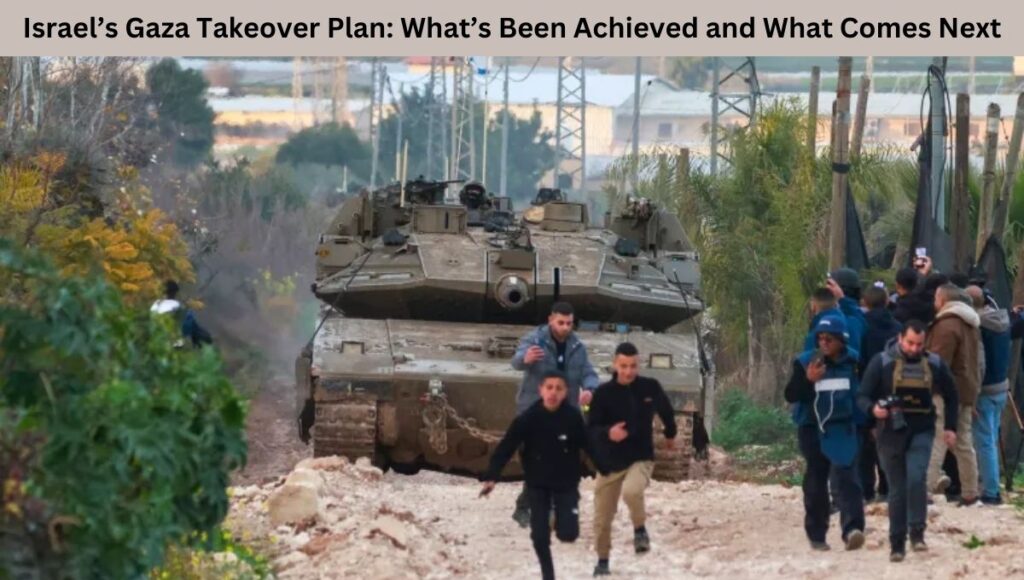
Israel’s Gaza Takeover Plan: What’s Been Achieved and What Comes Next
Gaza Takeover Plan: Where Things Stand
On Wednesday, the IDF confirmed it had begun the first stages of its long-planned offensive to seize Gaza City, the largest urban stronghold of Hamas.
According to IDF spokesperson Brigadier General Effie Defrin, Israeli troops are now entrenched on the outskirts of Gaza City, operating in areas such as Zeitoun and Jabalia, long-time Hamas bastions.
“We have begun the preliminary operations and the first stages of the attack on Gaza City, and already now IDF forces are holding the outskirts,” Defrin said.
Israel’s security cabinet, chaired by Prime Minister Netanyahu, has formally approved plans to seize Gaza City, signaling that the offensive is entering a new, more aggressive phase.
Also Read: Netanyahu Pushes Gaza City Takeover Despite UN Warnings and Rising Civilian Deaths
Israel’s Military Achievements in Gaza So Far
Since the resumption of large-scale ground fighting, the IDF has touted several key military gains. On August 20, the army released a detailed operational update highlighting its progress.
Operational Control of 75% of Gaza
The IDF claims it has operational control over three-quarters of the Gaza Strip, with forces dominating key corridors and supply lines.
Elimination of 2,000 Hamas Fighters
According to Israeli officials, about 2,000 Hamas fighters, including several senior commanders, have been killed in recent months.
Strikes on 10,000 Terror Targets
The IDF reports destroying 10,000 targets, including command centers, weapons depots, and segments of Hamas’s vast tunnel network.
Establishment of Strategic Corridors
Operations codenamed “Morag” and “Magen Oz” were launched to fragment Hamas’s brigades, cut supply routes, and isolate Gaza City.
Simultaneous Operations Across Gaza
Israeli forces say they are conducting simultaneous ground, aerial, and subterranean operations, aiming to cripple Hamas’s command structure.
Military officials argue these achievements have paved the way for the larger and more difficult urban battle inside Gaza City.
Operation Gideon’s Chariots: The Next Phase
Israel’s next steps are being carried out under Operation Gideon’s Chariots B, a multi-stage plan to fully seize Gaza City and dismantle Hamas’s strongholds.
- Reservist Mobilization: 60,000 new reserve orders have been issued, with another 20,000 soldiers having their service extended.
- Troop Deployment: Five IDF divisions and 12 brigade-level combat teams will participate, backed by artillery, armored vehicles, and combat engineers.
- Urban Encirclement: The IDF aims to encircle Hamas strongholds in northern Gaza, then push deeper into Gaza City.
The IDF says that reservists will relieve active-duty personnel, allowing frontline brigades to spearhead the urban assault.
Netanyahu Pushes for Shorter Timelines
Facing both domestic pressure and international criticism, Prime Minister Benjamin Netanyahu has shortened the operational timeline for the Gaza City takeover.
His office confirmed this week that he is pushing the IDF to accelerate its advance. Netanyahu has insisted that “full control of Gaza” is essential to:
- Defeat and dismantle Hamas.
- Free the remaining hostages.
- Prevent future attacks on Israel.
However, critics argue that this rush risks spiraling into a deep humanitarian disaster, worsening conditions for Gaza’s 2.3 million residents.
Hamas’s Reaction: Accusing Israel of Brutality
In a statement on Telegram, Hamas condemned Israel’s Gaza takeover plan, accusing Netanyahu of deliberately blocking peace efforts.
“Netanyahu’s disregard for the mediators’ proposal proves that he is the real obstructionist of any agreement. His brutal war continues against innocent civilians in Gaza City.”
Hamas claims it has accepted a 60-day ceasefire proposal, which includes the release of Israeli hostages in exchange for Palestinian prisoners. Israel, however, has not formally accepted the deal.
The Humanitarian Toll: Gaza on the Brink
The Gaza war’s humanitarian cost continues to mount.
- Palestinian casualties: More than 62,000 Palestinians have been killed since October 2023, according to Gaza health officials. Most are women and children.
- Israeli casualties: About 1,200 Israelis were killed in Hamas’s October 7 attack, with 251 hostages taken. Dozens remain captive.
- Displacement: Nearly all of Gaza’s population has been displaced multiple times. Refugee camps, schools, and hospitals have been destroyed.
- Starvation: The United Nations has warned of famine. At least 266 deaths, including 122 children, have been directly linked to starvation.
The International Committee of the Red Cross (ICRC) warned that intensifying the Gaza offensive could deepen an “irreversible humanitarian crisis.”
Israeli Troops Clash with Hamas Fighters
The challenges of urban warfare remain evident. On Wednesday, IDF troops clashed with Hamas fighters near Khan Younis, south of Gaza City.
Fifteen Hamas militants reportedly emerged from tunnel shafts and launched attacks with small arms and anti-tank missiles. The IDF confirmed that one Israeli soldier was critically injured and two others lightly wounded.
The Al-Qassam Brigades, Hamas’s military wing, claimed responsibility, saying one of its fighters detonated explosives among Israeli troops.
This incident highlights the dangers Israel faces in Gaza’s dense urban and subterranean battlefield.
Evacuation Orders and Civilian Displacement
As Israel pushes into Gaza City, hundreds of thousands of civilians are expected to receive evacuation orders. The IDF has promised to issue warnings before advancing into populated areas.
But humanitarian groups stress that such warnings are often ineffective. Past “safe zones” have also been bombed.
Mahmoud Bassal of Gaza’s Civil Defence agency described the situation in neighborhoods like Zeitoun and Sabra as “very dangerous and unbearable.”
On Wednesday, 25 people were killed, including children, in airstrikes on the Shati refugee camp.
International Reaction: Growing Alarm
Israel’s Gaza takeover plan has drawn intense global criticism.
- France’s President Emmanuel Macron warned the offensive “can only lead to disaster for both peoples.”
- UN Secretary-General António Guterres urged an immediate ceasefire, warning of “inevitable death and destruction.”
- Australia, Canada, and France have voiced support for recognizing a Palestinian state while condemning Israel’s settlement expansion.
Humanitarian organizations say civilians are “utterly exhausted” after nearly two years of war and displacement.
Also Read: Several countries slam Israel’s plan to occupy Gaza; warn of more bloodshed
Ceasefire Talks: Stalled Yet Ongoing
Despite the escalation, mediators from Qatar and Egypt continue efforts to secure a ceasefire deal.
The proposed agreement includes:
- A 60-day truce in fighting.
- Release of at least 10 Israeli hostages.
- Exchange of Palestinian prisoners.
- Negotiations for a permanent ceasefire.
Hamas says it has accepted the plan. Israel remains hesitant, demanding the release of all hostages at once.
Hostage families inside Israel have grown increasingly vocal, urging Netanyahu to accept the deal rather than prolong the war.
Settlement Expansion in the West Bank
Even as the Gaza war dominates headlines, Israel approved a new settlement project in the West Bank.
Finance Minister Bezalel Smotrich hailed the plan as a direct challenge to international recognition of Palestinian statehood.
“The Palestinian state is being erased from the table not with slogans but with actions,” Smotrich declared.
The move has drawn condemnation from Western governments, who warn it could permanently undermine prospects for a two-state solution.
Trump, Netanyahu, and Global Politics
Former U.S. President Donald Trump has expressed strong support for Netanyahu, praising him as a “war hero” and calling for Hamas to be “destroyed.”
Meanwhile, countries like Australia have taken a harder stance against Israel, even revoking the visa of far-right Israeli politician Simcha Rothman.
This divide underscores the polarized global politics surrounding the Gaza war.
Conclusion: A Critical Crossroads
Israel’s Gaza takeover plan marks a turning point in a war that has already devastated the Strip and inflamed regional tensions. While Israel touts major military gains and insists on the need for total control of Gaza, humanitarian agencies warn of catastrophic consequences if the offensive expands into Gaza City.
With 60,000 reservists mobilized, Hamas promising fierce resistance, and mediators struggling to secure a ceasefire, Gaza stands at a critical crossroads one that could decide not only the future of the Strip, but also the trajectory of Israeli-Palestinian relations for years to come.
Related Posts:
- Trump’s 20-Point Gaza Peace Plan Gains Urgent Global…

- Israel–Hamas Ceasefire Under Strain: 4 More Hostage…

- Afghanistan–Pakistan War 2025: Inside the 48-Hour Ceasefire

- 7 Alarming Facts About Super Typhoon Fung-wong

- Netanyahu Orders Gaza Hostage Talks as Israel Pushes…

- 5 Key Developments as Israel Confirms Hamas Handed…
