

President Trump pushes for a historic Putin–Zelensky Summit: Where Could Peace Talks Happen? The possibility of Russian President Vladimir Putin and Ukrainian President Volodymyr Zelensky meeting face-to-face has once again sparked global debate.
Thank you for reading this post, don't forget to subscribe!With U.S. President Donald Trump pushing for direct negotiations, speculation is mounting over where such a historic summit could take place and whether it could realistically bring the war in Ukraine closer to an end.
Although Russia has yet to confirm any plans, Trump has made it clear that the White House is exploring potential venues for a meeting. But given Putin’s international isolation, the ICC arrest warrant against him, and the enormous political stakes, the choice of location is fraught with both symbolism and controversy.
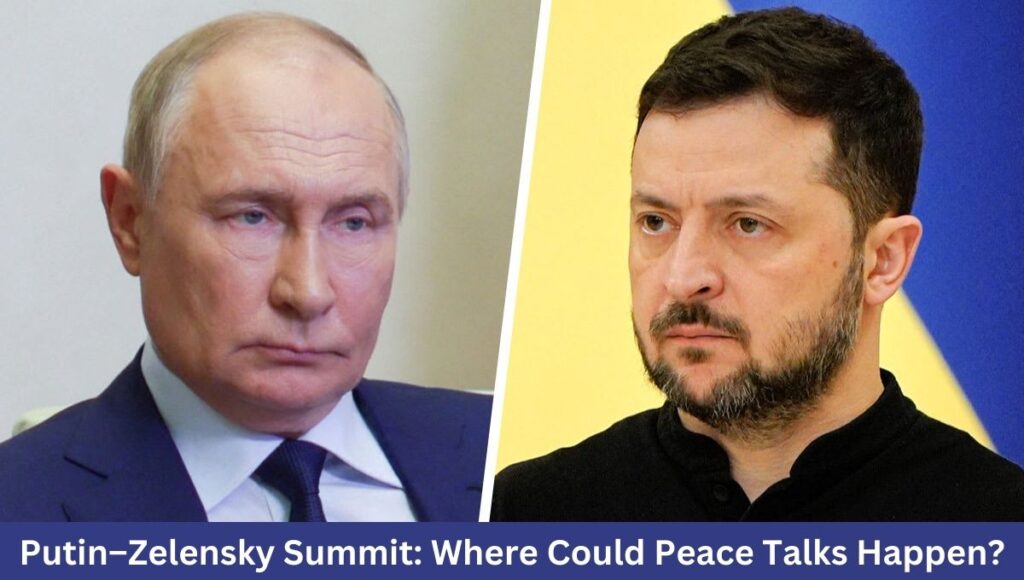
Putin–Zelensky Summit: Where Could Peace Talks Happen?
Trump’s Push for a Putin–Zelensky Meeting
President Trump has cast himself as a potential dealmaker in the war. Following his meeting with Putin in Alaska and his hosting of Zelensky alongside European leaders in Washington, Trump has been vocal about arranging a direct Putin–Zelensky summit.
Initially, he suggested a three-way meeting involving himself. However, he has since shifted position, claiming that it “would be better” if the two leaders met alone first, leaving the option open for him to join later “if necessary.”
Speaking on Fox News, Trump admitted that solving the Russia–Ukraine conflict was “a tough one” but emphasized his instinct for diplomacy.
He also confirmed that he spoke privately with Putin after his White House meeting with European leaders, describing the call as “very good” and revealing that Putin “very happily” accepted the idea of future talks.
Kremlin Reaction: Playing for Time
The Kremlin’s response has been predictably cautious. Putin reportedly told Trump he was open to a meeting with Zelensky, but Russian Foreign Minister Sergey Lavrov quickly tempered expectations, warning that any summit would require “gradual preparation, step by step.”
This reflects Moscow’s well-worn diplomatic playbook: show vague openness to talks while delaying actual commitments.
Kremlin officials, including UN Deputy Ambassador Dmitry Polyanskiy, have stressed that any talks must avoid becoming “a meeting for the sake of a meeting.”
Putin even suggested Moscow as a possible venue something both Zelensky and the U.S. rejected outright.
Where Could the Putin–Zelensky Summit Be Held?
Finding a suitable location for a potential Putin–Zelensky meeting is proving to be one of the thorniest issues.
Because of the ICC warrant against Putin, options are limited to countries that are not signatories to the Rome Statute, or that are willing to bend rules in the name of diplomacy.
Here are the top contenders:
Budapest, Hungary
The White House has confirmed that Budapest is being considered as a possible venue, with Hungarian Prime Minister Viktor Orbán reportedly supportive.
Hungary is one of the few EU states maintaining close ties with Moscow, and Orbán has long advocated opening negotiations with Putin.
However, Budapest carries symbolic baggage. In 1994, it hosted the signing of the Budapest Memorandum, which offered Ukraine security guarantees from Russia, the U.S., and the UK in exchange for giving up its nuclear arsenal. Those guarantees famously failed in 2014 and 2022.
Polish Prime Minister Donald Tusk has openly warned against Budapest, calling it a “cursed place” for Ukraine.
Geneva, Switzerland
Switzerland, famous for its neutrality, has offered to host peace talks despite being an ICC signatory. Foreign Minister Ignazio Cassis said Putin could attend “if he comes for peace purposes.”
French President Emmanuel Macron has also floated Geneva as a potential location, emphasizing its symbolic role as a center of international diplomacy.
However, Geneva could raise logistical and legal headaches given Putin’s ICC status.
Istanbul, Turkey
Turkey has hosted multiple rounds of Russia–Ukraine talks in the past, making Istanbul a natural candidate.
Turkish President Recep Tayyip Erdoğan has maintained channels of communication with both Moscow and Kyiv, while positioning himself as a mediator.
Earlier this week, Erdoğan spoke directly with Putin about Ukraine, reinforcing speculation that Istanbul may emerge as the most practical option.
Minsk, Belarus
Belarusian President Alexander Lukashenko has offered Minsk as a venue. In the past, Minsk hosted negotiations that produced the now-defunct Minsk Accords.
But given Belarus’s role as a staging ground for Russian troops during the invasion, Ukraine is deeply skeptical of Minsk. For Zelensky, meeting in Belarus would amount to entering Putin’s backyard.
Moscow, Russia
Putin himself reportedly proposed Moscow as a venue, though the idea was quickly dismissed. For Zelensky, traveling to Russia during an ongoing war would be politically suicidal.
For the U.S. and Europe, it would symbolize capitulation.
This option is widely regarded as dead on arrival.
Why Putin Hesitates to Meet Zelensky
While Trump is eager to arrange a summit, Putin faces ideological hurdles. Since the invasion began, the Russian leader has derided Zelensky as illegitimate, mocking him as a “clown” and dismissing Ukraine as a fake state.
A face-to-face meeting would contradict Putin’s own narrative. As Orysia Lutsevich of Chatham House notes, “Putin would have to accept the failure of sitting down with a president he considers a joke from a country that doesn’t exist.”
Moreover, Russia’s conditions for peace remain unacceptable to Ukraine, including recognition of annexed territories and the limitation of Kyiv’s Western ties.
Unless Putin’s demands shift, any meeting risks being little more than theater.
Trump’s Dilemma: Broker or Bystander?
Trump has framed himself as uniquely capable of brokering peace, yet his position is delicate. If he pushes too hard for concessions from Ukraine, he risks alienating European allies.
If he fails to extract anything from Putin, he risks being seen as ineffective.
He has already hinted at offering U.S. “air support” if European countries commit ground troops to enforce a ceasefire, though he ruled out American boots on the ground. This suggestion left many European leaders puzzled.
For Trump, the danger lies in overpromising. Having boasted that he could “end the war in 24 hours” during his campaign, he now faces the complexity of realities on the battlefield and in international law.
European Reactions: Hopeful but Skeptical
European leaders are split on Trump’s push.
- Emmanuel Macron called Putin “a predator” and expressed “the greatest doubt” in Moscow’s sincerity.
- Finnish President Alexander Stubb warned that Putin is “rarely to be trusted.”
- Hungary’s Viktor Orbán, however, insists the West must admit that “isolation has failed” and seek direct talks with Russia.
This division underscores a larger problem: Europe’s lack of unity on how to engage Moscow.
The Battlefield Reality: Diplomacy vs. Force
Even as discussions about peace talks swirl, the war grinds on. Russian drone and missile strikes continue to devastate Ukrainian cities, with recent attacks injuring civilians in Odesa and Sumy.
Russia’s military pressure gives Putin little incentive to make concessions at the negotiating table. For Kyiv, meanwhile, conceding territory remains a red line.
This deadlock suggests that even if a summit takes place, it may serve more as a symbolic gesture than a breakthrough.
Putin’s Strategy: Delay and Divide
Analysts argue that Putin’s approach is to delay meaningful negotiations while maintaining pressure.
By dangling the possibility of talks, he creates divisions among Ukraine’s allies and buys time for Russia to consolidate its battlefield gains.
Tatiana Stanovaya of the Carnegie Russia Eurasia Center put it bluntly:
“Trump is seen as an enabler of the Russian vision of the settlement.” Moscow hopes Trump will pressure Kyiv into compromising.
The Last Putin–Zelensky Meeting: Paris 2019
It’s worth recalling that Putin and Zelensky last met in 2019 at the Normandy Format Summit in Paris.
That meeting produced agreements to disengage troops and hold elections in occupied territories but none of the promises materialized.
The failure of those talks underscores the difficulty of reconciling Russia’s demands with Ukraine’s sovereignty.
Conclusion: A Summit or a Stalemate?
As Trump pushes for a Putin–Zelensky summit, the world is left wondering whether such a meeting could deliver results or simply serve as a photo opportunity. The potential venues from Budapest and Geneva to Istanbul and Minsk reflect the geopolitical complexity surrounding the Ukraine war.
Each option carries risks, symbolism, and political baggage. Ultimately, the obstacle is not the location but the fundamental clash of demands: Russia insists on recognition of its territorial gains, while Ukraine insists on sovereignty and justice. Until those positions shift, even the most carefully choreographed summit may prove to be little more than diplomatic theater.
Also Read: 7 Shocking Moments from Trump’s ‘Destroy You’ Ultimatum to Ukraine
Also Read: Ukraine President Volodymyr Zelensky’s first reaction after Trump-Putin Alaska summit: ‘Will meet…’
Related Posts:
- ICC Issues Arrest Warrants for Taliban Leaders Over…

- Putin’s Shocking Risks Ahead of Trump–Hungary Summit 2025

- US Expanded Sanctions on ICC Judges Over Netanyahu’s…

- US President Donald Trump Fuels Third-Term…

- 12 Explosive Claims as Donald Trump Says Iran War…

- Can the EU and NATO Impose Tariffs on India and…
