After June’s 12-day war, tensions have escalated again as Iran Warns of Renewed War with Israel Amid Missile Threats. Tensions between Iran and Israel have once again reached dangerous levels, with senior Iranian officials openly declaring that the fragile ceasefire in place since June could collapse “at any moment.” The warnings come as Tehran showcases its new missile capabilities and prepares for large-scale military drills, signaling that the region is teetering on the edge of another war.
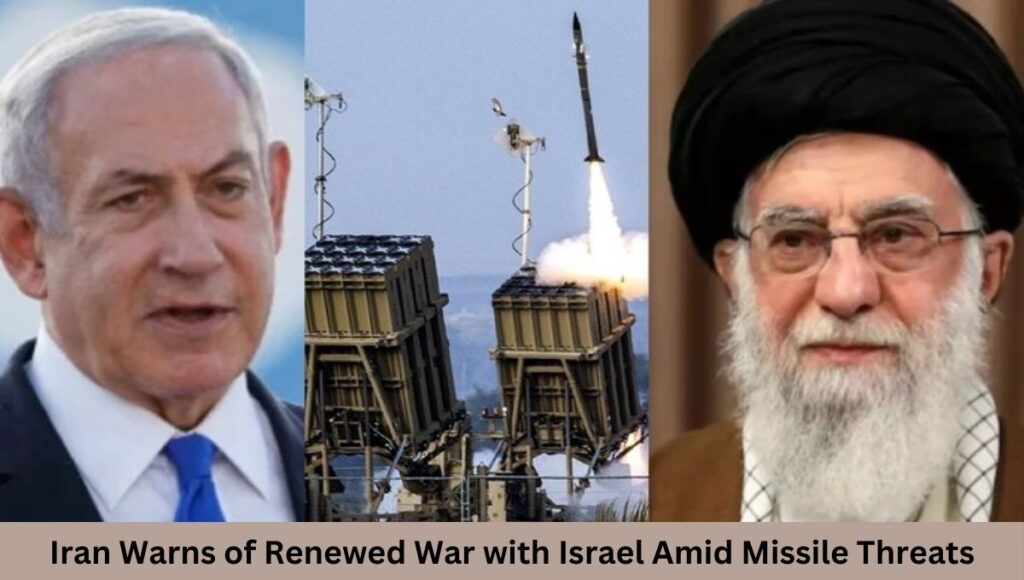
Iran Warns of Renewed War with Israel Amid Missile Threats
The Fragile Pause in Hostilities
In June, the Middle East witnessed a devastating 12-day conflict between Iran and Israel, which began after Israel launched a massive bombing campaign targeting Iranian military installations, nuclear scientists, senior commanders, and even residential neighborhoods.
The strikes killed hundreds, sparking retaliatory missile and drone attacks from Iran. The United States briefly entered the war by targeting Iranian nuclear facilities, escalating fears of a regional conflagration.
On June 24, both sides agreed to a fragile ceasefire. But since then, Iranian leaders have repeatedly stressed that the truce should not be mistaken for peace.
First Vice President Mohammad Reza Aref made the stark statement:
“We are not even in a ceasefire; we are in a cessation of hostilities. We must be prepared at every moment for confrontation.”
Iranian Leaders Warn of Renewed War
In recent days, a series of warnings have poured out from Iranian military, judicial, and political leaders. Yahya Rahim Safavi, senior adviser to Supreme Leader Ayatollah Ali Khamenei, bluntly stated:
“We are not in a ceasefire; we are in a stage of war. No protocol, regulation, or agreement has been written between us and the US or Israel. I think another war may happen, and after that, there may be no more wars.”
Defense Minister Aziz Nasirzadeh revealed that Iran has now developed new missiles with greater capabilities than those used in the June conflict.
“The missiles used in the 12-day war were manufactured years ago,” Nasirzadeh told state-run television. “Today, we have developed missiles with far greater capabilities, and if the Zionist enemy dares to start another adventure, we will undoubtedly use them.”
Judiciary spokesperson Asghar Jahangir echoed these sentiments, warning against trusting “baseless promises” from the United States and Israel. He accused Washington of intensifying its hostility rather than pursuing genuine peace.
Iran’s New Missile Capabilities
Iran’s latest missile arsenal is designed to act as a deterrent against what it calls Israeli adventurism.
Iranian officials have confirmed that the armed forces are preparing for a two-day military drill, where various short- and medium-range cruise missiles will be tested.
This announcement is a direct message to Israel and the United States: Iran is not only replenishing its arsenal but upgrading it.
According to analysts, Tehran now has over 1,600 missiles capable of reaching Israel, giving it the ability to wage a war of attrition.
Western intelligence reports indicate that while Iran can sustain prolonged conflict, Israel is facing shortages in missile defense systems, particularly Arrow 3 interceptors.
This imbalance could complicate Israel’s ability to withstand another wave of sustained Iranian attacks without significant US military support.
Israel’s Objectives in June’s War
Experts argue that Israel’s strikes in June were about more than halting Iran’s nuclear program.
According to Trita Parsi, executive vice president of the Quincy Institute for Responsible Statecraft, Israel’s objectives were threefold:
- Draw the United States into a direct military conflict with Iran.
- Weaken or topple Iran’s leadership.
- Turn Iran into another Syria or Lebanon vulnerable to constant strikes.
Of these, only the first objective partially succeeded. The US briefly joined the conflict but refrained from committing to a prolonged war.
Iran’s leadership survived, and its nuclear program though damaged remains active.
The Nuclear Program Dispute
At the heart of the conflict lies Iran’s nuclear program. Following the June strikes, the US claimed that Iran’s nuclear ambitions had been destroyed.
Tehran strongly rejected that narrative, insisting its program is for civilian use only and not aimed at producing nuclear weapons.
Meanwhile, France, the UK, and Germany have warned Iran that if it does not return to nuclear talks and deliver tangible results by the end of August, UN sanctions may be reimposed.
Iranian Foreign Ministry spokesman Esmaeil Baghaei has linked Israeli aggression to its broader ambitions of a “Greater Israel,” claiming that Israeli expansionism, if unchecked, will drag the Middle East into “endless wars.”
Regional and Global Reactions
Iran’s continued military buildup has raised alarm across the West. France has urged for a comprehensive deal with Tehran that goes beyond its nuclear program and includes its missile capabilities and regional influence.
Tehran, however, has rejected any such conditions, insisting that its defense programs are non-negotiable.
Iranian officials argue that the nation has no choice but to maintain a strong deterrent in the face of repeated Israeli and US threats.
War Preparations on Both Sides
The Iranian Armed Forces General Staff has issued a stern warning that any renewed aggression by Israel or the United States will be met with a “crushing response much stronger” than the June war.
Israel, for its part, has vowed readiness for further strikes, with military leaders declaring that they remain on alert. However, experts believe Israel cannot sustain a prolonged conflict without full US backing.
According to Trita Parsi, Israel is likely to launch another war against Iran before December, perhaps as early as late August.
He warned that Iran, this time, would strike decisively from the outset rather than pacing its attacks, leading to a “far bloodier” conflict.
The US Position
The Trump administration finds itself in a precarious position. While Israel pressures Washington for stronger military involvement, the US president is preoccupied with trade wars, domestic politics, and economic challenges at home.
Analysts suggest that a new war with Iran could become politically disastrous for Washington, especially if it spirals into a prolonged Middle Eastern conflict.
This has led to uncertainty about whether the US would fully commit to backing Israel in a second war.
Could Another War Break Out?
As the end of August approaches, the situation remains volatile. Iran has new missiles, is conducting military drills, and has issued repeated warnings that it is ready to retaliate. Israel, meanwhile, continues to threaten strikes against Iran’s nuclear infrastructure.
Experts remain divided. Some believe that another round of war is inevitable, given Israel’s security concerns and Iran’s refusal to scale back its missile program.
Others argue that both sides may prefer to avoid a costly conflict, at least for now.
What is clear is that the current pause is not a peace, but merely a breathing space in an ongoing struggle that has defined Middle Eastern geopolitics for decades.
Conclusion
The warnings from Tehran, the unveiling of new missile capabilities, and the intensifying rhetoric on both sides all point to one reality: the Middle East remains one misstep away from renewed war. While diplomacy remains a possibility, the absence of trust, the unresolved nuclear dispute, and the ambitions of regional powers make the path to peace increasingly uncertain.
For now, the world watches nervously as Iran and Israel prepare for the possibility of another devastating confrontation one that could reshape the balance of power in the Middle East and drag the United States deeper into conflict.
Also Read: Trump Hails Israeli Strike on Iran as “Excellent,” Warns Tehran to Make a Deal or Face More Attacks
Also Read: Iran warns US intervention in conflict with Israel risks ‘all out war’
Related Posts:
- 3 Explosive Conditions Iran Sets to End War with US…

- 10 Explosive Strikes: Israel Bombs Tehran Oil Depots…

- 10 Explosive Signals: Trump Rates Iran War “15/10”…

- 10 Explosive Signals Trump Says Iran War Could End…
- 10 Explosive Warnings as Donald Trump Calls Iran…

- 7 Explosive Signs Russia Is Quietly Backing Iran in…