As US sanctions blocked banking access, Putin Pays Rs 2.2 Crore Cash to Refuel Jets at Trump Alaska Summit. Russian President Vladimir Putin’s visit to the United States for the high-stakes Alaska summit with Donald Trump turned into an unusual episode that highlights the growing impact of Western sanctions on Moscow.
Reports confirm that Putin’s delegation had to pay $250,000 (about Rs 2.2 crore) in cash to refuel three jets while in Alaska, as they were barred from accessing the American banking system. The episode not only underscores the seriousness of the US sanctions on Russia but also reflects how Moscow is forced to adapt to diplomatic and financial restrictions while continuing its war in Ukraine.
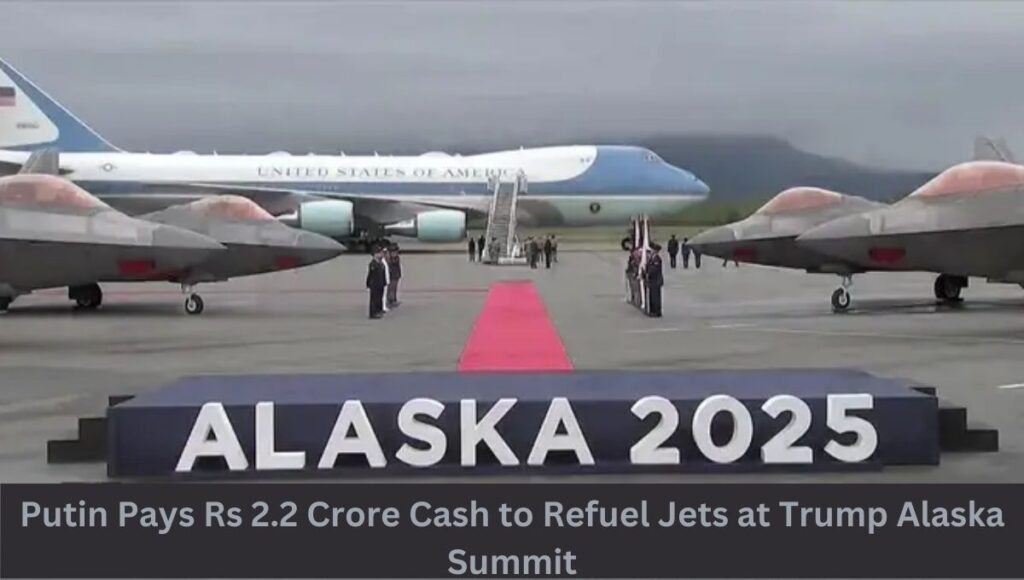
Putin Pays Rs 2.2 Crore Cash to Refuel Jets at Trump Alaska Summit
Why Putin Had to Pay in Cash
US Secretary of State Marco Rubio revealed in an interview with NBC News that Putin’s team had no option but to carry bundles of cash to cover jet fuel costs. “When the Russians landed in Alaska, they were there to refuel.
They had to offer to pay in cash to refuel their aeroplanes because they can’t use our banking system,” Rubio explained.
The sanctions effectively ban Russian officials from using American financial institutions, meaning even routine transactions such as paying for aircraft fuel cannot be processed.
This forced the Russian delegation to make the entire payment in cash before flying back to Moscow.
Sanctions Bite: No Banking Access, No Mobile Services
The incident is not an isolated one. Russian officials and journalists who accompanied Putin to Alaska also reported being unable to use local bank cards or mobile networks during their stay.
This is a direct consequence of sanctions imposed by Washington, which target Russian access to financial systems and technology.
Although US authorities temporarily lifted travel restrictions to allow Putin and his team to attend the Alaska summit, banking and telecom barriers remained in place.
This meant that, despite the red-carpet welcome, the delegation operated under severe limitations.
The Alaska Summit: No Ceasefire Agreement
Putin spent nearly five hours in Alaska, including a three-hour closed-door meeting with US President Donald Trump.
While Trump later described the talks as “productive,” no breakthrough was achieved in terms of securing a Ukraine ceasefire agreement.
Reports suggest Russia floated a proposal that Trump encouraged Ukraine to consider, but Ukrainian President Volodymyr Zelenskyy made it clear that he would not accept any deal involving territorial concessions.
Zelenskyy reiterated his stance during follow-up meetings with Trump and European leaders in Washington, where discussions centered on long-term security guarantees for Kyiv.
Trump’s Mixed Messages on Russia and Sanctions
Following the summit, Trump offered mixed signals on sanctions. While he acknowledged the financial constraints Russia faces, he hesitated to impose additional secondary sanctions.
“I may have to think about it in two or three weeks, but we don’t have to think about that immediately,” he told Fox News.
In a late-night Truth Social post, Trump also doubled down on his long-held view regarding Ukraine and NATO.
He wrote:
“No getting back Obama given Crimea (12 years ago, without a shot being fired!), and NO GOING INTO NATO BY UKRAINE. Some things never change!!!”
This statement sparked fresh concerns among European allies, who fear Trump may soften his stance toward Putin while Ukraine continues to resist Moscow’s aggression.
Zelenskyy: Ready for Talks, But No Territorial Concessions
After the Trump-Putin summit, Trump hosted Zelenskyy and European leaders in Washington.
Zelenskyy indicated that he is open to direct talks with Putin, but firmly rejected any agreement that would involve surrendering Ukrainian land.
“Security guarantees are the key issue,” Zelenskyy told reporters, stressing that Ukraine must have long-term protection against future Russian aggression.
His remarks reinforced Kyiv’s consistent stance that peace can only be achieved on fair and sovereign terms.
Marco Rubio Defends Sanctions, But Admits Limitations
Secretary of State Marco Rubio defended the sanctions regime, noting that all measures imposed before Trump took office remain intact.
He emphasized that sanctions have put Russia under daily pressure, but admitted they have not fundamentally altered the direction of the war.
“Sanctions take months and sometimes years to bite,” Rubio explained. He warned that adding new measures could disrupt delicate diplomatic negotiations and make it harder to bring both sides to the table.
Wider Impact: Trade Tensions with India and Europe
The sanctions drama around Putin’s Alaska trip also unfolded against the backdrop of wider US trade tensions.
Trump recently imposed a 25% tariff on Indian goods over New Delhi’s continued purchases of Russian oil, bringing the total duty to 50%.
India denounced the move as “unfair and unjustified,” warning it could harm key export sectors such as textiles and leather.
Meanwhile, European leaders are reportedly considering tightening their sanctions regime to ramp up pressure on Moscow.
The UK government confirmed that discussions are underway to coordinate additional measures across the European Union.
Symbolism of the Cash Payment
The fact that Putin had to hand over Rs 2.2 crore in cash just to refuel his jets is more than a symbolic gesture it’s a stark reminder of how Russia’s global financial isolation is playing out in real time.
Despite being one of the world’s most powerful leaders, Putin could not rely on international banking systems while traveling on US soil.
This unusual cash transaction has become a powerful symbol of the daily impact sanctions have on Moscow’s operations abroad.
While sanctions alone have not forced Russia into a ceasefire, they have restricted its ability to function normally in international spaces.
What Lies Ahead
The Alaska summit once again highlighted the complexities of the Russia-Ukraine conflict. On one hand, Trump’s willingness to host Putin and Zelenskyy within days of each other shows his desire to play mediator.
On the other, the inability to reach a ceasefire underscores how deep the divisions remain.
For now, sanctions will continue to shape how Russia engages with the outside world. As Rubio pointed out, they may not yield immediate results, but they ensure Moscow faces consequences daily.
The question remains whether these measures combined with diplomatic negotiations can eventually push Putin toward a sustainable peace deal.
Conclusion
Putin’s forced cash payment of Rs 2.2 crore to refuel jets in Alaska is not just an anecdotal inconvenience it is a symbol of Russia’s growing isolation under Western sanctions. The Alaska summit may not have produced a ceasefire, but it revealed the harsh realities of global diplomacy in wartime.
With Ukraine standing firm on sovereignty, Trump navigating contradictory positions, and Europe weighing tougher measures, the road to peace remains uncertain.
Also Read: Trump-Putin Alaska Summit: Putin Demands Donbas, Trump Pushes Ukraine Toward Deal
Also Read: ‘Next time in Moscow?’: Five takeaways after Trump and Putin’s Alaska summit