7 Defining Signals: Zelensky’s Bold Election Offer Amid War and US Pressure—if allies guarantee security.Ukrainian President Volodymyr Zelensky has signaled a dramatic political opening amid the country’s grinding war with Russia, saying Ukraine is prepared to hold national elections within the next 60 to 90 days — if international allies can guarantee security.
The statement, made as Zelensky departed Italy following meetings with European leaders and Pope Leo XIV, comes at a pivotal moment: mounting US pressure, internal legal hurdles under martial law, shifting dynamics in peace negotiations, and renewed global scrutiny over Ukraine’s democratic legitimacy.
Zelensky’s remarks appear aimed at countering accusations from US President Donald Trump, who has suggested that Ukraine is using the war as an excuse to avoid elections — and at reasserting Ukraine’s sovereignty over decisions that strike at the core of its democracy.
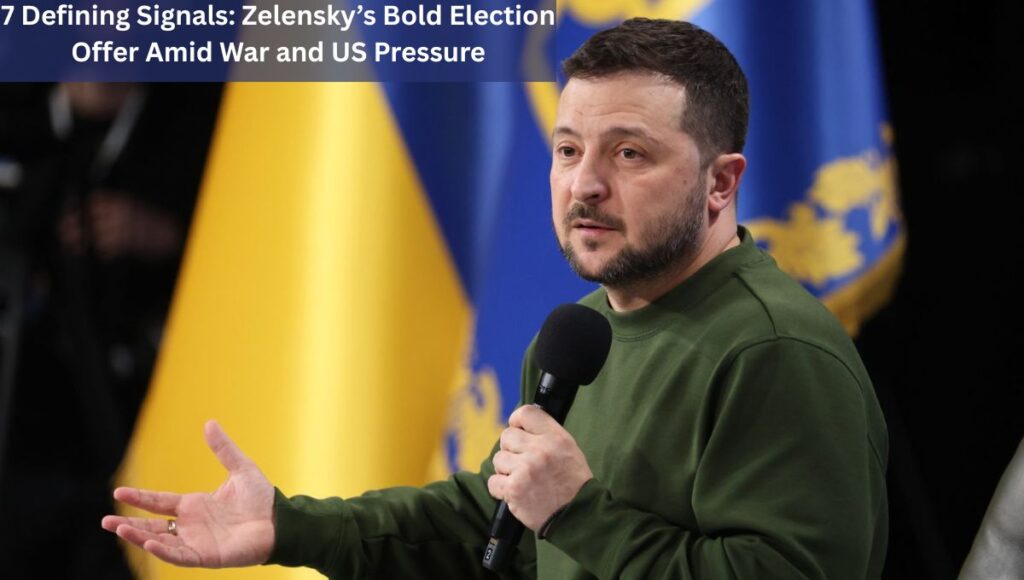
7 Defining Signals: Zelensky’s Bold Election Offer Amid War and US Pressure
A Direct Response to Trump’s Democracy Critique
Speaking to reporters aboard his plane, Zelensky addressed head-on comments made by Trump in a recent interview with Politico, where the US president questioned whether Ukraine could still call itself a democracy without holding elections.
“I am ready for the elections,” Zelensky said. “Not only that — I am openly asking the United States of America, together with our European colleagues, to help ensure security for holding elections.”
Trump had argued that Ukraine’s failure to go to the polls — presidential elections were originally due in March 2024 — undermines democratic legitimacy.
“They talk about a democracy,” Trump said, “but it gets to a point where it’s not a democracy anymore.”
Zelensky pushed back firmly, emphasizing that Ukraine’s current reality — daily missile strikes, drone attacks, and active combat — makes elections logistically and ethically complex.
“How can this be done under missile attacks?” he asked. “The question is, how will they vote?”
Why Ukraine Has Not Held Elections Since 2019
Ukraine last held national elections in 2019, when Zelensky won the presidency. Since Russia’s full-scale invasion in February 2022, the country has been under martial law, which constitutionally prohibits elections during wartime.
This legal framework is not controversial inside Ukraine. Even Zelensky’s political opponents have largely agreed that holding elections under fire would risk chaos, disenfranchisement, and manipulation — potentially benefiting Russia.
Key Barriers to Wartime Elections:
- Constant missile and drone attacks
- Millions of displaced civilians
- Soldiers on active duty at the front
- Occupied territories unable to vote
- Media disruption and infrastructure damage
- Legal prohibition under martial law
Still, international criticism — especially from Washington — has intensified pressure on Kyiv to demonstrate democratic openness.
Zelensky Asks Parliament to Explore Legal Changes
Acknowledging these challenges, Zelensky said he has asked Ukrainian lawmakers to prepare legislative proposals that could allow elections under martial law — an unprecedented step.
“I am asking MPs to prepare proposals regarding the possibility of amending the legislative foundations and the law on elections during martial law,” he said.
However, Zelensky made clear that security guarantees come first. Without credible protection for voters, candidates, polling stations, and election infrastructure, any vote could be invalid, illegitimate, or exploited by Russia.
Security Guarantees: The Core Condition
Zelensky’s proposal shifts the burden onto international partners — particularly the United States and Europe.
“I am now declaring this openly: I am asking the United States, together with our European partners, to help ensure security for holding elections.”
This is more than a procedural request. Analysts interpret it as a strategic move that reframes the election debate:
- If security is guaranteed, Ukraine will hold elections.
- If security is not guaranteed, responsibility lies partly with allies and Russia.
In effect, Zelensky is challenging Washington to match its democratic rhetoric with concrete actions — such as pressuring Moscow toward a ceasefire.
Elections as a Strategic Countermove
By publicly declaring readiness for elections, Zelensky neutralizes two lines of attack:
- Russian claims that Ukraine’s leadership is “illegitimate”
- US criticism that Kyiv is avoiding democratic accountability
At the same time, he avoids unilateral concessions by tying elections to conditions largely beyond Ukraine’s control.
Political observers in Kyiv note another reality: incumbent wartime leaders typically enter elections with strong advantages, including visibility, authority, and public trust forged during crisis.
Peace Talks Intensify Alongside Election Signals
Zelensky’s announcement comes amid renewed diplomatic efforts to end the nearly four-year war.
Following meetings with leaders from Britain, France, Germany, Italy, and the Vatican, Zelensky said Ukraine would soon submit an updated peace proposal to the United States.
“We are working today and tomorrow. I think we will hand it over tomorrow,” he said.
Three Documents Under Discussion
Zelensky said negotiations currently involve three separate frameworks:
- A 20-point peace framework (revised from an earlier US-backed 28-point plan)
- Security guarantees, including responses to future Russian aggression
- Post-war recovery and reconstruction, to be addressed after a ceasefire
Disputes Over the US Peace Proposal
Tensions remain high between Kyiv and Washington over the shape of a final deal.
The US proposal — according to Ukrainian and European officials — includes elements seen as favoring Russia, particularly territorial concessions in eastern Ukraine.
Zelensky rejected these outright. “We have no legal or moral right to cede territories,” he said. “Not under Ukrainian law, our constitution, or international law.”
Crimea: A Rare Acknowledgment of Limits
In a notable shift in tone, Zelensky acknowledged Ukraine currently lacks the military capacity to retake Crimea, which Russia illegally annexed in 2014.
“Today, we do not have the strength for this,” he said. “We do not have sufficient support.” However, he framed this as a temporary military reality — not a recognition of Russian sovereignty.
This admission aligns with growing realism among Ukraine’s allies, while underscoring why security guarantees — not territorial trade-offs — remain Kyiv’s priority.
Europe Pushes Back as Trump Criticizes Allies
Trump’s increasingly confrontational tone toward Europe has further complicated the diplomatic environment.
In his interview, Trump accused Europe of failing to deliver tangible results.
“They talk but they don’t produce,” he said.
European leaders swiftly rejected that narrative.
Pope Leo XIV Speaks Out
After meeting Zelensky, Pope Leo XIV warned that sidelining Europe in peace talks would be dangerous.
“This is a war in Europe,” the pope said. “Trying to reach a peace agreement without Europe is unrealistic.”
He described Trump’s recent rhetoric as threatening a long-standing transatlantic alliance.
Russia’s Narrative and the Legitimacy Question
Russian President Vladimir Putin has repeatedly claimed Ukraine’s leadership lacks legitimacy due to delayed elections.
Zelensky’s announcement directly counters that narrative while exposing the contradiction at its core:
Russia demands elections while continuing attacks that make elections impossible.
Ukrainian parliament has repeatedly affirmed that current institutions remain lawful until elections can safely occur.
Domestic Reaction Inside Ukraine
Within Ukraine, reactions have been cautious but largely supportive. Opposition lawmakers acknowledge Zelensky’s openness while warning against rushed or unsafe polls.
“It would only help the enemy,” said Serhiy Rakhmanin of the Holos party. Civil society groups also stress the importance of inclusivity — ensuring soldiers, displaced people, and citizens under occupation are not excluded.
The Deeper Meaning of Zelensky’s Announcement
Beyond elections themselves, Zelensky’s move carries broader implications:
- It reclaims initiative in talks dominated by US pressure
- It reframes democracy as a shared responsibility
- It forces allies to confront the cost of security guarantees
- It undercuts Russian propaganda on legitimacy
In short, Zelensky is signaling flexibility without surrender.
What Happens Next?
Several outcomes are now possible:
- Security guarantees are provided → Elections proceed within 90 days
- Ceasefire or strike-limitation agreement → Conditions improve for voting
- Security cannot be guaranteed → Ukraine retains democratic legitimacy while shifting responsibility outward
Either way, the announcement ensures that Ukraine’s democratic future is now central to peace diplomacy, not an afterthought.
Conclusion: A High-Stakes Gamble Under Fire
Zelensky’s readiness to hold elections under extraordinary conditions is both bold and calculated.
It answers critics without conceding control, exposes the contradiction of demanding democracy amid war, and forces international partners to confront uncomfortable realities about security, sovereignty, and responsibility.
As the war grinds on and diplomacy intensifies, Ukraine’s offer has reshaped the debate: not whether elections should happen, but what it will take to make them possible. In a conflict defined by force, Zelensky has placed democracy itself on the negotiating table — and challenged the world to protect it.
Also Read: 9 Crucial Revelations as Trump Says Zelenskyy Isn’t Ready for US Peace Plan
Also Read: Ukraine ‘ready for elections’ if U.S. ensures security, Zelensky says
Related Posts:
- Robert Francis Prevost Elected Pope Leo XIV: First…

- Pope Leo XIV Begins Papacy with Inaugural Mass…
- Pope Leo XIV Calls for Global Peace in First Sunday…
- From Chicago to the Vatican: How Pope Leo XIV’s…

- Who Will Lead the Catholic Church Next? A Look at…

- 3 Explosive Conditions Iran Sets to End War with US…