

9 Crucial Revelations as Trump Says Zelenskyy Isn’t Ready for US Peace Plan as talks reach critical stage. US President Donald Trump has openly criticised Ukrainian President Volodymyr Zelenskyy, claiming the Ukrainian leader is not prepared to accept a US-authored peace proposal aimed at ending the Russia–Ukraine war, now approaching its fourth year.
Trump’s remarks came after three days of intensive talks between American and Ukrainian negotiators in Florida, talks meant to narrow differences over the White House’s plan. Instead, the discussions have exposed lingering mistrust, unresolved territorial disputes, and growing political friction between Washington and Kyiv.
Speaking to reporters before attending the Kennedy Center Honors, Trump said he was “a little bit disappointed” that Zelenskyy had not yet reviewed the proposal, despite claims that Ukrainian negotiators had responded positively to its framework.
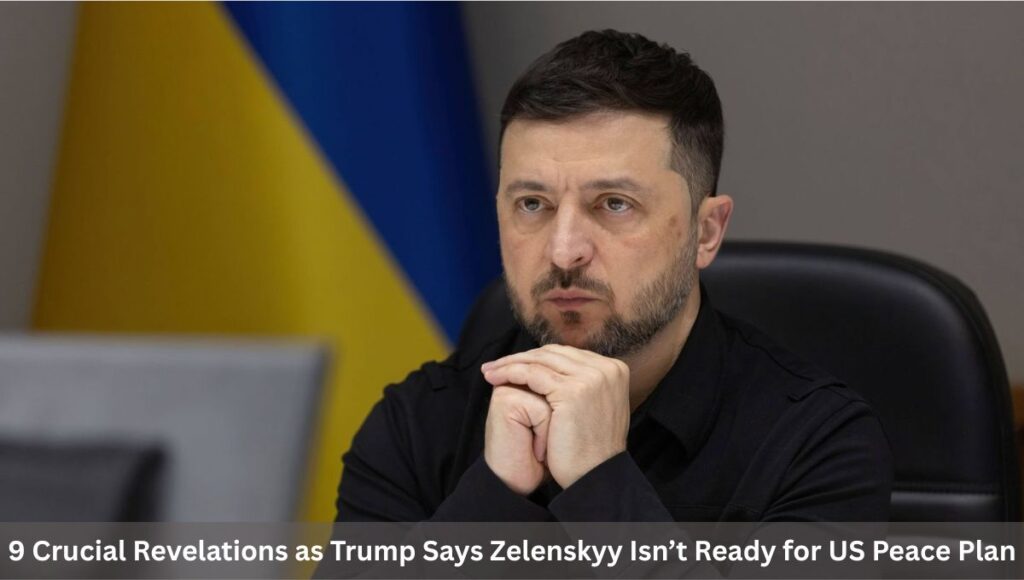
9 Crucial Revelations as Trump Says Zelenskyy Isn’t Ready for US Peace Plan
Trump Voices Frustration With Zelenskyy
Trump did not hide his irritation when asked about the status of negotiations.
“I’m a little bit disappointed that President Zelenskyy hasn’t yet read the proposal, that was as of a few hours ago,” Trump said. “His people love it, but he hasn’t.”
The US president went further, suggesting that Kyiv may now be the main obstacle to concluding the deal.
“Russia is, I believe, fine with it. But I’m not sure that Zelenskyy’s fine with it. His people love it. But he isn’t ready.”
The comments mark one of Trump’s sharpest public criticisms of Zelenskyy since returning to the White House for a second term.
What Is the US Peace Plan?
The US peace proposal, which has gone through several drafts since emerging last month, aims to bring an end to the full-scale invasion Russia launched in February 2022.
While full details of the plan have not been made public, officials and analysts say its key pillars include:
- Territorial compromises involving Donbas
- Arrangements around the Zaporizhzhia Nuclear Power Plant
- Security guarantees designed to prevent renewed fighting
- A broader reset of US–Russia relations
Critics argue the framework heavily favours Moscow, a charge that has followed the proposal since its first draft circulated among allies.
Zelenskyy: Talks ‘Constructive but Not Easy’
President Zelenskyy struck a more measured tone, saying Ukraine remained committed to diplomacy but warning that peace would not come at the expense of sovereignty or accountability. In a social media post, Zelenskyy confirmed he had a “substantive phone call” with American officials involved in the talks.
“Ukraine is determined to keep working in good faith with the American side to genuinely achieve peace,” he wrote.
In a video address, the Ukrainian leader described discussions with Trump’s envoys, including Steve Witkoff and Jared Kushner, as productive but challenging. “It was a constructive conversation, although not easy. We will continue to work.”
Ukraine’s Conditions for Peace
Despite Trump’s claims, Zelenskyy has repeatedly stressed that any peace deal must be “dignified” and rooted in international law.
Key Ukrainian demands include:
- Continued international pressure on Russia
- Accountability for ongoing Russian strikes
- Coordinated negotiating positions among the US, Europe, and NATO allies
- Protection of Ukraine’s territorial integrity
“Ukraine deserves a dignified peace,” Zelenskyy said, adding that peace depends “entirely on Russia, on our collective pressure on Russia, and on the sound negotiating positions of the United States, Europe, and all our other partners.”
Trump’s Hot-and-Cold Relationship With Zelenskyy
Trump’s relationship with Zelenskyy has been uneven and often tense.
Since returning to office, Trump has:
- Repeatedly described the war as a waste of US taxpayer money
- Pressured Ukraine to cede territory to Russia
- Questioned continued American financial and military assistance
- Suggested Kyiv bears partial responsibility for prolonging the conflict
Trump’s blunt approach contrasts sharply with the policies of previous administrations, which framed Ukraine’s defence as central to European security.
Russia’s Lukewarm but Strategic Response
Despite Trump’s claims that Moscow is “fine” with the proposal, President Vladimir Putin has not endorsed it publicly.
In fact, Putin said last week that parts of the plan were unworkable, even as the original draft leaned heavily toward Russian interests.
However, Russia welcomed another major development: the Trump administration’s updated national security strategy.
Kremlin Welcomes New US Strategy
Kremlin spokesman Dmitry Peskov praised the White House document released on Friday, saying it aligned with Moscow’s vision. “There are statements there against confrontation and in favour of dialogue and building good relations,” Peskov said.
He added that Russia hopes the strategy will lead to “further constructive cooperation with Washington on the Ukrainian settlement.” The document states that ending the Ukraine war is a core US interest, essential to re-establishing strategic stability with Russia after years of strained relations.
Donbas: The Central Territorial Stalemate
One of the biggest stumbling blocks remains Donbas, comprising the Donetsk and Luhansk regions.
Why Donbas matters
- Russia controls most of the region
- Moscow illegally annexed it three years ago
- Ukraine considers it sovereign territory
- Any concession risks domestic backlash in Kyiv
Outgoing US Ukraine envoy Keith Kellogg said negotiations are in the “last 10 metres” but hinge largely on terrain — primarily Donbas.
Zaporizhzhia Nuclear Power Plant: A Dangerous Flashpoint
The other major obstacle is the Zaporizhzhia Nuclear Power Plant, Europe’s largest nuclear facility.
- Located in Russian-controlled territory
- Shut down since early in the invasion
- Requires constant cooling to avoid disaster
- Surrounded by military forces
Any agreement involving the plant raises complex questions about sovereignty, safety, and international oversight.
UK, France and Germany Step In
As US-led talks stalled, European leaders moved to engage directly. Officials confirmed that the leaders of the United Kingdom, France, and Germany would meet Zelenskyy in London to discuss next steps.
The move reflects growing concern in Europe that Washington may push a deal that undermines Ukrainian or European security interests.
War Continues Despite Diplomatic Push
Even as negotiations unfold, fighting on the ground shows no sign of slowing.
Over the weekend:
- At least four civilians were killed in Russian attacks
- A drone strike killed a man in Chernihiv
- Missile and drone attacks hit Kremenchuk, causing power and water outages
- Shelling in Kharkiv killed three and injured 10
Ukrainian officials accuse Russia of weaponising winter, targeting infrastructure to deprive civilians of heat and electricity for a fourth consecutive winter.
Trump Jr: US May Walk Away
Adding uncertainty to diplomacy, Donald Trump Jr. suggested the United States could withdraw from peace efforts altogether. Speaking at the Doha Forum, Trump’s eldest son warned that Americans have little appetite for continued funding.
“People don’t want to keep writing cheques,” he said.
He also accused Ukrainian elites of corruption, claims long used by critics of continued Western support. Though Trump Jr. holds no official role, his comments highlight pressure within Trump’s political base to disengage.
Domestic Pressure Inside Ukraine
Zelenskyy also faces challenges at home.
- Continued mobilisation strains society
- Corruption allegations remain sensitive
- Military recruitment and training demands are rising
Zelenskyy stressed the importance of domestic resilience, announcing steps to strengthen combat brigades and expand soldier training.
Is the Peace Plan Close or Collapsing?
Trump’s envoy insists the deal is close. Zelenskyy says talks are ongoing. Russia offers cautious optimism while continuing attacks.
Yet the contradictions are stark:
- Trump claims Russia is ready; Putin says parts are unworkable
- Trump says Zelenskyy hasn’t read the plan; Zelenskyy says talks are substantive
- Diplomacy advances while civilians continue to die
What Comes Next
Several scenarios loom:
- Renewed talks with concessions on territory
- US withdrawal from mediation
- European-led peace framework
- Prolonged stalemate with continued violence
With so much hinging on unresolved questions, the coming weeks may determine whether diplomacy finally ends the war — or merely reshapes it.
Conclusion: Peace at a Crossroads
Trump’s claim that Zelenskyy “isn’t ready” underscores a central truth: ending the Russia–Ukraine war is not just about drafting agreements but reconciling irreconcilable interests. As bombs fall and negotiations stall, the window for a durable peace remains narrow.
Whether the US plan succeeds or collapses may redefine not only Ukraine’s future, but the balance of power in Europe for years to come.
Also Read: 19 Bold Shifts: Inside Zelenskyy’s High-Stakes Talks with Trump on a Revised Ukraine Peace Deal
Also Read: Russia ‘Ready For War’: Putin Warns Europe Against ‘Sabotaging’ Ukraine Peace Plan
Related Posts:
- 5 Powerful Highlights as Trump Lands Second Nobel…

- Trump’s 2025 Gaza Peace Plan Signing and Historic…

- 7 Shocking Reasons FIFA’s Peace Prize for Trump…

- Trump’s 20-Point Gaza Peace Plan Gains Urgent Global…

- 11 Explosive Revelations From Ted Cruz’s Leaked…

- Dramatic Moments Behind Trump’s Gaza Peace Push and…
