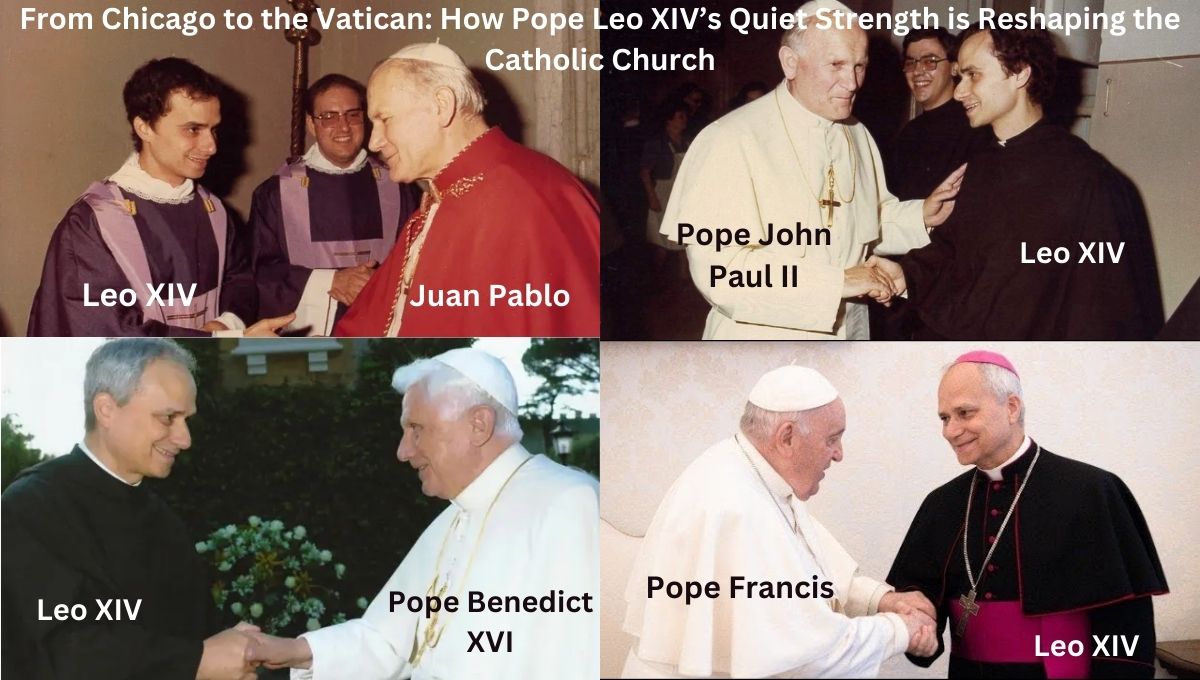
A Humble Journey From Chicago to the Vatican: How Pope Leo XIV’s Quiet Strength is Reshaping the Catholic Church. The rise of Pope Leo XIV, formerly Cardinal Robert Prevost, is more than a personal triumph it’s a reflection of a changing Catholic Church. From his early life in suburban Chicago to his quiet but firm leadership as new pope 2025, Leo XIV’s journey exemplifies service, global vision, and deep-rooted humility.
Known as “Bob” among American friends and “Roberto” in Latin American and European circles, Pope Leo XIV has captivated the global Catholic community with a leadership style that blends pastoral compassion, intellectual rigor, and missionary courage.
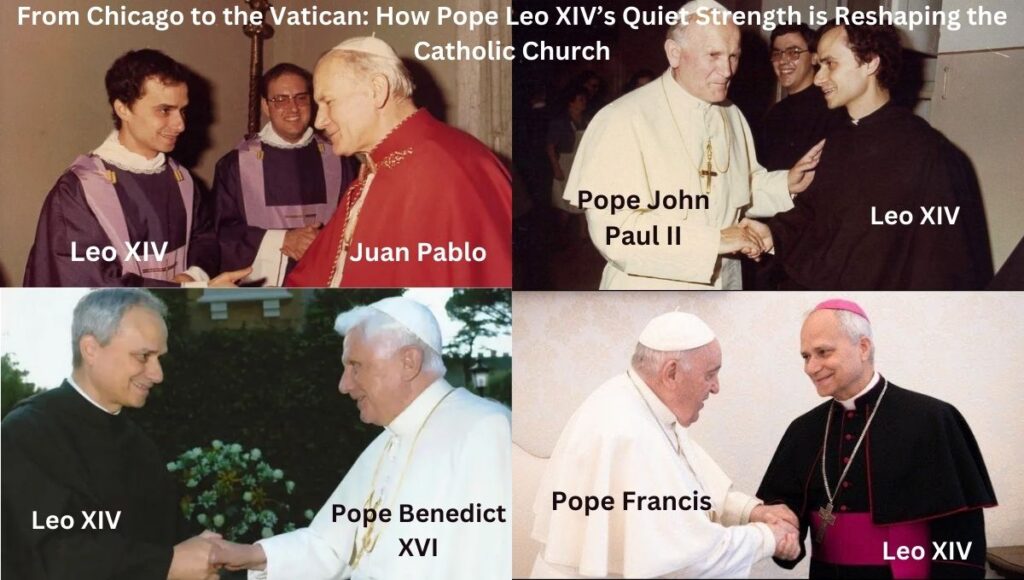
From Chicago to the Vatican: How Pope Leo XIV’s Quiet Strength is Reshaping the Catholic Church
Spiritual Roots in the American Heartland
Born into a devout Catholic family near Chicago’s South Side, Robert Prevost’s path to the papacy began early.
At just 14, he left home to join St. Augustine Seminary High School in Michigan, embracing a disciplined spiritual and academic life.
He later graduated from Villanova University with a mathematics degree and earned his Master of Divinity from the Catholic Theological Union in Chicago.
There, he was influenced by liberation theology, Vatican II reforms, and ecumenical dialogue all of which continue to shape his theology and worldview.
Missionary Courage in the Face of Danger
In 1985, Prevost moved to Peru to begin what would become a defining chapter of his life. As civil unrest rocked the country, the young priest worked in impoverished regions during a time of Shining Path insurgency and authoritarian crackdowns.
Displaying calm conviction, he once confronted armed soldiers trying to forcibly conscript seminarians citing Church laws to protect his flock.
He also organised plays and dramatisations with young Peruvians to promote healing and reconciliation, reinforcing his commitment to the marginalised.
This lived experience of suffering and resilience deeply informed his sense of pastoral responsibility, shaping the future Pope Leo XIV as a leader grounded in real-world compassion.
Rising Through the Augustinian Order
In 2001, Cardinal Prevost was elected to lead the Augustinian order worldwide, based in Rome. Over 12 years, he visited communities across Africa, Asia, and Latin America, engaging clergy and laity alike with sincerity and cultural fluency.
Whether eating balut in the Philippines or listening more than speaking in African villages, his time as a global religious leader established him as a humble yet strategic thinker a rare blend that made him stand out in Vatican circles.
A Return to Peru and the Vatican’s Inner Circle
After his global leadership stint, Pope Francis sent Robert Prevost back to Peru in 2014, appointing him bishop of Chiclayo.
There, he tackled thorny governance issues like financial mismanagement and clergy abuse cases, maintaining transparency and pastoral care.
In 2023, recognizing his administrative acumen and moral integrity, Pope Francis brought him to Rome as head of the Dicastery for Bishops a powerful Vatican office overseeing bishop appointments worldwide.
Later that year, he was elevated to Cardinal Bishop, the highest rank in the College of Cardinals.
The Conclave and Papal Election
With Pope Francis nearing the end of his papacy, the 2025 conclave marked a moment of pivotal transition for the Church.
Despite being American a nationality often considered a disadvantage in papal elections Cardinal Prevost emerged as a frontrunner.
His fluency in English, Spanish, and Italian, and his deep ties to both the Global South and Vatican elite, allowed him to move seamlessly between cultural and theological divides.
His election as Pope Leo XIV reflected a growing demand for pastoral leadership over political theater.
Humility in Action: A Pope for the People
In his early days as Pope Leo XIV, small gestures spoke volumes. He quietly slipped into the Augustinian headquarters near St. Peter’s Square to share a modest lunch with old friends.
When they expressed sorrow at losing his daily presence, he simply replied, “I see one has to give up many things.”
Even his ride back to the Vatican a black Volkswagen Tiguan symbolised his desire to remain grounded, accessible, and humble. It was a striking contrast to the pomp often associated with papal office.
Global Impact and the Road Ahead
Now leading 1.4 billion Catholics across a fractured world, Pope Leo XIV faces unprecedented challenges: climate change, rising authoritarianism, economic inequality, and the moral implications of artificial intelligence.
His experience from confronting soldiers in Peru to leading the Dicastery for Bishops makes him uniquely equipped to navigate these modern crises.
His leadership is expected to prioritize inclusivity, pastoral outreach, and a reaffirmation of Augustinian values: humility, unity, and truth.
A Papacy of Quiet Reform
Pope Leo XIV is not a revolutionary but a quiet reformer. Vatican insiders describe him as deeply spiritual, patient, and incredibly organized. His leadership at the Synod on Synodality, where he bridged English and Spanish-speaking groups, further solidified his reputation as a unifying force.
His continued commitment to service despite occupying one of the most powerful roles in the world offers a model of spiritual authority rooted in humility rather than hierarchy.
Conclusion: Hope and Leadership in Uncertain Times
Whether remembered for his missionary work in Peru, his rise through the Augustinian order, or his administrative prowess at the Vatican, Pope Leo XIV stands out as a pope for the people.
As the Catholic Church enters a new era of global and internal challenges, the leadership of Pope Leo XIV grounded in faith, compassion, and global awareness offers hope to millions.
His story proves that quiet strength, lived service, and authentic humility can still change the world.
Also Read: Pope Leo XIV Calls for Global Peace in First Sunday Address: “Never Again War”
Also Read: Pope Leo XIV to Cardinals: Church must respond to digital revolution