
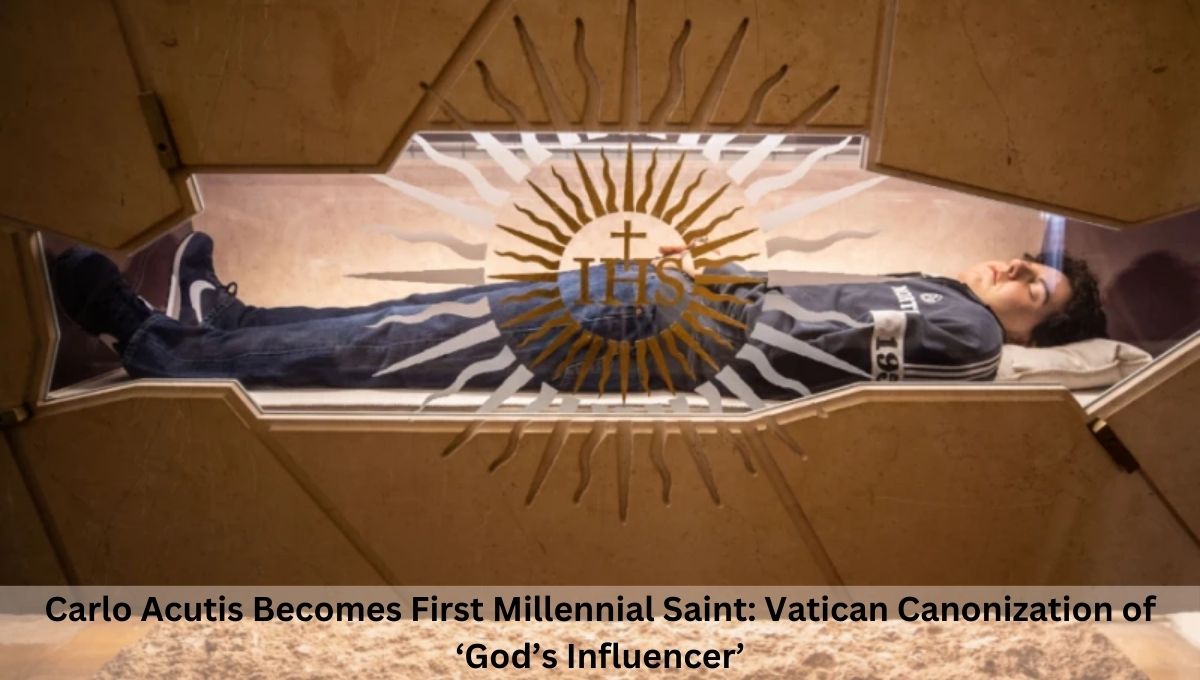
A London-born Italian teenager, Carlo Acutis Becomes First Millennial Saint: Vatican Canonization of ‘God’s Influencer.’ On September 7, 2025, in front of a sea of youthful pilgrims at St. Peter’s Square in Vatican City, history was made. Carlo Acutis, a London-born Italian teenager who died in 2006, was officially declared a saint of the Catholic Church.
Known worldwide as “God’s Influencer”, Acutis was no ordinary candidate for sainthood. He was a millennial, born in 1991, who loved video games, football, pets, and technology. Yet, he used those passions to serve a higher mission: spreading the Catholic faith through digital media.
In a ceremony led by Pope Leo XIV, the Church recognized Acutis as the first millennial saint, a symbol of how holiness can exist in the digital age. Alongside him, Pier Giorgio Frassati, an Italian youth from the 1920s, was also canonized. Together, their lives speak to different generations of young Catholics seeking role models in faith.
This canonization represents more than a religious formality. It is a message to young Catholics around the world: holiness is possible in modern times, even while wearing jeans, sneakers, and carrying a PlayStation controller.
Carlo Acutis Becomes First Millennial Saint: Vatican Canonization of ‘God’s Influencer’
The Life of Carlo Acutis: From London Baptism to Milan Childhood
Carlo Acutis was born on May 3, 1991, in London, England, while his father, Andrea Acutis, worked in finance. He was baptized at Our Lady of Dolours Church in Chelsea, a parish that has since become a place of pilgrimage with a relic of his hair preserved in a shrine.
Though his birthplace was London, Carlo’s childhood unfolded mostly in Milan, Italy, after his family returned to their homeland. Growing up, Carlo was a mix of ordinary and extraordinary.
He enjoyed video games like Super Mario, football with friends, and making funny videos of his pets. His mother, Antonia Salzano, remembers him as a cheerful, curious boy with a sense of humor.
But behind this youthful energy was a deep, mature faith. Carlo began attending daily Mass after his First Communion at the age of seven, prayed the Rosary regularly, and practiced Eucharistic Adoration. While his peers worried about school and sports, Carlo quietly cultivated a spiritual depth that would eventually make him one of the most relatable saints in history.
Why He Was Called “God’s Influencer”
Carlo’s nickname, “God’s Influencer”, captures both his identity as a millennial and his mission. Unlike saints of the past who preached in pulpits or traveled the world, Carlo chose the internet as his pulpit.
Self-taught in computer coding and programming, Carlo created a website cataloging more than 100 Eucharistic miracles approved by the Catholic Church.
These included accounts where consecrated bread allegedly bled or turned into living tissue, affirming the Catholic belief in the Real Presence of Christ in the Eucharist.
At a time when most of his peers were using the internet for entertainment, Carlo used it to spread faith globally. He understood both the promise and dangers of technology, once saying:
“The internet is not inherently bad. It depends on how you use it. We must use it for good, to spread the truth and beauty of the faith.”
His mission was clear: to be a witness of faith in the digital age. This pioneering vision has made him not only the patron saint of the internet and digital evangelization but also a symbol of how technology can be a tool for holiness.
A Teenager Who Lived Holiness in Everyday Life
While Carlo’s tech skills drew headlines, his everyday acts of charity spoke even louder. He used his pocket money to buy sleeping bags and food for the homeless in Milan. He defended classmates who were bullied. He comforted children of divorced parents.
His mother recalls how he encouraged her to simplify their lifestyle:
“If I wanted to buy two pairs of shoes, Carlo would say, ‘One is enough. There are people starving who don’t have anything. Let’s help them instead.’”
Carlo believed sainthood was not distant or reserved for the chosen few. As he often said:
“All are born originals, but many die as photocopies.”
This mantra has since become a rallying cry for young Catholics to embrace their unique calling in life.
The Illness That Cut His Life Short
In 2006, at the age of 15, Carlo was diagnosed with acute promyelocytic leukemia, a fast-acting form of blood cancer. Despite the devastating diagnosis, Carlo remained serene, offering his suffering for the Church and the Pope.
He famously said before his death:
“I’m happy to die because I lived my life without wasting a minute on things that don’t please God.”
On October 12, 2006, Carlo passed away in Milan. His death left a void but also sparked a movement. His story began spreading across the globe, and young Catholics who resonated with his lifestyle of video games, pets, and sneakers felt a connection to this teenager who embraced holiness with joy.
Miracles Attributed to Carlo Acutis
The Catholic Church requires two miracles attributed to a person’s intercession for canonization. In Carlo’s case, the miracles were as extraordinary as they were inspiring.
The First Miracle: Healing a Brazilian Boy
In 2013, Matheus Vianna, a seven-year-old boy from Brazil, was suffering from a rare pancreatic disorder that left him unable to eat normally. After prayers were made asking for Carlo’s intercession, Matheus was miraculously healed. He began eating without medical intervention, stunning doctors.
The Second Miracle: Recovery of a Costa Rican Student
In 2022, Valeria Valverde, a Costa Rican student in Florence, Italy, suffered a severe head injury after a bicycle accident. Doctors feared she would not survive.
Her mother prayed at Carlo’s tomb in Assisi. Soon after, Valeria made a full, medically inexplicable recovery.
These two miracles, thoroughly examined by Vatican medical and theological commissions, were confirmed as authentic, paving the way for Carlo’s canonization.
Carlo’s Canonization: A Historic Ceremony in St. Peter’s Square
On September 7, 2025, Pope Leo XIV, the first American pontiff, presided over the canonization ceremony at St. Peter’s Basilica in Vatican City.
An estimated 70,000 worshippers, most of them young people, gathered in St. Peter’s Square holding flags and banners with Carlo’s image. Many wore jeans and sneakers in tribute to the casual attire Carlo himself wore during his life.
Carlo was canonized alongside Pier Giorgio Frassati, a young Italian who died in 1925 and was known for his charity to the poor.
In his homily, Pope Leo XIV praised both saints:
“They encourage us not to squander our lives but to direct them upwards and make them masterpieces. Carlo loved to say that heaven has always been waiting for us, and that to love tomorrow is to give the best of ourselves today.”
The crowd erupted in applause as the names of Carlo Acutis and Pier Giorgio Frassati were added to the official list of Catholic saints.
Also Read: Faithful in Brazil venerate relic of Carlo Acutis in Campo Grande
Carlo’s Resting Place in Assisi: A Pilgrimage Site
Carlo’s body rests in Assisi, the birthplace of St. Francis of Assisi, a saint whom Carlo deeply admired. His body was exhumed 12 years after his death and placed in a glass sarcophagus at the Church of Santa Maria Maggiore.
Dressed in jeans, Nike sneakers, and a casual top, Carlo appears strikingly different from traditional saints, often depicted in formal robes. His tomb is now a major pilgrimage site, attracting over a million visitors annually.
In addition, a fragment of his heart has been preserved as a relic, touring churches across Europe, North America, and Latin America, where it draws massive crowds of young Catholics.
A Relatable Saint for Millennials and Gen Z
What sets Carlo apart is his relatability. Unlike saints of centuries past, Carlo’s life mirrors that of today’s youth. He loved the internet, sports, and pets.
He played video games but limited himself to one hour a week, understanding the dangers of digital addiction.
For many millennials and Gen Z Catholics, Carlo’s life is proof that sainthood is not about withdrawing from modern life but about living holiness within it.
A young pilgrim, Diego Sarkissian from London, summed it up:
“The fact that you can think of a saint who played Super Mario and wore jeans makes sainthood feel closer to us than it ever has before.”
Pier Giorgio Frassati: A Companion in Holiness
Carlo was not canonized alone. Pier Giorgio Frassati, who died at 24 in 1925, was also canonized. Known for his generosity to the poor and his involvement in Catholic social action, Frassati has long been a role model for Catholic youth.
Together, Acutis and Frassati bridge two centuries of youth spirituality Frassati representing service to the poor in the 20th century, and Carlo representing digital evangelization in the 21st.
Criticism and Debate Surrounding Carlo’s Canonization
Not everyone welcomed Carlo’s canonization without hesitation. Some theologians, such as Professor Andrea Grillo of Rome’s Pontifical Athenaeum, criticized the heavy focus on Eucharistic miracles, calling it “problematic devotion.”
Grillo argued:
“Faith should not rely on collecting special signs or miracles but on the deeper meaning of the Eucharist.”
Despite such criticisms, the overwhelming majority of Catholics view Carlo’s canonization as a renewal of hope and inspiration for young people in a Church facing declining participation in the West.
Carlo Acutis: Lessons for Modern Catholics
Carlo’s life and canonization offer timeless lessons:
- Use Technology for Good – Carlo showed how the internet can spread faith and hope.
- Holiness Is Possible in Everyday Life – He balanced video games, sports, and school with deep prayer.
- Charity Matters – He actively helped the homeless and defended the vulnerable.
- Embrace Individuality – His motto, “All are born originals, but many die as photocopies,” calls young people to live authentically.
Global Reactions: Carlo Acutis as a Saint for the World
From Rome to Rio, London to Los Angeles, Catholics have embraced Carlo as a global saint for millennials and Gen Z.
- In Canada, youth groups see him as a patron of social media evangelization.
- In Spain, students describe him as a “sign of hope.”
- In India and Latin America, churches are dedicating chapels to him.
- In the United States, Catholic schools are integrating his story into curricula.
Carlo Acutis is no longer just an Italian teenager. He has become a worldwide symbol of faith, technology, and youth holiness.
Conclusion: A Saint for the Digital Age
The canonization of Carlo Acutis, the first millennial saint, is a watershed moment for the Catholic Church. By elevating a teenager who loved technology, video games, and sports, the Church has shown that sainthood is not distant but deeply accessible.
Carlo’s life proves that holiness can thrive in the midst of modern life, that digital evangelization can spread the Gospel, and that even a teenager can inspire millions worldwide.
As Pope Leo XIV reminded the faithful in his homily:
“The greatest risk in life is to waste it outside of God’s plan.” Carlo Acutis chose not to waste his life. Instead, he turned it into a masterpiece of faith and love a model for every young person navigating the digital age.
Also Read: From Chicago to the Vatican: How Pope Leo XIV’s Quiet Strength is Reshaping the Catholic Church
Related Posts:
- Robert Francis Prevost Elected Pope Leo XIV: First…

- Hajj 2025 Begins: 2 Million Muslims Gather in Mecca…

- Who Will Lead the Catholic Church Next? A Look at…

- Sarah Mullally Appointed First Female Archbishop of…

- Pope Leo XIV Begins Papacy with Inaugural Mass…
- From Chicago to the Vatican: How Pope Leo XIV’s…
