
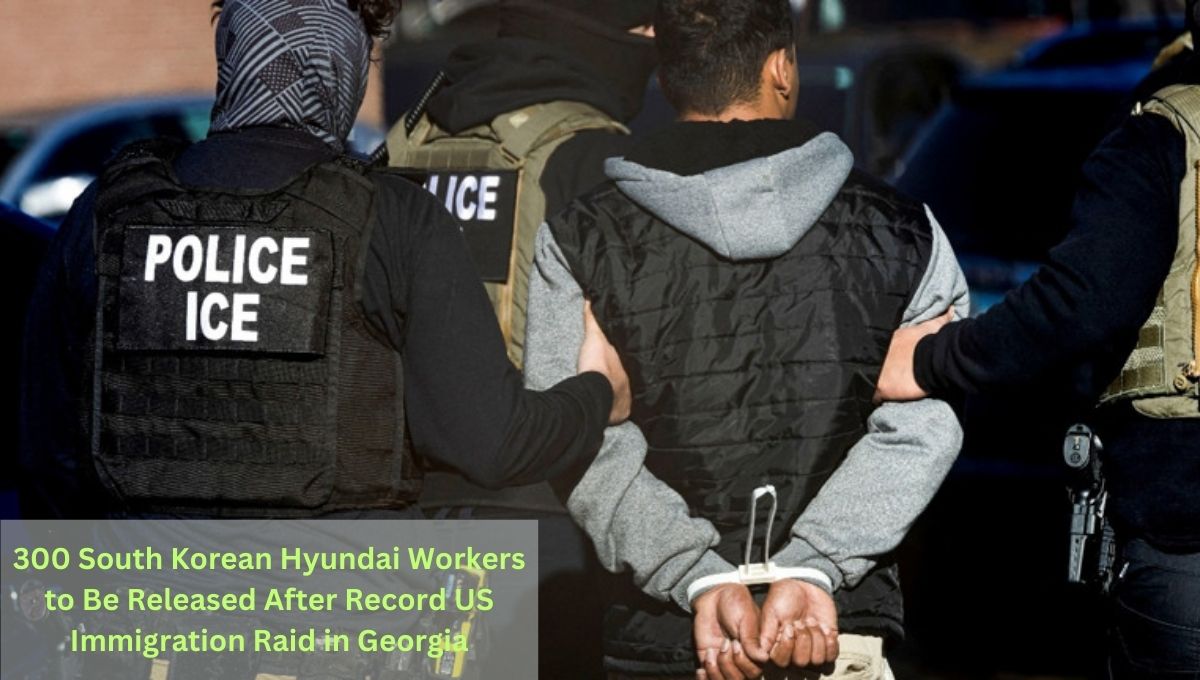
Detained 300 South Korean Hyundai Workers to Be Released After Record US Immigration Raid in Georgia. More than 300 South Korean workers detained in a sweeping US immigration raid at a Hyundai and LG Energy Solution plant in Georgia are set to be released and repatriated.
The announcement came after urgent negotiations between Seoul and Washington, marking a dramatic turn in a case that has shaken diplomatic ties, rattled communities, and sparked wider debates about immigration enforcement and foreign investment in the United States.
South Korea’s presidential chief of staff Kang Hoon-sik confirmed on Sunday that the two governments had finalised an agreement for the workers’ release. A chartered flight is expected to return the detainees to Seoul once administrative procedures are completed. The decision follows two days of tense diplomacy after the raid, which saw federal agents storm the $7.6 billion electric vehicle complex outside Savannah.
For Seoul, the resolution has eased immediate pressure, but officials remain wary. “The economic activities of our investors and the legitimate rights and interests of our nationals must not be unjustly infringed in the course of US law enforcement,” foreign ministry spokesperson Lee Jae-woong said.
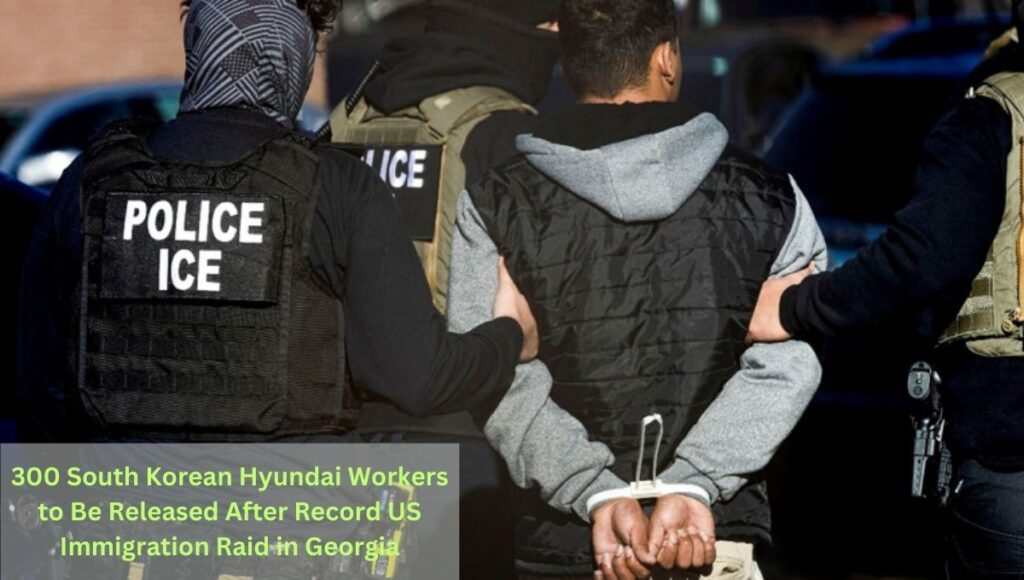
300 South Korean Hyundai Workers to Be Released After Record US Immigration Raid in Georgia
The Largest Immigration Raid in US History
Thursday’s raid codenamed Operation Low Voltage was carried out by US Immigration and Customs Enforcement (ICE) and Homeland Security Investigations (HSI). Officials said 475 people were detained, among them more than 300 South Korean nationals.
Workers were arrested inside the sprawling 3,000-acre Hyundai-LG facility in Ellabell, Georgia, with some led away in chains.
According to ICE, the raid stemmed from a months-long criminal investigation into alleged illegal employment practices at the plant’s battery construction site.
Officials described it as the largest single-site immigration enforcement operation in Homeland Security’s history.
Footage released by US authorities showed federal agents in armoured vehicles directing workers in safety vests to line up outside.
Some detainees were shackled at the wrists, ankles, and waist before being loaded onto buses. Others were handcuffed with plastic ties. In one dramatic scene, men attempted to flee into a sewage pond on the premises, only to be hauled out by agents.
Steven Schrank, the HSI special agent in charge of the operation, defended the raid. “This operation underscores our commitment to protecting jobs for Georgians and Americans, ensuring a level playing field for businesses that comply with the law, safeguarding the integrity of our economy, and protecting workers from exploitation,” he said.
Panic Inside the Hyundai Plant
Workers caught in the raid described scenes of chaos and fear. A South Korean employee who spoke to the BBC on condition of anonymity recalled receiving a flood of phone calls from managers urging him to shut down operations.
“Multiple phone lines were ringing and the message was to shut down operations,” he said.
As family members tried to contact their loved ones, many workers had already been separated from their phones.
“They were detained and they left all their cell phones in the office. They were getting calls, but we couldn’t answer because the office was locked,” he added.
Others spoke of panic as agents entered the site, ordering workers to line up against buses. Some tried to hide in air ducts, describing the stifling heat as they waited out the raid.
“Everyone came out running and told us immigration has arrived. We hid ourselves in an air duct and it was really hot,” one worker told CNN.
A construction worker likened the scene to a military assault. “It was like a war zone,” he said. “They just told everybody to get on the wall. We stood there for about an hour and were then taken to another section where we waited. Then we went inside another building and got processed.”
Why Were the Workers Detained?
US officials insist that the operation targeted individuals who were unlawfully present in the United States or violating the terms of their visas. According to ICE, those arrested included people who had:
- Crossed the border illegally
- Entered under visa waiver programs but were prohibited from working
- Overstayed their visas
Immigration attorney Charles Kuck, representing two of the detainees, argued that at least some had entered legally under South Korea’s visa waiver program, which allows short stays for tourism or business.
“One of my clients has been in the US for a couple of weeks, the other about 45 days,” he said. “They were planning to return home soon.”
A South Korean worker interviewed by the BBC suggested that most of those arrested were mechanics installing production lines or trainers sent from Seoul, working under visas that did not permit employment.
“I was shocked but not surprised,” he said, adding that contractors had cut corners to meet tight construction deadlines.
Hyundai and LG Respond
Hyundai Motor Company and LG Energy Solution, the firms behind the Georgia complex, quickly issued statements distancing themselves from the detained workers.
“Based on our current understanding, none of those detained is directly employed by Hyundai Motor Company,” the automaker said. It pledged to fully comply with all investigations.
LG Energy Solution also confirmed cooperation. “We will fully cooperate with the relevant authorities,” the company said.
Both companies have paused construction at the site, which is intended to supply batteries for electric vehicles and is considered the largest economic development project in Georgia’s history.
Diplomatic Fallout
The raid threatened to escalate into a diplomatic flashpoint between Washington and Seoul. South Korea’s foreign ministry summoned US officials in Seoul to express “concern and regret.”
President Lee Jae Myung ordered his cabinet to respond swiftly, with Foreign Minister Cho Hyun considering a visit to Washington.
South Korean lawmakers and community leaders warned that the raid could discourage investment in the US. “After this happened, many companies will think again about investing in the United States because setting up a new project might take so much longer than before,” one worker said.
The timing also added strain to trade relations already tested by US tariffs on imported goods and disputes over a $350 billion investment agreement.
Political Reactions in the US
In the United States, the raid sparked political division. Lawmakers from Georgia and the Congressional Asian Pacific American Caucus voiced alarm over the scale of the operation.
“Instead of targeting violent criminals, the Trump administration is going after immigrants at work and in communities of colour to meet its mass deportation quotas,” they said in a joint statement.
President Donald Trump defended the raid, framing it as a necessary step in enforcing immigration law. “These are illegal aliens. ICE is just doing its job,” he told reporters, reaffirming his “America First” agenda.
The operation drew comparisons to workplace raids carried out during Trump’s first term, but this raid eclipsed them all in scale and visibility.
The Korean American Community Reacts
In Savannah, where many of the workers lived, the raid reverberated through the local Korean community.
“People are in shock,” said James Woo, communications director for the Atlanta office of Asian Americans Advancing Justice. He noted that Savannah lacked the legal and community resources available in larger cities like Atlanta. “People don’t know where to go, or how to find legal representation,” he said.
Cho Dahye, president of the Korean American Association of Greater Savannah, said the raid tarnished the image of a global brand. “It’s very shocking to me and the image of a global, well-known company,” she said.
The Bigger Picture: Immigration and Foreign Investment
The raid has exposed the intersection of immigration enforcement, economic policy, and foreign investment. South Korean firms have poured billions into US manufacturing plants, often encouraged by American incentives to boost domestic production.
But the crackdown underscores the risks. For companies racing to meet deadlines, the complexity of US visa rules has encouraged the use of temporary or improperly documented workers.
“The time and administrative hurdles involved in obtaining US visas had encouraged foreign companies to cut corners,” one worker acknowledged.
Experts warn that the fallout could deter future investment. “This will make foreign companies think twice,” said a trade analyst. “The message from Washington seems contradictory: invest in America, but beware of aggressive enforcement.”
What Happens Next
With negotiations leading to the release of the detained South Koreans, the immediate crisis appears resolved. A chartered plane will carry them home once US procedures are finalised.
But broader questions remain. How will the US balance its immigration enforcement with its courtship of foreign investment? What safeguards will companies adopt to avoid similar crackdowns? And will the diplomatic damage between Seoul and Washington linger?
For now, the Hyundai-LG project remains on hold, and hundreds of skilled workers will soon return to South Korea, leaving behind uncertainty in Georgia’s flagship development project.
Also Read: Raid on Hyundai plant in US swept up workers on visitor visas
Related Posts:
- 5 Major Takeaways from the US Supreme Court's…

- 7 Heartbreaking Facts About Venezuela's Earthquake Disaster

- Afghanistan–Pakistan War 2025: Inside the 48-Hour Ceasefire

- 7 Powerful Measures: Trump Sanctions Russian Oil…

- 7 Powerful Facts About Ayatollah Ali Khamenei’s…

- In 8 Moves, EU Targets China-Linked Refineries and…
