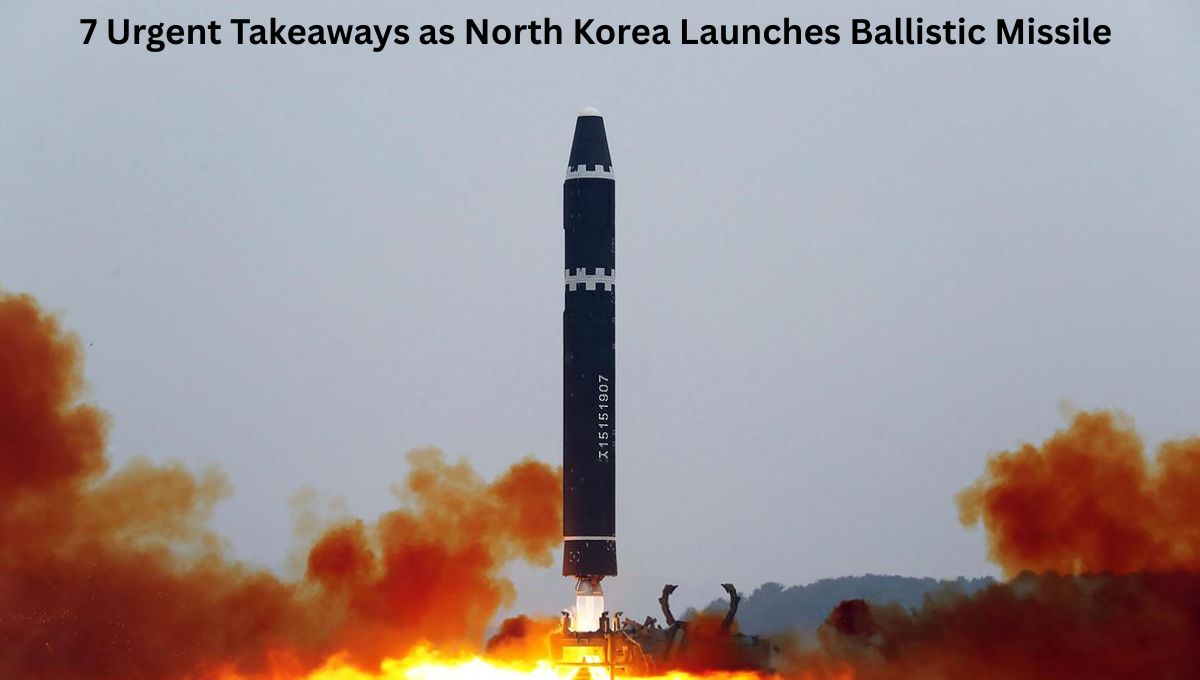
7 Urgent Takeaways as North Korea Launches Ballistic Missile after Trump’s renewed offer for talks. Tensions flared across East Asia on Friday as North Korea launched a ballistic missile toward its eastern waters, jolting South Korea and Japan into high alert. The latest missile test — Pyongyang’s most provocative move in weeks — comes amid frozen diplomacy with Washington and fresh warnings from Seoul about escalating threats.
As regional powers scramble to assess the launch, analysts say the test signals a bold message from Kim Jong Un: North Korea is far from backing down in the face of U.S. pressure and global sanctions.
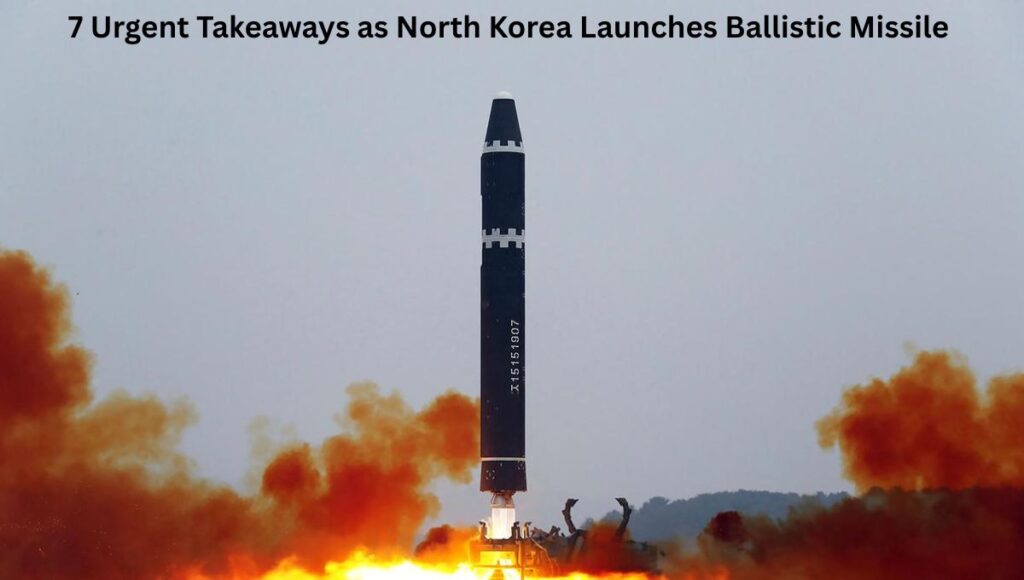
7 Urgent Takeaways as North Korea Launches Ballistic Missile
1. Pyongyang Launches Another Missile Into Eastern Waters
North Korea fired a ballistic missile toward the sea off its eastern coast on Friday morning, according to officials from South Korea and Japan.
The South Korean Joint Chiefs of Staff (JCS) reported that the missile was launched from an inland area near the western county of Taekwan, traveling across the peninsula before landing in waters outside Japan’s Exclusive Economic Zone (EEZ).
While flight details were not immediately released, Japan’s Defense Ministry later said the missile traveled more than 450 kilometers, falling harmlessly into the sea.
South Korea estimated a slightly longer range — around 700 kilometers — suggesting the test involved a short-range ballistic missile (SRBM) capable of reaching regional targets.
Officials in both Seoul and Tokyo confirmed there were no reports of damage to aircraft or ships, but they condemned the launch as a direct threat to regional security.
2. Japan and South Korea Respond with Heightened Vigilance
Following the test, Japan and South Korea immediately increased military surveillance and shared real-time data with the United States.
Japanese Prime Minister Sanae Takaichi told reporters that the missile’s landing outside Japan’s EEZ “did not cause any known damage,” but reaffirmed her government’s stance that North Korea’s repeated launches violate U.N. resolutions.
South Korea’s military also strengthened its vigilance posture, closely monitoring for additional launches. The JCS emphasized ongoing cooperation with Washington and Tokyo, calling the event “a serious provocation that undermines peace and stability on the Korean Peninsula.”
3. The Launch Follows Trump’s Renewed Offer for Dialogue
The timing of the launch has drawn global attention because it came just days after U.S. President Donald Trump publicly expressed willingness to meet Kim Jong Un again.
During his recent Indo-Pacific tour, Trump suggested he was open to reducing sanctions in exchange for “meaningful progress” on denuclearization — even extending his trip to allow for a possible meeting with the North Korean leader.
However, Pyongyang has so far ignored the proposal, and the missile test appears to underscore Kim’s reluctance to engage under Washington’s terms. Analysts say the launch sends a clear message: North Korea will not be pressured into negotiations while sanctions remain in place.
4. New Sanctions Have Further Strained Relations
Earlier this week, the U.S. Treasury Department imposed sanctions on eight North Korean individuals and two entities accused of laundering money from cybercrimes to fund the regime’s nuclear weapons program.
Washington said the targeted individuals were state-sponsored hackers linked to illicit cyber operations that bankroll Pyongyang’s missile development.
In response, North Korea’s Foreign Ministry denounced the sanctions as “hostile acts” and accused the Trump administration of harboring wicked intentions toward the country.
Pyongyang vowed to take unspecified countermeasures, signaling that dialogue is unlikely to resume soon.
5. Kim Jong Un’s Growing Alliance with Russia
Beyond its standoff with Washington, North Korea has deepened its ties with Moscow, sending military personnel and equipment to support Russia’s war in Ukraine.
Western intelligence agencies believe that in return, Pyongyang has received technical assistance to accelerate its missile and nuclear programs — including guidance on solid-fuel propulsion and long-range missile re-entry systems.
At a recent military parade in Pyongyang, Kim Jong Un unveiled new weapons, including what analysts described as a next-generation intercontinental ballistic missile (ICBM) potentially capable of reaching the U.S. mainland.
The parade was attended by senior officials from Russia, China, and Vietnam, underlining Pyongyang’s push to project strength and diversify its diplomatic allies.
Also Read: Kim Jong Un Launches Luxury Beach Resort as North Korea Bets on Tourism
6. Regional Powers on High Alert
The latest launch has intensified regional anxiety, especially in Seoul and Tokyo, where leaders have been urging closer trilateral cooperation with Washington to deter further provocations.
South Korean President Lee Jae Myung, who recently met Chinese President Xi Jinping in Gyeongju, called on Beijing to use its influence over Pyongyang to bring the North “back to the dialogue table.”
Meanwhile, U.S. Defense Secretary Pete Hegseth, who visited South Korea this week, praised Seoul’s plans to boost defense spending amid what he called “growing nuclear threats and strategic uncertainty.”
Military analysts warn that North Korea’s launch cycle could accelerate in the coming weeks, particularly as Kim seeks leverage before any possible diplomatic outreach. “Each test allows Pyongyang to refine its weapons while reminding Washington that pressure alone won’t work,” said Dr. Min-woo Park, a Seoul-based defense expert.
7. What’s Next: More Tests and More Tension
With diplomacy stalled since the 2019 collapse of Kim–Trump talks, North Korea has continued expanding its nuclear arsenal and upgrading missile technology. Its weapons now include nuclear-capable missiles covering U.S. allies in Asia — and potentially the U.S. mainland itself.
Experts believe that North Korea maintains its nuclear test site in full readiness, meaning a seventh nuclear test could be conducted at any time if Kim gives the order. “Kim Jong Un is playing a long game,” said former U.N. sanctions monitor Hana Chung. “He’s waiting for Washington to offer concessions first while showcasing his growing strength.”
Washington, Tokyo, and Seoul are expected to tighten coordination through joint military drills, missile tracking, and sanctions enforcement in the near term. However, without diplomatic progress, analysts warn of a cycle of provocation and retaliation that risks destabilizing the entire Indo-Pacific region.
Background: From Trump’s Summit Collapse to Today’s Escalation
The last significant diplomatic engagement between Washington and Pyongyang occurred in 2019, when talks between Trump and Kim collapsed in Hanoi over disagreements on sanctions relief and nuclear dismantlement steps.
Since then, Kim has rebuffed all outreach efforts, focusing instead on modernizing his arsenal and asserting independence from the West.
While Trump has maintained that he’s “open to meeting Kim when the time is right,” Pyongyang’s recent actions — including the October 28 test of sea-based cruise missiles and multiple artillery launches — suggest it intends to maintain maximum pressure of its own.
North Korea’s strategy, experts say, is to demonstrate strength while waiting for leverage. By conducting frequent launches and rejecting dialogue, Kim ensures that Washington and its allies remain on edge, potentially opening the door for more favorable negotiation terms later.
Regional Stability at Risk
The missile launch underscores how fragile the security situation remains in Northeast Asia.
Each provocation threatens to trigger an arms race, as Japan and South Korea expand missile defenses and invest in advanced strike capabilities.
Meanwhile, China’s cautious response reflects its balancing act — opposing U.S. influence in the region while seeking to avoid instability on its northern border.
The United Nations Security Council has yet to issue a statement on the latest launch, amid divisions between Western members and Russia/China over how to handle Pyongyang’s defiance.
Conclusion: A Warning Signal to the World
North Korea’s latest ballistic missile test is not merely a routine display of firepower — it is a strategic message aimed at Washington, Seoul, and Tokyo. By launching so soon after Trump’s outreach, Pyongyang is signaling that it won’t return to talks under pressure or sanctions.
As the United States balances diplomacy and deterrence in the Indo-Pacific, and as Japan and South Korea fortify their defenses, the region faces a volatile year ahead.
Unless genuine dialogue resumes, North Korea’s cycle of escalation will likely continue — keeping the world on edge and the path to peace ever more uncertain.
Also Read: Kim Jong Un Vows Rapid Nuclear Expansion Amid US-South Korea Military Drills
Also Read: North Korea fires ballistic missile, says South Korea; ‘no impact on Japan’