Tariffs on Russian Oil Buyers Could Trigger Economic Collapse, Says US Treasury Chief, forcing Vladimir Putin into peace talks on Ukraine. United States Treasury Secretary Scott Bessent has called for a fresh round of economic pressure on Moscow, arguing that additional sanctions and secondary tariffs on countries buying Russian oil could push the Kremlin to the brink of collapse and force President Vladimir Putin into serious peace negotiations over the ongoing war in Ukraine.
Appearing on NBC’s Meet the Press on Sunday, Bessent accused India and China of effectively funding Russia’s war machine through large-scale energy purchases. He urged Washington’s European allies to join the US in tightening restrictions, warning that time is running out as Ukraine faces sustained military pressure.
“If the US and the EU can come in, do more sanctions, secondary tariffs on the countries that buy Russian oil, the Russian economy will be in full collapse, and that will bring President Putin to the table,” Bessent said. The remarks highlight the Trump administration’s growing frustration over its inability to end the nearly four-year-old war in Ukraine, despite repeated promises that peace was within reach.
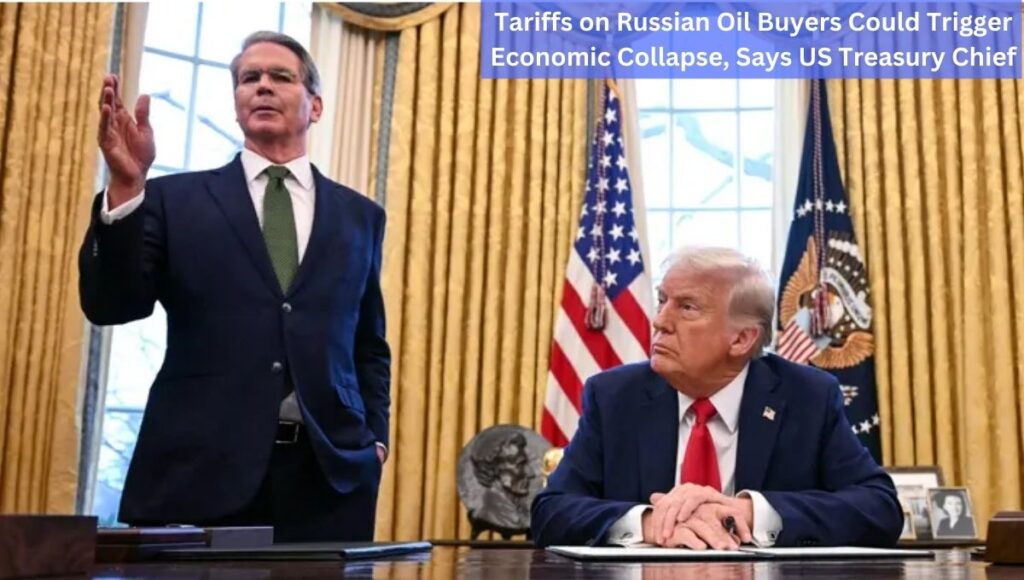
Tariffs on Russian Oil Buyers Could Trigger Economic Collapse, Says US Treasury Chief
Bessent Targets India and China Over Russian Oil Purchases
Bessent did not mince words when discussing India and China. He has previously referred to both countries as “bad actors” for maintaining strong oil ties with Moscow.
India has faced steep 50% tariffs imposed by Washington for purchasing Russian crude, while China was threatened with a 145% levy though the latter has been suspended for a 90-day review period.
While defending its actions, New Delhi accused the West of hypocrisy, pointing out that several European countries also continue to import Russian energy but have not faced similar punitive measures.
Indian officials maintain that their energy policy is based on “national interest and market dynamics”, rejecting the idea that oil imports from Russia amount to financing the war.
Despite tensions, President Donald Trump has softened his rhetoric against Prime Minister Narendra Modi in recent days, describing India as a “special partner” and calling Modi a “great prime minister”.
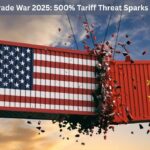
Also Read: US Sanctions Bombshell: India Faces 500% Tariff Over Russian Oil
The Push for “Secondary Tariffs”
At the core of Bessent’s proposal are secondary tariffs penalties imposed not only on Russia but also on third-party countries that continue to buy its oil and gas.
He stressed that unilateral US action would not be enough, warning that European Union cooperation is essential to collapse Moscow’s economy.
“We are in a race now between how long the Ukrainian military can hold up versus how long the Russian economy can hold up,” Bessent said. “If the US and the EU do this together, Russia will be forced to negotiate.”
Bessent also revealed that Trump and Vice President JD Vance had recently held a “productive call” with European Commission President Ursula von der Leyen to coordinate future sanctions.
Trump’s Frustration Over Ukraine
The call for stronger measures comes against the backdrop of Trump’s frustration at not being able to end the war, despite repeatedly pledging that he could secure a deal “quickly” after returning to the White House in January.
Last month’s high-profile summit in Alaska between Trump and Putin ended without a breakthrough. While Trump described the talks as “productive”, he admitted there was “no deal until there’s a deal.”
The failure to secure an agreement has raised questions about Trump’s strategy, especially as Russian forces continue their aggressive campaign in Ukraine.
Escalation in Kyiv and Russian Retaliation
On Sunday, the conflict escalated dramatically. Russian missiles struck government buildings housing Ukraine’s cabinet in central Kyiv, killing at least three people and igniting fires in the heart of the capital.
Ukraine responded by targeting Russia’s Druzhba oil pipeline in the Bryansk region, escalating hostilities further into energy infrastructure.
The Kyiv assault, described by Ukrainian officials as the most serious escalation in months, underscores the difficulty of achieving a diplomatic solution even as new sanctions are debated in Washington and Brussels.
Trump Signals “Phase Two” of Sanctions
For the first time, President Trump suggested he was ready to move to a “phase two” of sanctions against Russia.
Speaking to reporters at the White House, Trump said:
“Yeah, I am,” when asked if he was prepared for a second phase of punitive measures. “That cost hundreds of billions of dollars to Russia… and I haven’t done phase two yet or phase three.”
The remark indicates a more aggressive posture from the administration, though Trump offered no details on what “phase two” might entail.
India Pushes Back on Tariffs
India, now facing 50% US tariffs, has described the measures as “unjustified and unreasonable.”
Despite the strain, Modi has publicly reciprocated Trump’s recent attempts to calm tensions, saying on Saturday that he “fully reciprocates” the US president’s “positive assessment” of their partnership.
“India and the US have a very positive and forward-looking Comprehensive and Global Strategic Partnership,” Modi said.
Analysts believe Trump is attempting to balance pressure with diplomacy, hoping not to alienate New Delhi entirely as he pushes for a broader coalition against Russia.
China in the Crosshairs
While India has faced the brunt of US tariffs, China remains a major buyer of Russian oil and gas.
Trump has so far avoided fully implementing the 145% tariff threat on Chinese imports, giving Beijing a 90-day grace period.
Critics say this demonstrates a double standard, as Washington tries to manage tensions with China while maintaining pressure on India.
Nevertheless, Bessent insisted that China cannot escape accountability if the West is serious about collapsing Russia’s war economy.
European Cooperation Seen as Crucial
The US Treasury chief made clear that Washington cannot achieve its goals alone.
He emphasized the importance of European solidarity, saying sanctions would only succeed if Brussels and Washington move in lockstep.
“We need our European partners to follow us, because if the US and the EU do this together, we are in a race now between how long the Ukrainian military can hold up versus how long the Russian economy can hold up,” Bessent reiterated.
Reports suggest Trump and Vance have pressed European leaders, including von der Leyen and Finnish President Alexander Stubb, to adopt tougher restrictions.
Russia Already Struggling Under Sanctions
Russia is already facing crippling sanctions imposed by both the US and EU since the war began in 2021.
Yet, Moscow has found alternative customers, including India, China, and several Global South countries, to keep its energy exports flowing.
Analysts say this has blunted the impact of Western sanctions, allowing Russia to maintain its war footing while Western capitals struggle to keep Ukraine supplied with weapons and financial aid.
Domestic Political Dimension in the US
The debate over sanctions also has a domestic political angle.
Some US lawmakers have questioned whether tariffs on India and other partners risk alienating key allies, while others argue that anything short of full economic collapse for Russia will fail to end the war.
The administration has defended its approach, saying tariffs on India and China are necessary “leverage” to weaken Putin’s resources.
Bessent also confirmed that while a US circuit court has deemed some tariffs illegal pending appeal, the administration is “confident of winning at the Supreme Court.”
Conclusion: A Race Against Time
As the war enters its fourth year, the Trump administration appears determined to escalate economic warfare against Moscow and its trade partners, even at the risk of straining ties with allies like India.
With Kyiv under renewed assault and Russia showing no signs of backing down, Washington’s strategy hinges on whether tariffs and sanctions can break the backbone of Russia’s economy before Ukraine’s defenses falter.
Bessent summed it up bluntly:
“We are in a race now between how long the Ukrainian military can hold up versus how long the Russian economy can hold up.” For now, that race shows no sign of slowing and much depends on whether Trump’s proposed “phase two” of sanctions gains traction in both Washington and Europe
Also Read: Trump Threatens 50-100% Tariffs On China, Demands NATO Stop Buying Russia Oil