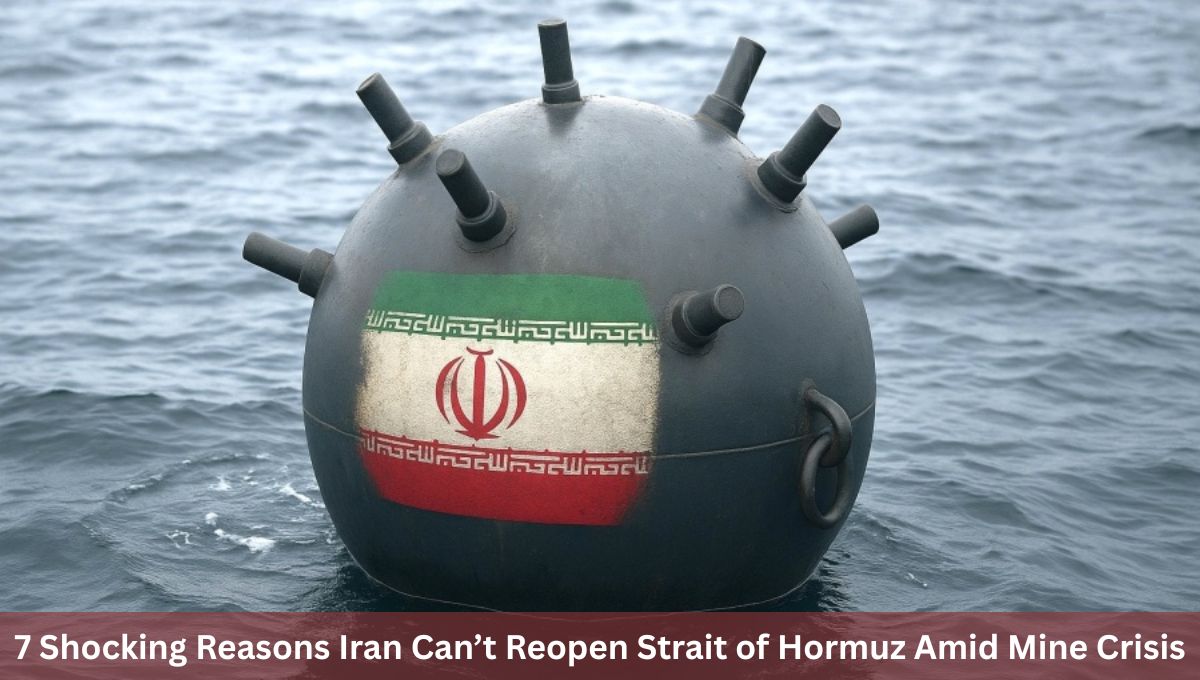
7 Shocking Reasons Iran Can’t Reopen Strait of Hormuz Amid Mine Crisis impacting global oil supply. The global energy market is once again on edge as tensions in the Middle East ripple across international trade routes. At the center of this crisis lies the strategically vital Strait of Hormuz—a narrow yet indispensable waterway that handles nearly one-fifth of the world’s oil supply.
Despite signaling willingness to reopen the strait following a temporary ceasefire, Iran is facing an unexpected and deeply ironic obstacle:
it cannot locate all the naval mines it deployed during the conflict.
This self-inflicted complication is now delaying the full restoration of maritime traffic, raising serious concerns for global energy security, shipping logistics, and geopolitical stability.
7 Shocking Reasons Iran Can’t Reopen Strait of Hormuz Amid Mine Crisis
What Went Wrong: The Mine Deployment Strategy
A Tactical Move That Backfired
When conflict escalated following joint military actions by the United States and Israel, Iran quickly turned to asymmetric warfare tactics.
One of its most impactful moves was mining the Strait of Hormuz using small, fast-moving boats operated by the Islamic Revolutionary Guard Corps.
Initially, the strategy worked.
- Shipping traffic dropped sharply
- Oil prices surged globally
- Insurance premiums for vessels skyrocketed
- Iran gained significant leverage in negotiations
However, the execution appears to have been flawed.
Haphazard Deployment
According to reports citing US officials, Iran deployed mines in a scattered and poorly documented manner.
This lack of systematic tracking has now created a dangerous scenario:
- Some mines were never logged
- Others may have drifted due to ocean currents
- The exact number of deployed mines remains unknown
In military terms, this represents a breakdown in operational discipline and situational awareness.
1. Iran Cannot Locate All the Mines
The most critical issue is straightforward yet severe: Iran does not know where all its mines are.
Even when some positions were recorded, the dynamic marine environment means:
- Mines can shift unpredictably
- Anchoring systems may fail
- Ocean currents can carry them into new zones
This creates a high-risk maritime environment where even a single undetected mine can cripple a tanker.
2. Mine Clearance Is Extremely Complex
Deploying naval mines is relatively simple. Removing them is not.
Mine-clearing requires:
- Specialized sonar systems
- Remote-operated underwater vehicles
- Highly trained personnel
- Time-intensive operations
Even the United States, with advanced naval capabilities, relies on specialized ships for such missions.
Iran, by comparison, lacks the technical infrastructure to conduct large-scale mine-clearing efficiently.
While Iran possesses a large number of small boats, it does not have:
- Advanced minesweeping fleets
- Sophisticated detection technology
- Integrated maritime surveillance systems
This limitation significantly slows any effort to reopen the strait safely.
4. Mines May Have Drifted
One of the most dangerous aspects of the situation is that some mines may no longer be where they were originally placed.
Floating or drifting mines can:
- Enter previously safe shipping lanes
- Move unpredictably with tides
- Increase risk for unsuspecting vessels
This uncertainty makes it nearly impossible to declare any route completely safe.
5. Continued Security Threats
Even beyond the mines, the Strait of Hormuz remains a volatile zone.
Risks include:
- Drone attacks
- Missile strikes
- Harassment by fast patrol boats
Despite suffering losses from US strikes, Iran still retains hundreds of small vessels capable of disrupting shipping.
This layered threat environment discourages shipping companies from resuming normal operations.
6. Partial Reopening Isn’t Enough
Iran has attempted to manage the situation by:
- Leaving a narrow corridor open
- Allowing ships to pass under strict conditions
- Warning vessels about mine risks
However, these measures fall short.
Global shipping requires:
- Predictable routes
- Insurance assurance
- Verified safety
Without these, large-scale maritime traffic cannot resume.
7. Geopolitical Pressure Complicates Matters
The crisis is unfolding alongside high-stakes diplomacy involving leaders like Donald Trump and Abbas Araghchi.
US Demands
The United States has made it clear:
- The strait must reopen fully and safely
- No tolls or restrictions will be accepted
- The waterway is considered international
Trump has even tied ceasefire conditions to the reopening of Hormuz.
Iran’s Response
Iran has acknowledged “technical limitations”—a phrase widely interpreted as a reference to the mine problem.
Meanwhile, negotiations involving JD Vance are expected to address the issue directly.
Why the Strait of Hormuz Matters So Much
A Global Energy Lifeline
The Strait of Hormuz connects:
- The Persian Gulf
- The Gulf of Oman
- The Arabian Sea
It is crucial for:
- Oil exports from Gulf countries
- Liquefied natural gas shipments
- Global energy stability
Impact on India and the World
For countries like India:
- Up to 80% of energy imports pass through Hormuz
Globally:
- Around 20–25% of oil supply flows through the strait
Any disruption has immediate consequences:
- Rising fuel prices
- Supply chain disruptions
- Economic uncertainty
Shipping Crisis: Real-World Impact
Traffic Collapse
Since the mining began:
- Tanker movement has dropped drastically
- Thousands of ships remain delayed
- Crew members are stranded
Insurance and Risk
Shipping companies face:
- Increased war-risk premiums
- Uncertainty in navigation routes
- Liability concerns
As a result, many are avoiding the region entirely.
The Irony of Iran’s Strategy
Iran’s mining operation was meant to:
- Pressure global powers
- Control shipping lanes
- Strengthen bargaining position
While it achieved short-term gains, it has now:
- Limited Iran’s own options
- Delayed reopening efforts
- Increased international scrutiny
In essence, the tactic has become a strategic liability.
What Happens Next?
Negotiations in Focus
Talks in Islamabad are expected to address:
- Safe reopening timelines
- Mine-clearing cooperation
- Security guarantees
The outcome could shape:
- Global oil markets
- Middle East stability
- Future maritime policies
Possible Scenarios
1. Gradual Reopening
Controlled routes expand slowly as mines are cleared.
2. International Intervention
External forces assist in mine-clearing operations.
3. Continued Disruption
If unresolved, the crisis could persist for months.
Conclusion
The delay in reopening the Strait of Hormuz highlights how quickly tactical decisions in wartime can spiral into strategic complications.
Iran’s inability to locate and remove its own naval mines has transformed a powerful geopolitical tool into a major operational challenge.
With global energy markets, international shipping, and diplomatic negotiations all hanging in the balance, the situation remains highly volatile.
As the world watches closely, one thing is clear:
reopening the Strait of Hormuz is no longer just a political decision—it is a complex technical and security challenge with global consequences.
Also Read: 10 Explosive Updates: US Destroys 16 Iranian Mine-Laying Ships in Strait of Hormuz Crisis
Also Read: US-Iran War: Strait Of Hormuz Crisis Deepens As Iran Struggles To Clear Mines
Related Posts:
- 10 Explosive Updates: US Destroys 16 Iranian…
- 7 Critical Ways Iran’s Yuan Oil Plan Could Shake the…
- 10 Critical Risks if the Strait of Hormuz Closes…

- 7 Critical Impacts of the Strait of Hormuz Crisis as…
- 9 Explosive Developments in Iran–US Hormuz Crisis Escalation
- 7 Explosive Reasons Oil Prices Are Surging as Trump…