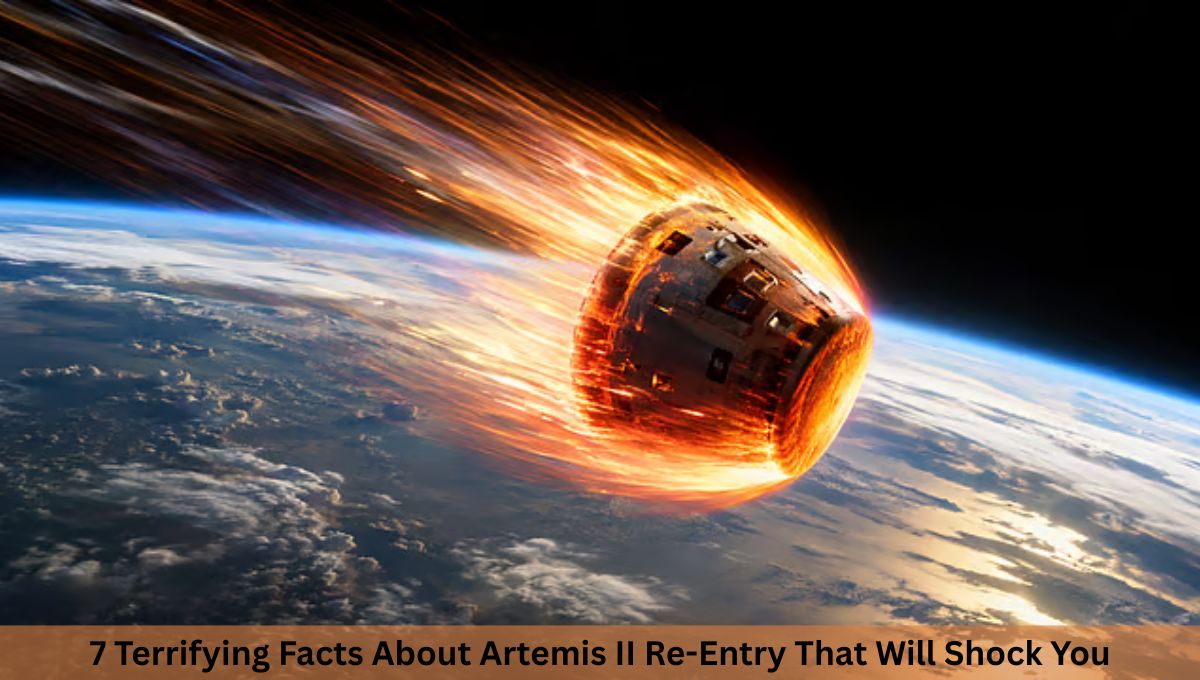
7 Terrifying Facts About Artemis II Re-Entry That Will Shock You — The mission’s most dangerous phase. The Artemis II mission is not just another milestone in space exploration—it is a defining moment in humanity’s return to deep space after more than half a century.
Thank you for reading this post, don't forget to subscribe!After a historic journey around the Moon, the mission now faces its most perilous challenge: re-entering Earth’s atmosphere at extreme speeds and temperatures.
Traveling at nearly 40,000 kilometers per hour and enduring temperatures hotter than molten lava, the Orion spacecraft must survive one of the harshest environments any human-rated vehicle has ever encountered.
The success of this phase will not only determine the safe return of its crew but also shape the future of lunar and Mars missions.
This article provides a comprehensive, globally relevant breakdown of the Artemis II re-entry, the science behind it, the risks involved, and why the world is watching closely.

7 Terrifying Facts About Artemis II Re-Entry That Will Shock You
Artemis II Nears Its Most Critical Moment
After completing a 10-day mission around the Moon, Artemis II is now heading back toward Earth.
The crew—Reid Wiseman, Victor Glover, Christina Koch, and Jeremy Hansen—has already made history by travelling farther from Earth than any humans before them.
But the journey home is far from routine. Re-entry is widely regarded as the most dangerous phase of any space mission.
Unlike launch, where failure can sometimes be mitigated with escape systems, re-entry offers no second chances. The spacecraft must perform flawlessly.
NASA officials have acknowledged this risk. The Orion capsule’s thermal protection system—the heat shield—is the single most critical component for survival. There is no backup system.
Why Re-Entry Is So Dangerous
Extreme Speed: Hypersonic Entry
Orion will hit Earth’s atmosphere at approximately 40,000 km/h—over 30 times the speed of sound. This makes it the fastest re-entry ever attempted by a crewed spacecraft.
At such speeds, the spacecraft carries enormous kinetic energy. All of that energy must be dissipated safely through atmospheric drag.
If not managed correctly, the spacecraft could burn up or skip off the atmosphere into space.
Extreme Heat: Up to 2,700°C and Beyond
As Orion descends, air molecules in front of it are violently compressed, generating extreme heat.
Temperatures outside the capsule can reach around 2,700 degrees Celsius—and even higher in the surrounding shockwave.
This heat is intense enough to melt most metals. The only thing protecting the astronauts is the spacecraft’s ablative heat shield, designed to absorb and dissipate this thermal energy.
The Role of the Heat Shield
The Orion capsule uses an advanced thermal protection system made of ablative materials.
These materials work by slowly burning away, carrying heat with them and preventing it from reaching the spacecraft’s interior.
This process is intentional. The heat shield is designed to sacrifice itself to protect the crew.
However, there are concerns. During the Artemis I test mission, engineers observed unexpected wear and material loss in the heat shield.
Although adjustments have been made, Artemis II will be the first real test with astronauts onboard.
The margin for error is extremely small.
Step-by-Step: How Orion Will Re-Enter Earth
1. Separation at 122 Kilometers
At about 122 kilometers above Earth, the Orion spacecraft will separate from its service module. The discarded module will burn up in the atmosphere.
2. Entry Interface
The crew module begins its descent, entering the upper atmosphere at hypersonic speeds. This is where heating begins to intensify rapidly.
3. Plasma Formation and Blackout
As temperatures rise, a layer of ionized gas—plasma—forms around the spacecraft.
This plasma sheath blocks radio signals, leading to a communication blackout lasting several minutes.
During this time, astronauts are completely cut off from mission control.
4. Controlled Deceleration
Unlike uncrewed capsules, Orion uses aerodynamic lift to control its descent. This reduces g-forces and ensures a safer ride for the crew.
5. Parachute Deployment
Once the spacecraft slows down sufficiently:
- Drogue parachutes deploy first, stabilizing the capsule
- Pilot parachutes follow
- Finally, three main parachutes deploy, slowing the descent dramatically
6. Splashdown in the Pacific
The spacecraft will land in the Pacific Ocean off the coast of California. Recovery teams will retrieve the crew shortly after splashdown.
The Importance of Precision
Re-entry is not just about surviving heat—it’s about precision. NASA engineers must guide Orion through a very narrow corridor in the atmosphere.
Even a slight deviation in angle can have catastrophic consequences:
- Too steep: The spacecraft could burn up
- Too shallow: It could skip off the atmosphere
Flight directors have emphasized that the margin of error is less than a degree.
Communication Blackout: The Silent Danger
One of the most nerve-wracking aspects of re-entry is the communication blackout.
As plasma forms around the spacecraft, it blocks all radio signals. For several minutes, mission control has no contact with the crew.
This blackout is expected, but it adds psychological pressure. The astronauts must rely entirely on onboard systems during this phase.
G-Forces and Human Limits
During re-entry, astronauts will experience intense deceleration forces. These are measured in g-forces.
While uncrewed spacecraft can endure extreme forces, human bodies have limits. Orion’s design ensures that g-forces remain within survivable ranges.
Even so, the experience is physically demanding. Astronauts may feel extreme pressure on their bodies, making movement difficult.
A “Skip Re-Entry” Strategy
To manage heat and stress, Orion uses a technique called skip re-entry.
In this approach, the spacecraft briefly exits the atmosphere after initial entry, allowing it to shed speed and heat before re-entering again.
For Artemis II, engineers have modified this approach slightly to reduce stress on the heat shield.
Splashdown and Recovery Operations
After surviving re-entry, the mission is not over.
The spacecraft will land in the Pacific Ocean, where recovery teams from the U.S. Navy will retrieve the crew.
Recovery involves:
- Securing the capsule
- Ensuring no debris hazards remain
- Safely extracting astronauts
- Transporting them for medical evaluation
This process can take over an hour.
The Overview Effect: A Changed Perspective
Beyond the technical challenges, Artemis II has delivered a profound human experience.
Astronauts described seeing Earth from deep space—a moment often referred to as the “overview effect.”
From this vantage point, Earth appears as a fragile blue sphere in the vast darkness of space. Borders disappear. Differences fade.
Many astronauts report a lasting shift in perspective, emphasizing unity, environmental responsibility, and the uniqueness of our planet.
Scientific Observations During the Mission
The Artemis II crew conducted several observations during their lunar flyby, including:
- Viewing meteorite impacts on the Moon
- Capturing high-resolution images of the lunar surface
- Observing a solar eclipse from deep space
- Documenting Earth from unprecedented distances
These observations will contribute to future lunar exploration and scientific research.
Why Artemis II Matters Globally
Artemis II is more than a national achievement—it is a global milestone. The mission includes international collaboration, with a Canadian astronaut onboard.
It represents a renewed commitment to space exploration that involves multiple countries and agencies.
Its success will pave the way for:
- Artemis III (human landing on the Moon)
- Long-term lunar bases
- Future missions to Mars
The Future of Human Space Exploration
Artemis II is a test mission—but its implications are enormous.
It validates technologies, systems, and procedures needed for deep-space travel. Every component, from life support to navigation, is being evaluated.
The data collected will shape the next generation of spacecraft and missions.
Risks That Still Remain
Despite careful planning, several risks remain:
- Heat shield performance under extreme conditions
- Precise trajectory control
- Communication blackout uncertainties
- Environmental factors like weather at splashdown
NASA engineers have mitigated these risks, but they cannot be eliminated entirely.
A Moment the World Is Watching
As Artemis II approaches re-entry, millions around the world are watching.
The mission represents the return of human exploration beyond low Earth orbit—a journey that has not been attempted since the Apollo era.
Its success will inspire future generations and reaffirm humanity’s ability to achieve extraordinary feats.
Final Thoughts: A Fiery Return Home
The Artemis II mission is a testament to human ingenuity, courage, and ambition.
But its final chapter—the re-entry—is a reminder of the risks involved in pushing the boundaries of exploration.
At 40,000 km/h and temperatures reaching thousands of degrees, the Orion spacecraft will quite literally ride a fireball back to Earth.
If successful, it will mark not just the safe return of four astronauts—but the beginning of a new era in space exploration.
And as the world waits for splashdown, one thing is certain:
this is history in the making.
Also Read: 9 Stunning Moments from Artemis II That Reveal Earth & Moon Like Never Before
Also Read: Heat shield worries resurface as the Artemis II moon mission nears reentry
Related Posts:
- 9 Stunning Moments from Artemis II That Reveal Earth…

- NASA Fast-Tracks Nuclear Reactor for Moon to Counter…

- 7 Powerful Reasons Russia’s Lunar Nuclear Plan…

- 5 Major Takeaways from the US Supreme Court's…

- 7 Heartbreaking Facts About Venezuela's Earthquake Disaster

- 7 Powerful Facts About Ayatollah Ali Khamenei’s…