
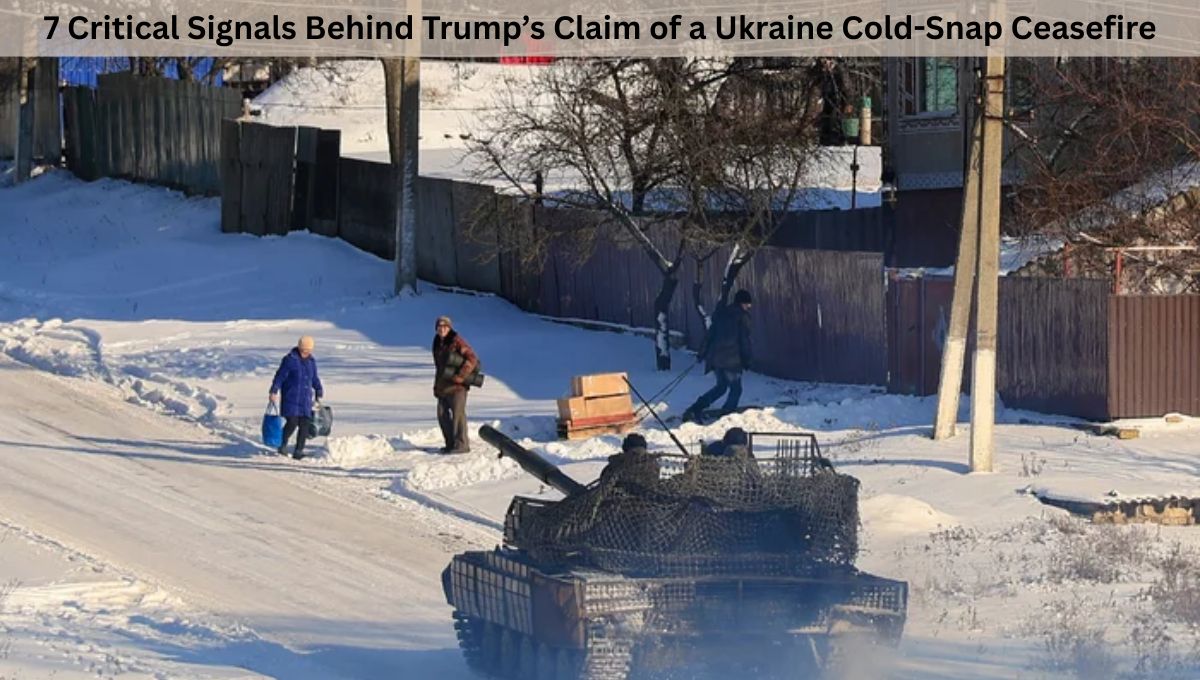
7 Critical Signals Behind Trump’s Claim of a Ukraine Cold-Snap Ceasefire as doubts grow over its durability. US President Donald Trump has claimed that Russian President Vladimir Putin agreed to a temporary, week-long pause in attacks on Kyiv and other Ukrainian cities, citing the extraordinary cold currently gripping Ukraine and parts of Russia.
The announcement, made during a televised Cabinet meeting in Washington, immediately drew global attention, not only because of its humanitarian implications but also because Russia has not publicly confirmed any such agreement.
“I personally asked President Putin not to fire into Kyiv and the various towns for a week, and he agreed to do that,” Trump said, describing the move as a humane response to extreme winter conditions. According to Trump, the pause was driven by concern for civilians already struggling with freezing temperatures, damaged infrastructure, and limited access to heating and electricity.
The US president added that many doubted Putin would agree to such a request. “A lot of people said, ‘Don’t waste the call, you’re not going to get that,’” Trump said. “And he did it.”
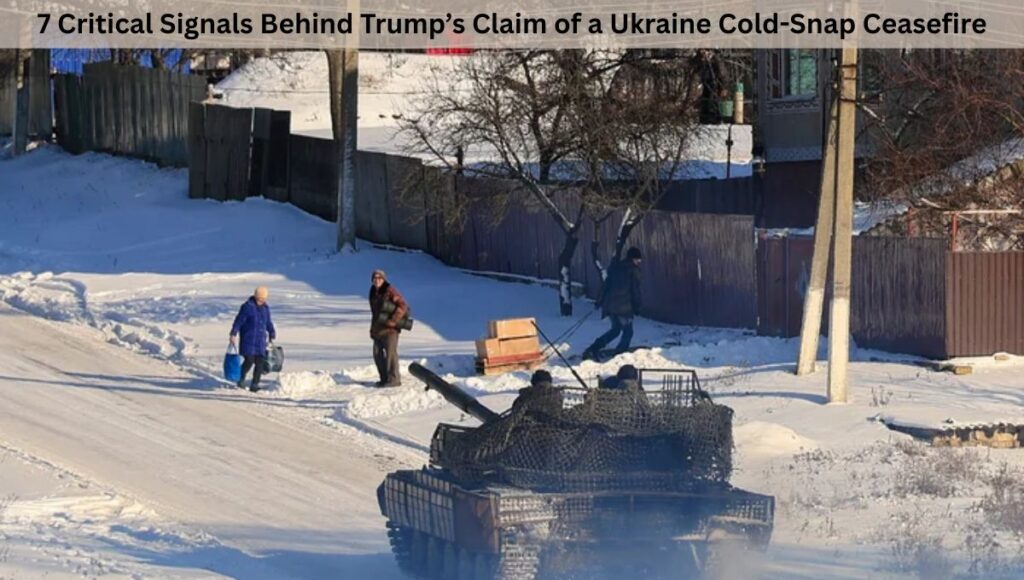
7 Critical Signals Behind Trump’s Claim of a Ukraine Cold-Snap Ceasefire
Ukraine Faces Brutal Winter Conditions
The timing of Trump’s claim coincides with one of the harshest winter cold snaps Ukraine has faced in years.
According to Ukrainian meteorological authorities, temperatures in many regions are expected to plunge as low as minus 27 degrees Celsius overnight, with daytime temperatures remaining well below freezing.
Kyiv, along with regions such as Chernihiv, Zhytomyr, Rivne, Sumy, Poltava, and Kharkiv, is forecast to experience overnight lows of minus 20 to minus 25 degrees Celsius.
Daytime temperatures are expected to hover between minus 15 and minus 22 degrees Celsius, making daily life extremely difficult, especially for residents without reliable heating.
Ukraine’s State Emergency Service has warned that the cold wave poses serious risks to vulnerable populations, including the elderly, children, and those displaced by the war.
Emergency shelters have been opened in several cities, but repeated Russian attacks on energy infrastructure have complicated efforts to keep people warm.
Energy Infrastructure Under Pressure
Russia has intensified its strikes on Ukraine’s energy infrastructure during winter periods throughout the war, a strategy that has left millions without electricity and heating at critical moments.
Power plants, substations, and heating facilities have been frequent targets, forcing Ukrainian authorities and energy workers into round-the-clock repair operations.
Even when electricity is restored, the relief is often temporary. Residents report having power for only a few hours at a time—just enough to charge phones or briefly warm homes before outages return.
During extreme cold, these disruptions can be life-threatening. Kyiv Mayor Vitali Klitschko said this week that hundreds of residential buildings in the capital remain without heating.
In sub-zero temperatures, even well-insulated apartments can quickly become uninhabitable, pushing families to seek refuge with relatives, friends, or in public warming centers.
Zelenskyy Welcomes Trump’s Announcement
Ukrainian President Volodymyr Zelenskyy cautiously welcomed Trump’s statement, describing it as an “important signal” that could help protect civilians during the extreme winter period.
In a post on social media, Zelenskyy said discussions about a temporary pause in attacks had taken place during recent negotiations involving Ukrainian, US, and Russian officials in the United Arab Emirates.
“Our teams discussed this in the UAE. We expect the agreements to be implemented,” Zelenskyy wrote, adding that de-escalation steps can contribute to real progress toward ending the war.
However, the Ukrainian leader also made it clear that words alone would not be enough. In his nightly video address, Zelenskyy stressed that the coming days would show whether Russia abides by the reported agreement.
“We shall see what the real situation is with our energy facilities and cities in the days and nights to come,” he said.
Russia Remains Silent
Despite Trump’s confident assertions, the Kremlin has so far declined to confirm that any formal pause in attacks has been agreed.
Asked about a possible halt in strikes on Ukrainian energy infrastructure, Kremlin spokesman Dmitry Peskov said he could not comment, offering no clarification on whether Moscow had accepted the proposal.
Russia’s silence has fueled skepticism among analysts and Ukrainian officials, many of whom point to past instances where announced ceasefires failed to hold.
Previous humanitarian pauses, including those intended to allow evacuations or religious observances, have frequently collapsed amid mutual accusations of violations.
Russian Foreign Minister Sergey Lavrov has also poured cold water on broader ceasefire prospects, saying Moscow has yet to see a comprehensive and acceptable plan from Ukraine and its allies.
Russian officials continue to insist that territorial issues, security guarantees, and Ukraine’s political alignment remain unresolved.
A History of Fragile Ceasefires
The war in Ukraine has seen multiple attempts at temporary truces, most of which ended in failure.
In March 2022, planned humanitarian corridors from besieged cities such as Mariupol repeatedly broke down, with both sides accusing each other of shelling evacuation routes.
More recently, a three-day ceasefire announced by Russia in May last year was rejected by Ukraine, which said attacks continued despite Moscow’s claims that its forces had halted operations.
These experiences have made Kyiv deeply cautious about any unilateral or loosely defined pause in fighting.
Against this backdrop, Trump’s claim of a cold-snap ceasefire is being viewed less as a breakthrough and more as a fragile test of intent—one that could either ease civilian suffering or quickly unravel.
The Role of the United States
Trump’s announcement underscores the central role the United States continues to play in efforts to de-escalate the conflict.
Over the past several months, US officials have been engaged in intensive diplomatic activity aimed at narrowing differences between Kyiv and Moscow.
Unusual trilateral talks involving Ukrainian, Russian, and American negotiators were held recently in Abu Dhabi, marking the first such meetings since the war began.
All sides described the discussions as constructive, though no concrete breakthroughs were announced.
According to people familiar with the talks, American officials raised the idea of a temporary halt in attacks on energy infrastructure during periods of extreme cold.
At the time, it was unclear whether Russia would accept the proposal.
Ukraine Mirrors Moscow’s Actions
The BBC has reported that Ukraine has agreed to mirror Russia’s actions during the reported pause, including suspending its own attacks on Russian oil refineries.
Such reciprocal measures are seen as essential for maintaining even a limited de-escalation, as unilateral restraint risks being exploited militarily.
Ukrainian officials have emphasized that any pause must be mutual, verifiable, and focused on protecting civilians rather than providing tactical advantages.
Kyiv remains wary that Russia could use a lull in fighting to reposition forces or prepare for renewed strikes once temperatures rise.
The Science Behind the Cold Snap
Scientists say the extreme weather affecting Ukraine and Russia is linked to powerful waves of Arctic air sweeping across large parts of Eurasia.
One wave has impacted Eastern Europe, while another has brought heavy snowfall and plunging temperatures to eastern Russia and parts of Asia.
In Russia’s Far East, some regions are experiencing their heaviest snowfall in decades. Moscow itself has recorded its most significant January snowfall in over 200 years, according to Russian meteorological agencies.
Such extreme conditions not only affect civilians but also complicate military operations, logistics, and equipment performance.
Vehicles, weapons systems, and supply lines are all vulnerable to severe cold, potentially influencing battlefield dynamics.
Humanitarian Impact on Civilians
For ordinary Ukrainians, the reported pause—if it holds—could offer brief but vital relief. With temperatures dropping well below freezing, uninterrupted access to heating and electricity can mean the difference between safety and serious health risks.
Hospitals, shelters, and care facilities are particularly vulnerable during power outages. Medical equipment, water supplies, and sanitation systems all depend on reliable electricity, making energy infrastructure a lifeline rather than a strategic asset.
Aid organizations have repeatedly warned that winter poses one of the greatest humanitarian challenges of the war. Even short pauses in attacks can allow repair crews to restore power, reinforce heating systems, and distribute supplies.
Skepticism Among Analysts
Despite the potential benefits, many analysts remain skeptical about the durability of a cold-snap ceasefire. Russia’s lack of public confirmation, combined with its continued rhetoric on territorial demands, suggests that any pause may be informal, limited, or conditional.
There is also uncertainty over the exact timing of the reported agreement. Trump did not specify when his conversation with Putin took place or when the one-week pause would begin, raising questions about coordination and verification.
Past experience suggests that without clear mechanisms for monitoring and enforcement, temporary halts are prone to misunderstandings and rapid breakdowns.
The Broader Peace Process
Trump’s special envoy, Steve Witkoff, has expressed optimism about the state of negotiations, saying significant progress has been made on security guarantees and post-war recovery frameworks.
According to Witkoff, the people of Ukraine are hopeful that a peace deal could be delivered in the near future.
US Secretary of State Marco Rubio has identified territorial claims in eastern Ukraine, particularly the Donbas region, as the central unresolved issue.
Ukraine has consistently rejected demands to cede territory, while Russia maintains that control over certain regions is non-negotiable.
Kremlin aide Yury Ushakov has pushed back against the idea that territory is the only sticking point, suggesting that multiple complex issues remain on the table.
Can a Weather-Based Pause Lead to Peace?
The idea of a ceasefire driven by weather conditions may seem unusual, but it reflects the brutal realities of the conflict.
Extreme cold amplifies civilian suffering and strains military resources, creating rare incentives for restraint.
Whether this reported pause becomes a stepping stone toward broader de-escalation or remains a symbolic gesture depends largely on what happens next.
If attacks truly stop and infrastructure repairs proceed uninterrupted, trust—however limited—could begin to build.
Conversely, if strikes continue despite the announcement, it will reinforce doubts about the credibility of informal agreements and deepen mistrust between the parties.
What Happens After the Week Ends?
One of the biggest unanswered questions is what follows the reported seven-day pause. Without a framework for extending or formalizing the halt, there is a risk that fighting could resume with renewed intensity once temperatures rise or strategic conditions change.
Ukrainian officials have made it clear that any lasting ceasefire must be tied to concrete commitments on security, sovereignty, and territorial integrity. Temporary pauses, while welcome for humanitarian reasons, are not a substitute for a comprehensive peace settlement.
A Moment of Cautious Hope
For now, Trump’s claim has created a moment of cautious hope amid one of the darkest winters of the war. Civilians in Kyiv and other cities are watching closely, listening for the sound of generators rather than air raid sirens, and hoping that the coming nights will be quieter.
Whether this pause proves real, meaningful, or fleeting will soon become clear. In a conflict marked by broken promises and relentless violence, even a short respite can matter—but only if it holds.
As Ukraine braces for freezing temperatures and continued uncertainty, the world waits to see whether a cold-snap ceasefire can offer warmth not just to homes, but to the prospects of peace itself.
Also Read: 7 Alarming Signals as Russia Pounds Ukraine’s Energy Grid
Also Read: Kremlin says Trump asked Russia to pause strikes on Kyiv
Related Posts:
- Trump's 3 Blunt Warnings to China and Russia Over…
- Impacts of the Trump-Putin Call on Ukraine’s 2025 Strategy
- 11 Explosive Revelations From Ted Cruz’s Leaked…

- 7 Explosive Revelations Behind Trump’s Move to…

- Trump Threatens Military Action in Nigeria Over…
- Trump’s 2025 Gaza Peace Plan Signing and Historic…
