7 Alarming Signals as Russia Pounds Ukraine’s Energy Grid amid sub-zero temperatures. Russia has launched an intensified campaign of missile and drone strikes against Ukraine’s energy infrastructure, plunging large parts of the country into darkness and cold just as Kyiv, Moscow and Washington prepare for their first trilateral talks aimed at ending nearly four years of war.
With temperatures well below freezing, the strikes have left millions of Ukrainians without electricity and heating, compounding civilian suffering and raising fears that Moscow is attempting to gain leverage at the negotiating table by exploiting winter conditions.
Ukrainian officials say the timing of the attacks is no coincidence. As diplomatic momentum builds around negotiations in Abu Dhabi involving Ukrainian President Volodymyr Zelenskyy, Russian President Vladimir Putin and US President Donald Trump, Russia appears determined to reinforce its territorial demands through force rather than compromise.
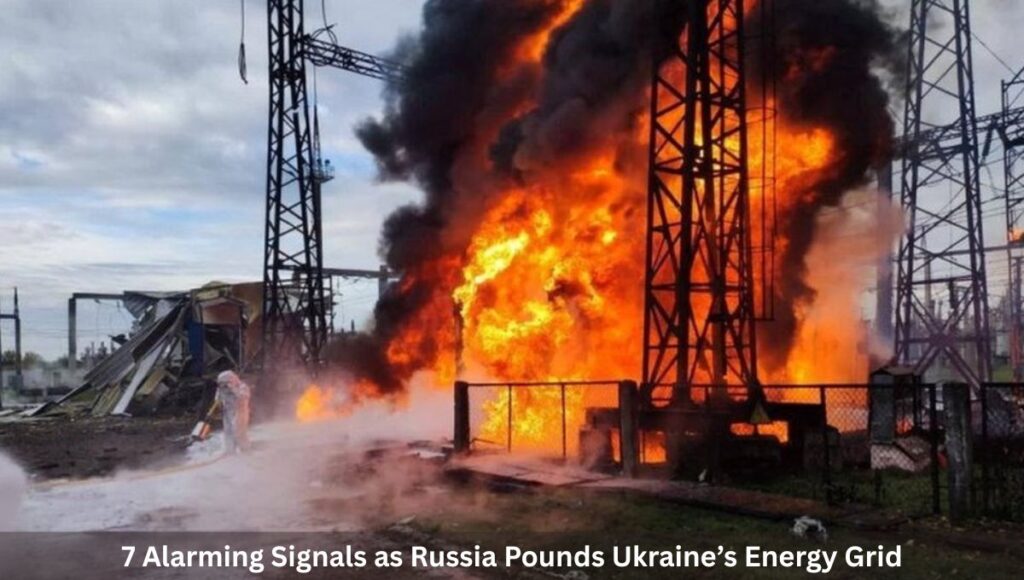
7 Alarming Signals as Russia Pounds Ukraine’s Energy Grid
A Winter Energy Crisis Across Ukraine
Almost half of Ukraine has experienced rolling blackouts and heating outages following repeated Russian strikes on power plants, substations and transmission networks.
In Kyiv alone, nearly 60 percent of the capital remained without electricity more than a week after major attacks on January 9 and 13, with further strikes this week worsening the situation.
“As of this morning, about 4,000 buildings in Kyiv are still without heat, and nearly 60 percent of the capital is without electricity,” Zelenskyy wrote on social media, adding that nationwide only around 60 percent of electricity demand was being met.
Emergency repair crews have been working around the clock to restore basic services. Zelenskyy said nearly 58,000 workers were engaged in repairing power grids, generation facilities and heating networks, often under the threat of renewed attacks.
Children and Vulnerable Groups at Risk
International organisations have warned that the energy crisis poses severe risks to civilians, particularly children, the elderly and hospital patients.
UNICEF said the prolonged outages were exposing Ukrainian children to hypothermia, pneumonia and other cold-related illnesses.
In several cities, schools and kindergartens have been forced to close temporarily, while hospitals have had to rely on backup generators to maintain critical care.
Local authorities have opened emergency warming centres, but capacity remains limited as temperatures plunge below minus 10 degrees Celsius.
Strikes Intensify Ahead of Trilateral Talks
The escalation has unfolded as Ukraine, Russia and the United States prepare for their first known trilateral meeting since the start of the war.
The talks, hosted by the United Arab Emirates in Abu Dhabi, are intended to explore pathways toward a negotiated settlement.
Following talks with Trump on the sidelines of the World Economic Forum in Davos this week, Zelenskyy said security guarantees had been agreed in principle and that the next phase would involve direct trilateral discussions with Russia.
US Special Envoy Steve Witkoff said negotiations had resolved all but one major issue, though he declined to specify which.
Zelenskyy later told reporters that the unresolved question concerned territory — specifically Russia’s demand that Ukraine cede parts of the eastern Donbas region.
The Territorial Sticking Point: Donbas
Russia has long insisted that Ukraine relinquish the remaining areas of the Donetsk region that Kyiv still controls, effectively formalising Moscow’s occupation of roughly one-fifth of Ukrainian territory.
Public opinion in Ukraine is deeply divided. A poll by the Kyiv International Institute of Sociology found that 54 percent of Ukrainians support Zelenskyy’s refusal to cede territory under any circumstances, while 39 percent said they would reluctantly accept concessions only in exchange for strong and binding security guarantees.
For Zelenskyy, territorial integrity remains a red line. Ukrainian officials argue that conceding land under pressure would reward aggression and set a dangerous precedent for future conflicts.
Moscow’s Claimed Battlefield Gains Questioned
Despite aggressive rhetoric, independent analysts say Russia’s actual battlefield progress has been limited.
Last week, Russian commander-in-chief Valery Gerasimov claimed that Russian forces had seized 300 square kilometres of Ukrainian territory this year.
However, an analysis based on geolocated footage by the Institute for the Study of War estimated Russian gains at closer to 74 square kilometres, casting doubt on Moscow’s assertions of momentum.
With no decisive breakthroughs on the ground, analysts suggest Russia is turning to infrastructure attacks as an alternative means of pressure.
Energy Infrastructure as a Weapon
Targeting power and heating systems has become a central feature of Russia’s strategy, particularly during winter months when outages can have life-threatening consequences.
“If the Russians seriously wanted to end the war, they’d focus on diplomacy — not on missile strikes, blackouts, and even attempts to damage our nuclear power plants,” Zelenskyy said in a recent address.
On January 20, Russia severed all external electricity supplies to the Chornobyl nuclear power plant, according to International Atomic Energy Agency Director Rafael Grossi.
While the plant is no longer operational, it still requires power to maintain cooling systems for radioactive material.
Record Drone and Missile Barrages
The same day the Chornobyl supply was cut, Russia launched 339 attack drones and 34 missiles against Ukrainian targets, many aimed at energy facilities.
Ukraine’s air defences intercepted the majority, but enough penetrated to cause widespread damage.
Zelenskyy acknowledged shortcomings in Ukraine’s ability to counter certain drone types, particularly Iranian-designed Shahed drones, which Russia now produces domestically.
“The performance of the air force against the Shaheds is unsatisfactory,” he said, announcing plans to overhaul air defence tactics.
Ukraine Adapts Its Air Defences
In response, Ukraine has begun implementing new approaches to short-range air defence, including mobile fire groups, interceptor drones and rapid-response units.
Zelenskyy has appointed Mykhailo Fedorov as defence minister to accelerate drone production and innovation, and named Colonel Pavlo Yelizarov as deputy head of the air force to improve so-called “small air defence” systems.
Ukraine has also showcased technological adaptations. On January 15, the air force released footage of a Sting interceptor drone successfully destroying a jet-powered Shahed, a faster variant that has proven difficult to stop.
Russia Expands Drone Production
Ukrainian military leaders warn that Russia is scaling up its capacity to overwhelm defences. Commander-in-chief Oleksandr Syrskii said Moscow plans to increase daily Shahed production from around 400 to as many as 1,000 units.
Zelenskyy has repeatedly warned Ukrainians to prepare for worse. “Russia has prepared for a massive strike and is waiting for the moment to carry it out,” he said over the weekend.
The Worst Day Since 2022 Blackouts
By the time Zelenskyy travelled to Davos to meet Trump, Ukraine’s power system was under immense strain.
“Today was the most difficult day for the power system since the blackout of November 2022,” Energy Minister Denys Shmyhal said, describing emergency shutdowns across the country as crews struggled to stabilise the grid.
Diplomacy Overshadowed by Turmoil in Davos
Hopes that Davos would showcase international unity behind Ukraine were derailed by broader geopolitical tensions.
European leaders had planned to rally support for an $800 billion reconstruction framework, but attention shifted to Trump’s announcement of his Board of Peace and renewed controversy over Greenland.
Trump’s remarks about seeking “complete and total control” of Greenland unsettled allies and triggered military reinforcements by several Nordic and Baltic states, further complicating the diplomatic environment.
Europe Reassesses Its Role
Amid uncertainty over US policy, European leaders signalled a growing willingness to shoulder more responsibility for Ukraine’s defence.
European diplomats said the EU is considering offering Ukraine preliminary membership by 2027 as part of security guarantees, even if this departs from the bloc’s traditional merit-based accession process.
Finnish President Alexander Stubb said Europe could defend itself without US support, while French President Emmanuel Macron noted that a coalition of 35 countries now provides the bulk of Ukraine’s military and financial assistance.
European Commission President Ursula von der Leyen echoed that sentiment, warning that shifts in the global order are permanent and that Europe must develop independent defence capabilities.
Biggest Air Assault of the Year
Hours after the first day of trilateral talks in Abu Dhabi, Russia launched its largest aerial assault of the year, firing more than 370 drones and 21 missiles across Ukraine.
Kyiv and Kharkiv were among the hardest-hit cities. In the capital, one person was killed and several wounded, with fires breaking out and thousands of apartment buildings losing heat as temperatures fell to minus 12 degrees Celsius.
In Kharkiv, strikes damaged residential buildings, a hospital and a maternity ward, injuring at least 19 people, including a child.
Talks Continue Amid Uncertainty
Despite the violence, negotiators from all three sides agreed to continue discussions over the weekend.
Ukraine’s top negotiator Rustem Umerov said the talks focused on achieving a “dignified and lasting peace,” thanking the United States for its mediation efforts.
Zelenskyy struck a cautious tone, saying it was too early to draw conclusions. “The main thing is that Russia must finally be ready to end the war,” he said.
War and Diplomacy Collide
Nearly four years after Russia launched its full-scale invasion, Moscow still occupies about 20 percent of Ukraine’s internationally recognised territory, including most of Luhansk and parts of Donetsk, Kherson and Zaporizhzhia.
As missiles and drones continue to fall, the contrast between diplomatic efforts and battlefield realities could not be starker.
A Defining Moment
For Ukraine, the coming days may prove decisive. The outcome of the trilateral talks will test whether diplomacy can prevail over coercion — or whether Russia’s winter campaign against Ukraine’s energy grid will harden positions and prolong the war.
As millions of Ukrainians endure cold and darkness, the stakes of the negotiations extend far beyond lines on a map, touching on the country’s survival, sovereignty and future place in Europe.
Also Read: 5 Explosive Firsts: Ukraine’s Underwater Drones Hit Russian Submarine
Also Read: Ukrainians left freezing as Russia hits power grid while trilateral talks get underway in UAE
Related Posts:
- 7 Critical Signals Behind Trump’s Claim of a Ukraine…
- 9 Alarming Impacts of a Massive U.S. Winter Storm
- In 8 Moves, EU Targets China-Linked Refineries and…

- 5 Major Takeaways from the US Supreme Court's…

- 9 Devastating Impacts of America’s Historic Winter…
- 7 Heartbreaking Facts About Venezuela's Earthquake Disaster