5 Explosive Firsts: Ukraine’s Underwater Drones Hit Russian Submarine, intensifying the Black Sea conflict.Ukraine has claimed a historic breakthrough in modern naval warfare, announcing that its underwater drones have struck and disabled a Russian Kilo-class attack submarine at the port of Novorossiysk.
If confirmed, the operation would mark the first time in history that an underwater unmanned vehicle has neutralised a submarine, underscoring Kyiv’s growing reliance on innovative drone warfare to offset Russia’s conventional military advantage.
The strike, disclosed by Ukraine’s Security Service (SBU), targeted a submarine allegedly used to launch Kalibr cruise missiles against Ukrainian cities and energy infrastructure. Russia has denied that any damage occurred, setting the stage for competing narratives as video footage circulates online.
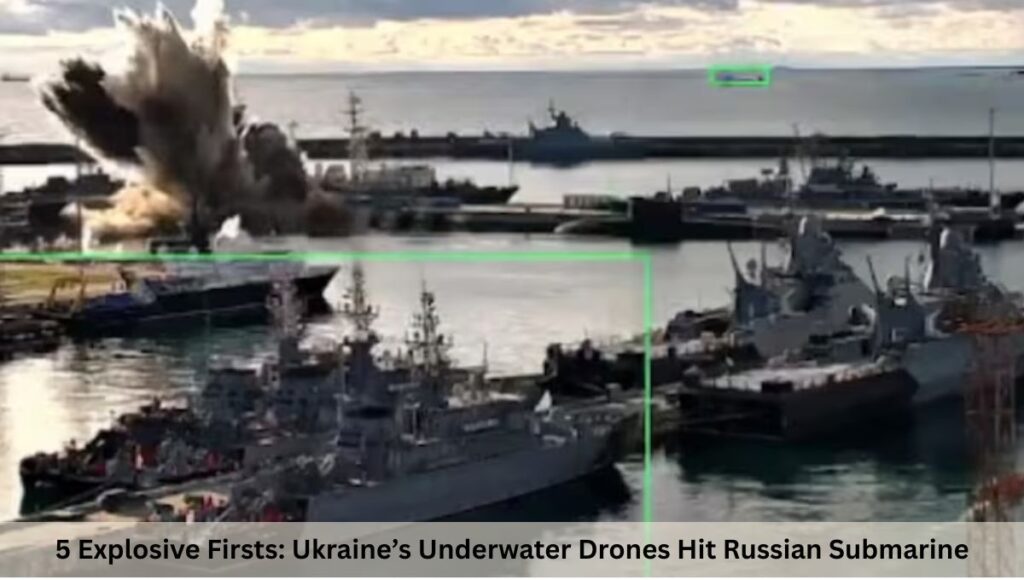
5 Explosive Firsts: Ukraine’s Underwater Drones Hit Russian Submarine
According to the SBU, the attack took place at Novorossiysk, Russia’s most important remaining Black Sea naval base. Moscow relocated much of its Black Sea Fleet to the port after repeated Ukrainian strikes forced Russian warships to withdraw from Sevastopol in occupied Crimea.
The SBU said its “Sub Sea Baby” underwater drones struck the submarine while it was docked near a pier. Footage released by Ukrainian authorities shows a powerful explosion erupting from the water close to where a submarine and several other vessels were moored.
“A Russian submarine used to launch Kalibr cruise missiles at Ukraine has been blown up by SBU underwater drones,” the agency said, describing the strike as unprecedented in naval warfare.
Alexander Kamyshin, an adviser to President Volodymyr Zelenskyy, reinforced the claim, writing on X that this was “the first time in history that an underwater drone has neutralised a submarine.”
What Kind of Submarine Was Hit?
Ukrainian officials said the vessel was a Project 636.3 Varshavyanka-class submarine, commonly known as the Kilo-class. These diesel-electric submarines form the backbone of Russia’s undersea strike capability in the Black Sea.
Key Capabilities of Kilo-class Submarines
- Designed for stealth operations
- Capable of launching Kalibr cruise missiles
- Widely used in strikes on Ukrainian cities and infrastructure
- Estimated value of around $400 million
The SBU said the submarine carried at least four Kalibr missile launchers and sustained critical damage, effectively putting it out of action. With Western sanctions restricting access to components and shipyards, Ukraine estimated that replacing the vessel could cost Russia up to $500 million.
Ukrainian navy spokesperson Dmytro Pletenchuk described the strike as a watershed moment in the naval dimension of the war.
“Hitting a submarine, one of the hardest naval targets, marks another turning point,” Pletenchuk said. “This day once again upends the perception of the possibilities of naval combat in this war.”
He added that repairing the submarine would be extremely difficult. Any major repair work would need to be conducted above water, leaving the vessel exposed to follow-up attacks.
Ukraine claims that Russia has now lost one of four submarines stationed in Novorossiysk, three of which were Kalibr missile carriers.
Russia Denies Any Damage
Russia has flatly rejected Ukraine’s claims. According to Russian state media, the Black Sea Fleet said the incident caused no damage to ships or submarines at Novorossiysk and that all personnel continue operations as normal.
Moscow has not provided independent evidence to counter the Ukrainian footage, nor has it commented in detail on the reported explosion near the pier.
What Are ‘Sub Sea Baby’ Underwater Drones?
The “Sub Sea Baby” drones represent a new phase in Ukraine’s maritime warfare strategy. While Sea Baby is widely known as the name for Ukraine’s family of armed surface drones, officials say the underwater variant is specifically designed for stealth attacks beneath the waterline.
The SBU said these drones have previously been used against Russia’s so-called shadow fleet of oil tankers but had never before been deployed against a submarine.
Possible Link to the ‘Marichka’ UUV
Defence analysts suggest that Sub Sea Baby may be a re-designation of the previously unveiled Marichka kamikaze unmanned underwater vehicle (UUV). Test footage of Marichka showed a system roughly the size of a heavyweight torpedo.
The explosion seen in the Novorossiysk footage indicates a yield comparable to conventional torpedoes, capable of critically damaging medium-sized vessels.
Why Kamikaze UUVs Are a Game-Changer
Unlike traditional torpedoes launched from submarines, kamikaze UUVs can be deployed from shorelines or motherships and operate with far greater flexibility.
Key Differences from Torpedoes
- Torpedoes: speeds of 50+ knots, ranges up to 50 km
- UUVs: slower, but with potentially much longer endurance
- Can loiter silently at depth like mobile underwater mines
- Can strike at a moment of choosing
This capability complicates naval defence, particularly at ports previously considered secure. Analysts say it will require continuous underwater surveillance and new countermeasures, especially at less guarded facilities.
How Did the Drone Penetrate Novorossiysk’s Defences?
One of the most intriguing aspects of the attack is how the underwater drone managed to reach its target.
Novorossiysk Bay is believed to be protected by:
- Boom barriers
- Underwater nets
- Anti-diver and anti-UUV countermeasures
Russia was well aware of Ukraine’s underwater drone capabilities, making the successful penetration of these defences particularly significant. Ukrainian officials have not disclosed operational details, but the strike suggests vulnerabilities in Russia’s harbour protection systems.
Half of Russia’s Varshavyanka Submarines Now Out of Action
At the start of the full-scale invasion on 24 February 2022, Russia deployed four Project 636.3 Varshavyanka submarines in the Black Sea:
- B-237 Rostov-on-Don
- B-265 Krasnodar
- B-268 Veliky Novgorod
- B-271 Kolpino
The Rostov-on-Don submarine was hit twice—once in September 2023 and again in August 2024, after which it reportedly sank at its mooring.
With the latest strike in Novorossiysk, Ukrainian officials say that no more than two combat-capable submarines of this class remain in the Black Sea. This significantly reduces Russia’s ability to launch Kalibr missile strikes from underwater platforms.
A Broader ‘Tanker-Port War’ in the Black Sea
The submarine strike comes amid escalating naval and port-related attacks in the Black Sea region. Russia recently retaliated against Ukrainian attacks on oil tankers by striking the port of Odesa with Kinzhal and Kalibr missiles.
A Turkish cargo ship anchored in the port was reportedly destroyed, and large sections of Odesa’s energy and industrial infrastructure were damaged. Russian media described the campaign as the start of a “tanker-port war,” aimed at cutting Ukraine off from the Black Sea basin.
Russia’s Strategy: Choking Ukraine’s Maritime Lifeline
According to Russian commentators and analysts, Moscow’s goal is to:
- Destroy Ukrainian port infrastructure
- Target vessels assisting Ukraine
- Disrupt maritime logistics
- Deter commercial shipping from entering Ukrainian ports
Strikes reportedly left more than 14 electrical substations and 10 transformer stations in the Odesa region nonfunctional, leaving parts of the city without heat or water.
Russian blogger Yuriy Podolyaki said military equipment storage facilities and warehouses were also hit, aligning with President Vladimir Putin’s earlier warning that Russia would respond forcefully to Ukrainian unmanned boat attacks.
Black Sea Security Raises Regional Alarm
Political analyst Marat Bashirov said the escalation deeply worries Black Sea countries.
“The new front is deeply worrying the Black Sea countries,” he said, noting concerns in Turkey, Bulgaria and Romania over the safety of shipping routes.
Putin has previously warned that Russia must protect key underwater infrastructure, including the Blue Stream and TurkStream gas pipelines, which supply Turkey and Europe.
Ukraine Claims Strikes Beyond the Black Sea
Separately, Ukraine’s Special Operations Forces claimed to have destroyed or damaged two Russian cargo vessels in the Caspian Sea in cooperation with a Russian rebel group called “Black Spark.”
The vessels—Kompozitor Rakhmaninov and Askar-Saridzha—were allegedly transporting arms and military equipment. Both ships have stopped transmitting AIS data for more than 18 days, according to vessel tracking services.
The claims could not be independently verified, and Russia has not commented.
Why This Matters Strategically
Ukraine’s strike on a docked submarine highlights how asymmetric tactics are reshaping the war.
Despite lacking a conventional navy, Ukraine has:
- Forced Russia’s Black Sea Fleet out of Crimea
- Reduced missile launch capabilities
- Threatened Russian logistics and energy routes
- Introduced new underwater threats that challenge naval doctrine
The use of kamikaze UUVs adds a new layer of risk for navies worldwide, particularly in port security and underwater infrastructure protection.
A Signal to Negotiators and Allies
The timing of the announcement is notable. It comes amid intense diplomatic talks in Berlin involving the US, Europe and Ukraine on a potential path to ending the war.
After US President Donald Trump suggested Ukraine “did not have the cards” in negotiations, Kyiv appears keen to demonstrate its continued ability to inflict significant damage on Russian forces.
Whether or not Russia confirms the loss, the message is clear: Ukraine’s maritime drone campaign is expanding—from the surface to the depths.
If Ukraine’s claims are accurate, the strike on a Russian Kilo-class submarine represents a historic first in modern conflict and a stark warning about the future of naval warfare.
Underwater drones, once experimental, are now proving capable of neutralising some of the most complex and heavily defended naval assets. For Russia, the implications are immediate and costly.
For the wider world, Novorossiysk may be remembered as the moment when undersea warfare irrevocably changed.
Also Read: Ukraine underwater drone obliterates Russian sub in daring raid humiliating Putin
Related Posts:
- Ukraine Eliminates Russian FSB Agents After SBU…

- 7 Critical Reasons the Donbas Is the Most Explosive…

- 3 Explosive Conditions Iran Sets to End War with US…

- 7 Powerful Facts About Ayatollah Ali Khamenei’s…

- 7 Powerful Signals US-Ukraine Peace Talks Are…

- 7 Heartbreaking Facts About Venezuela's Earthquake Disaster