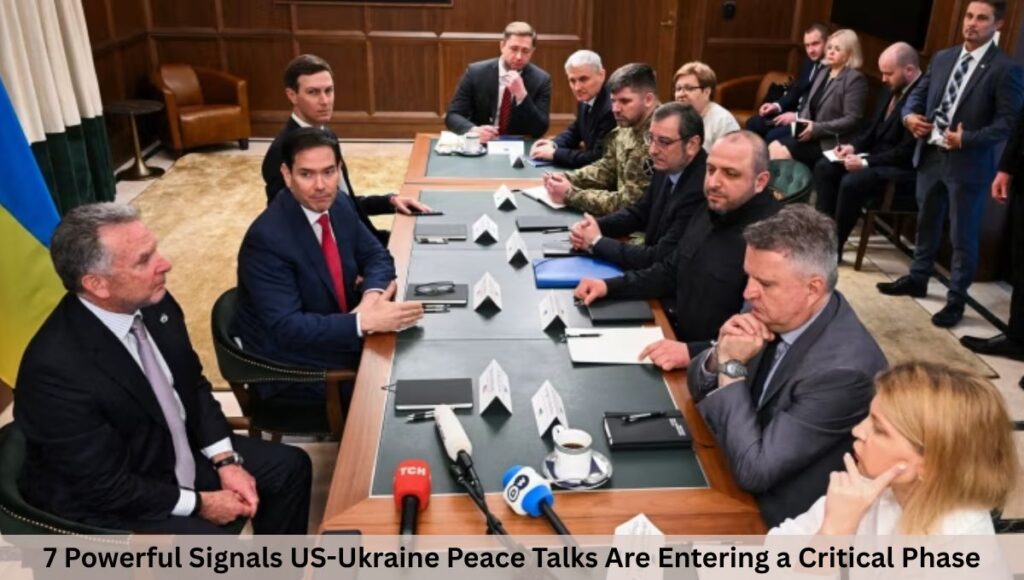
7 Powerful Signals US-Ukraine Peace Talks Are Entering a Critical Phase, with both sides calling the session productive but challenging. The most consequential diplomatic effort in nearly four years of Russia’s full-scale war against Ukraine took shape in Florida this weekend, as senior American and Ukrainian officials met for roughly four hours of high-stakes negotiations.
The talks—described by both sides as productive, complicated, and far from concluded—come at a moment when Washington, Kyiv, and Moscow are all signaling that the war may be entering a decisive phase.
Led on the US side by Secretary of State Marco Rubio, President Donald Trump’s envoy Steve Witkoff, and senior adviser Jared Kushner, the Florida meeting sought to refine a rapidly evolving peace framework and prepare the ground for Witkoff’s upcoming trip to Moscow—a visit the Kremlin says will include a face-to-face with President Vladimir Putin.
Representing Ukraine was a high-level delegation headed by Rustem Umerov, the newly appointed chief negotiator and head of Ukraine’s National Security and Defense Council. The meeting took place just days after Umerov’s predecessor, Andriy Yermak, resigned amid a corruption scandal that roiled Kyiv at a sensitive moment.
Both sides emerged from the talks cautiously optimistic. Rubio emphasized that achieving peace is not merely about stopping the fighting but about designing “a mechanism” ensuring that Ukraine remains secure, sovereign, and “never has another war again.” Umerov called the discussions “productive and successful,” praising the United States for what he said was clear, consistent support.
Yet behind the smiles, the challenges remain formidable: contested territory, Russian demands, Western pressure, corruption fallout in Kyiv, battlefield realities, and Moscow’s insistence that Ukraine’s government lacks legitimacy. This in-depth analysis explores the Florida talks, the wider diplomatic landscape, the critical issues at stake, and the powerful signals suggesting the war may be heading toward a new chapter—though not necessarily an easy one.
7 Powerful Signals US-Ukraine Peace Talks Are Entering a Critical Phase
How the Florida Talks Came Together
The Florida meeting took place at the Shell Bay Club in Hallandale Beach—a location developed by Witkoff, underscoring how deeply intertwined business figures have become in Trump-era diplomacy.
It was the culmination of two weeks of intense diplomatic activity triggered by the leak of a 28-point US peace plan. That plan, heavily criticized in Kyiv and Europe for appearing to tilt toward Russian demands, has now been revised multiple times through discussions in Geneva and Florida.
Rubio, Kushner, and Witkoff represented the American side. Ukraine’s delegation included:
- Rustem Umerov, head of the National Security Council
- Andrii Hnatov, commander-in-chief of the Ukrainian Armed Forces
- Oleksandr Bevz, senior presidential adviser
- Additional defense, intelligence, and security officials
Umerov framed the meeting as part of a broader diplomatic push to secure a “prosperous, strong Ukraine,” and repeatedly emphasized American support—remarks clearly aimed at Trump, who has criticized Kyiv in the past for lacking gratitude.
Both delegations portrayed the talks as comprehensive, constructive, and aimed at bridging difficult remaining gaps.
Rubio’s Message: Peace Must Guarantee Ukraine’s Long-Term Security
Speaking after the meeting, Secretary Rubio made it clear that diplomacy is balancing ambition with realism.
Not Just Ending the War—Ending the Cycle
Rubio’s core message was that Washington wants any peace deal to:
- Guarantee Ukraine’s sovereignty
- Provide long-term prosperity
- Ensure Ukraine can never again be invaded
“This is not just about ending a war,” Rubio said. “It’s about ending a war in a way that allows Ukraine to enter an age of true prosperity.” His comments reflect a shift in American strategy—from immediate conflict resolution toward broader regional stability, economic rebuilding, and postwar cooperation.
A Delicate Process With “Another Party” Holding Key Levers
Rubio also stressed that Russia must ultimately agree to whatever emerges. “There are a lot of moving parts. And obviously, there is another party involved.”
The US, he added, has been in contact “in varying degrees” with Russian counterparts and has a “pretty good understanding” of Moscow’s positions.
That acknowledgment signals the reality: no peace plan will advance without Russian buy-in, and Putin has shown little willingness to concede.
Ukraine’s Message: Gratitude, Resolve, and Urgency
Rustem Umerov’s tone throughout the talks was notably warm toward Washington—likely a strategic shift after Trump’s repeated complaints that Ukraine has not shown enough appreciation.
“US is hearing us. US is supporting us. US is working beside us,” Umerov said.
Clear Directives After Geneva
Umerov stressed that Ukraine entered the Florida meeting with:
- Clear priorities
- Negotiating directives
- A focus on “safeguarding Ukrainian interests”
- A goal of securing reliable, long-term security guarantees
The Ukraine negotiators also emphasized gratitude for the US role—an important political gesture given Trump’s influence over the process.
The Shadow of Corruption Scandal Back Home
The timing of the talks was complicated by domestic turbulence in Kyiv. The resignation of Andriy Yermak—Kyiv’s powerful chief of staff and previous lead negotiator—after a $100 million embezzlement scandal threatened to weaken Ukraine’s internal cohesion.
Trump himself referred to Ukraine’s corruption scandal as a “little problem,” suggesting it remained on Washington’s radar. Umerov, by contrast, sought to project confidence and continuity.
The Peace Plan: From Controversy to Revision
The original 28-point plan drafted by US and Russian contacts—apparently including Witkoff and Russian sovereign wealth fund head Kirill Dmitriev—sparked backlash for provisions seen as too favorable to Moscow.
Controversial Elements of the Early Draft
The initial draft reportedly required:
- Ukraine to cede the entire Donbas
- Limits on Ukraine’s military size
- A guarantee that Ukraine cannot join NATO
- Presidential elections within 100 days
- Concessions on energy reconstruction involving foreign operators
European allies privately warned that the plan required “additional work,” while Kyiv outright rejected sections.
Revised Framework Takes Shape
The revised version—now reportedly cut to 19 points—remains unpublished, but negotiators say key changes have been made.
Rubio emphasized that the framework must:
- Secure Ukraine
- Support economic recovery
- Provide a foundation for “true prosperity”
Yet one unresolved, explosive question remains at the heart of negotiations:
What Happens to Occupied or Annexed Ukrainian Territory?
Territory is the central sticking point:
- Russia demands Ukrainian forces withdraw from areas Moscow claims
- Ukraine refuses to cede any territory not already held by Russian troops
- Putin insists Crimea and Donbas remain non-negotiable
- Kyiv insists sovereignty and territorial integrity must be preserved
Rubio acknowledged the difficulty, saying the issue is “complicated” and unresolved.
Trump’s Role: Optimism, Real-Estate Diplomacy, and Moscow Outreach
President Donald Trump has taken a hands-on but flexible approach to the talks.
Speaking aboard Air Force One, he said:
“I think that there’s a good chance we can make a deal. Things are going along well.”
He also downplayed earlier deadlines he had hinted at:
“You know what the deadline for me is? When it’s over.”
Trump’s Envoys Head to Moscow
Steve Witkoff is scheduled to arrive in Moscow on Monday, with the Kremlin confirming he will meet President Putin on Tuesday.
Rubio said the US has “a pretty good understanding” of Russia’s demands but stressed that nothing will move forward until all sides can agree.
Kushner may also join the Moscow mission—a sign of how personalized this negotiation effort has become.
Trump’s Diplomacy Model: Deals Over Protocol
Witkoff and Kushner previously brokered a 20-point proposal that contributed to a Gaza ceasefire—cementing a pattern of unconventional but results-driven diplomacy based on:
- Deal-making
- Personal relationships
- Rapid iteration
- Minimal bureaucracy
Whether such an approach can solve Europe’s largest land war since WWII remains to be seen.
Zelensky: A “Dignified End” Is Within Reach
Ukrainian President Volodymyr Zelensky welcomed the Florida talks, calling the US approach “constructive” and expressing hope that a “dignified end” to the war could be mapped out in the coming days.
Kyiv’s Immediate Priorities
Zelensky listed key focus areas:
- Air defense
- Security guarantees
- Territorial integrity
- Working from the Geneva points
- Ensuring Ukraine’s sovereignty
He also stressed that Ukraine’s delegation has “clear priorities” and a mandate to negotiate.
International Diplomacy Intensifies
Zelensky is traveling to Paris for talks with French President Emmanuel Macron—a strong supporter of Ukraine—underscoring the sensitive timing.
He also spoke with NATO chief Mark Rutte, saying:
“These are important days and much can change.”
Battlefield Reality: Diplomacy Amid Escalating Attacks
While Florida talks were held, Russian forces launched some of their most intense drone and missile barrages in months.
According to Zelensky:
- 1,400 attack drones
- 1,100 guided aerial bombs
- 66 missiles
were used in just one week.
Kyiv Region Hit Repeatedly
- A drone strike killed one person and injured 11 on Sunday
- Overnight attacks on Saturday killed six and wounded dozens
- 400,000 households temporarily lost power
Vyshhorod, a suburb north of Kyiv, suffered heavy damage after a drone hit a nine-story apartment building.
Ukraine Strikes Back
Ukraine has also intensified deep-strike operations:
- Maritime drones hit two sanctioned Russian oil tankers
- A drone attack disrupted operations at the Novorossiysk oil terminal, owned by the Caspian Pipeline Consortium
- Kazakhstan rebuked Kyiv, saying attacks harmed bilateral relations
These strikes reflect Kyiv’s strategy of targeting Russia’s war-financing infrastructure.
Russia’s Position: No Signs of Concession
President Putin recently questioned Zelensky’s legitimacy—claiming Ukraine lost authority by not holding elections, an accusation Kyiv rejects under martial law.
Putin has signaled openness to reviewing the US draft but maintains his core demands:
- Ukrainian withdrawals from territory Russia claims
- No NATO membership
- Recognition of annexed territories
Kremlin adviser Yuri Ushakov said the latest US draft “requires serious analysis,” indicating Moscow has concerns.
Europe’s View: Fatigue, Frustration, and Strategic Anxiety
European partners appear increasingly strained:
- War fatigue is rising
- Winter energy shortages loom
- Support for Ukraine is politically divided
- Leaders worry a rushed US-Russia deal could weaken Kyiv
Theresa Fallon of the Centre for Russia Europe Asia Studies warned that the West must avoid rewarding Moscow:
“Putin should not be rewarded for beginning a war and the atrocities committed.”
She also noted that European support is shrinking, and Trump’s administration appears more focused on shifting responsibility to Europe.
Key Issues That Could Make or Break a Deal
1. Territorial Control
The biggest obstacle: Russia wants Ukraine to withdraw; Ukraine refuses territorial concessions.
2. Security Guarantees
Kyiv wants long-term guarantees comparable to NATO protections. Washington is exploring multiple options.
3. Ukraine’s Military Limits
Early US drafts proposed restricting Ukraine’s military—something Kyiv rejects.
4. NATO Membership
Russia demands Ukraine never join NATO; Kyiv insists on its sovereign right.
5. Elections Under Martial Law
The 100-day election proposal in early drafts faced backlash.
6. Economic Reconstruction Framework
Trump’s plan includes a “Ukraine Development Fund” involving US investment in tech, AI, gas infrastructure, and data centers.
7. Internal Instability in Kyiv
Corruption scandals threaten political unity at a critical time.
A War Without Clear Victory Paths
Ukraine’s former commander-in-chief Valerii Zaluzhnyi added a sobering note:
“War does not always end with the victory of one side and the defeat of the other.”
His words reflect the shifting mood: stalemate, exhaustion, and pressure for political solutions.
Conclusion: A Fragile but Historic Moment
The Florida talks mark a pivotal step in what could be the most serious push toward ending the Russia-Ukraine war since its outbreak. The atmosphere is cautiously hopeful, but the challenges—territory, legitimacy, security guarantees, Russian demands, corruption fallout, and relentless battlefield attacks—are immense.
Key variables still hang in the balance:
- Moscow’s response to the latest US draft
- Witkoff’s meeting with Putin
- Zelensky’s Paris discussions
- Western unity (or lack thereof)
- Ukraine’s battlefield situation this winter
For now, the most powerful signal is that all sides—however reluctantly—are engaging.
As Rubio put it:
“This is not easy. It is delicate and complicated. But we are making progress.” Whether that progress leads to a dignified end to the war—or to yet another diplomatic false dawn—will become clearer in the crucial days ahead.
Also Read: 19 Bold Shifts: Inside Zelenskyy’s High-Stakes Talks with Trump on a Revised Ukraine Peace Deal
Also Read: Explained: The big sticking points in the US peace plan to end Russia-Ukraine war
Related Posts:
- 5 Major Takeaways from the US Supreme Court's…

- 7 Powerful Measures: Trump Sanctions Russian Oil…

- Afghanistan–Pakistan War 2025: Inside the 48-Hour Ceasefire

- In 8 Moves, EU Targets China-Linked Refineries and…

- 7 Critical Reasons the Donbas Is the Most Explosive…
- 7 Heartbreaking Facts About Venezuela's Earthquake Disaster