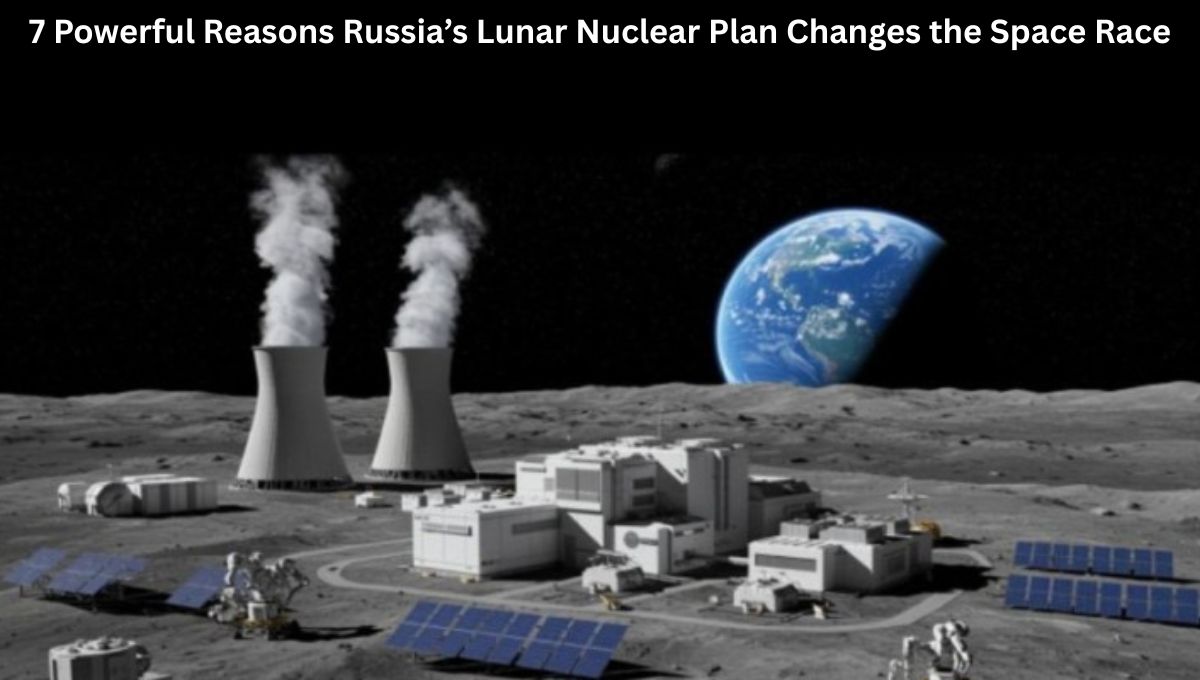
7 Powerful Reasons Russia’s Lunar Nuclear Plan Changes the Space Race and secures long-term energy and resources. Russia has unveiled one of its most ambitious space initiatives in decades: the construction of a power station on the Moon within the next ten years.
According to Russia’s state space agency, Roscosmos, the facility is intended to provide long-term energy for lunar missions, including robotic rovers, scientific observatories, and infrastructure for a joint Russian-Chinese research base.
While the agency has stopped short of explicitly calling it a nuclear reactor, the involvement of Russia’s nuclear institutions leaves little doubt about the nature of the project. The announcement comes at a time when major global powers are accelerating plans to establish a sustained presence on the Moon.
Energy, experts agree, is the single most critical requirement for long-term operations beyond Earth. In that context, nuclear power is increasingly viewed as not just viable, but essential.
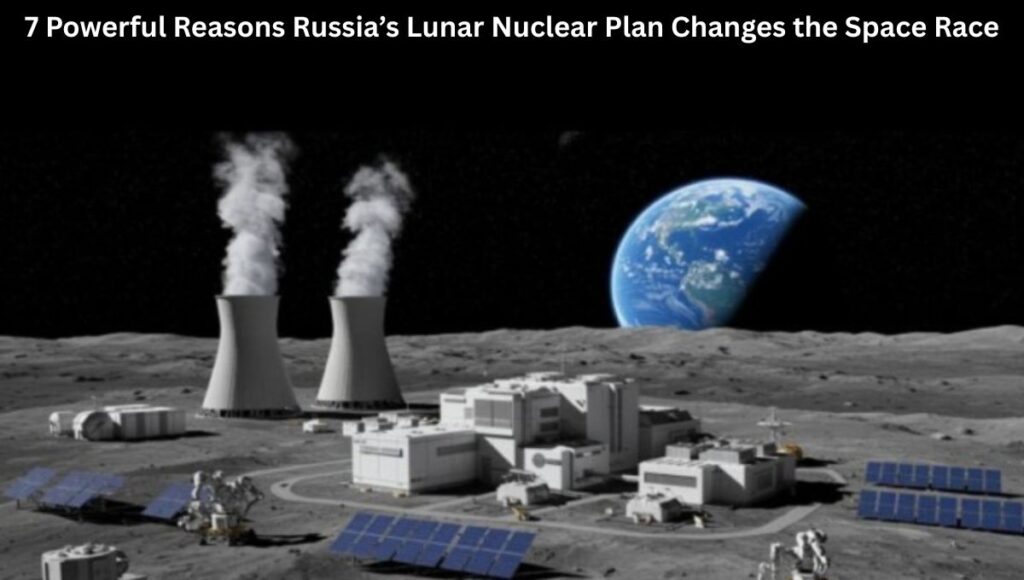
7 Powerful Reasons Russia’s Lunar Nuclear Plan Changes the Space Race
What Roscosmos Has Announced
Roscosmos confirmed that it has signed a government contract with NPO Lavochkin, Russia’s leading developer of deep-space and planetary missions, to carry out work on the lunar power project through 2036. The plan includes spacecraft development, ground-based testing, flight trials, and ultimately the deployment of infrastructure on the lunar surface.
Although Roscosmos did not explicitly label the facility a nuclear plant, it acknowledged that the project will involve Rosatom, Russia’s state-owned nuclear energy corporation, and the Kurchatov Institute, the country’s premier nuclear research center.
Their participation strongly indicates that nuclear energy will be the core power source. Roscosmos described the project as “an important step toward creating a permanently operating scientific lunar station,” marking a clear shift from one-off missions to a sustained exploration program.
Why Nuclear Power on the Moon Matters
The Moon presents extreme challenges for power generation. Lunar nights last roughly 14 Earth days, rendering solar panels ineffective for long periods. Dust accumulation further reduces efficiency, while temperature swings range from blistering heat to extreme cold.
Nuclear power offers a stable, continuous energy supply that is not dependent on sunlight. For space agencies planning permanent installations—whether robotic or human—this reliability is indispensable.
A lunar nuclear power station could support life-support systems, communications, scientific experiments, mining equipment, and future construction efforts. For Russia, the project represents both a technological necessity and a strategic statement.
A Joint Russian-Chinese Lunar Vision
The planned power station will support the International Lunar Research Station (ILRS), a long-term project being developed jointly by Russia and China. The ILRS is envisioned as a permanently functioning scientific base, expected to become operational in the mid-2030s.
During Chinese President Xi Jinping’s visit to Moscow earlier this year, the two countries reaffirmed their commitment to deepening cooperation on lunar exploration, including nuclear energy systems.
Under the partnership, Russia is expected to contribute expertise in nuclear power and deep-space systems, while China brings launch capabilities, robotics, and infrastructure development.
This collaboration reflects a broader realignment in global space politics, as Moscow and Beijing increasingly coordinate their ambitions in response to U.S.-led space initiatives.
Russia’s Space Legacy—and Recent Setbacks
Russia’s lunar ambitions are deeply rooted in its space history. The Soviet Union launched some of the earliest missions to the Moon and Venus, and Yuri Gagarin’s historic 1961 flight made the USSR the first nation to send a human into space.
However, Russia’s modern space program has struggled to maintain that legacy. A significant blow came in August 2023, when the unmanned Luna-25 spacecraft crashed into the Moon during a landing attempt. The failure underscored the technological and financial challenges facing Roscosmos.
At the same time, private-sector innovation—most notably by Elon Musk’s SpaceX—has transformed launch economics, eroding what was once a Russian specialty. Against this backdrop, the lunar nuclear power project is widely seen as an effort to reassert Russia’s relevance as a leading space power.
The United States Is Racing Too
Russia is not alone in viewing nuclear energy as essential for lunar exploration. NASA has announced plans to deploy a nuclear reactor on the Moon by the first quarter of fiscal year 2030, several years ahead of Russia’s stated timeline.
U.S. officials have framed the effort in openly competitive terms. Speaking about the plan, U.S. Transportation Secretary Sean Duffy said, “We’re in a race to the moon, in a race with China. And to have a base on the moon, we need energy.”
The U.S. Artemis program aims to return astronauts to the Moon, establish a sustained presence near the lunar south pole, and build the Lunar Gateway, a small space station orbiting the Moon. Reliable power, NASA argues, is a prerequisite for all of these goals—and for future missions to Mars.
Legal and Safety Considerations
International space law prohibits the placement of nuclear weapons in space, but it does not ban the use of nuclear energy sources. Existing treaties allow nuclear power systems as long as they meet safety, transparency, and risk-mitigation standards.
Nuclear power sources have already been used in space for decades, particularly in deep-space missions where solar energy is insufficient. Radioisotope thermoelectric generators (RTGs) have powered probes exploring the outer planets.
A full-scale nuclear power station on the Moon, however, would represent a significant escalation in scale and complexity, raising new questions about safety protocols, environmental impact, and international oversight.
The Moon’s Strategic and Economic Value
Interest in the Moon extends far beyond scientific curiosity. Researchers believe the lunar surface contains vast reserves of helium-3, a rare isotope on Earth that could one day be used in advanced nuclear fusion technologies. NASA estimates that up to one million metric tons of helium-3 may be embedded in lunar soil.
In addition, studies—including research by Boeing—suggest the Moon holds rare earth elements such as scandium, yttrium, and the lanthanides, which are critical for smartphones, computers, renewable energy systems, and advanced defense technologies.
The prospect of accessing these resources has fueled talk of a future “lunar gold rush,” with energy infrastructure seen as the gateway to commercial exploitation.
Why 2036 Is a Critical Timeline
Roscosmos’ target year of 2036 aligns with broader international timelines for establishing permanent lunar installations. By then, both China and the United States expect to have operational bases or near-permanent facilities on or around the Moon.
For Russia, meeting this deadline is crucial. Delays or failures could further marginalize its role in lunar exploration. Success, on the other hand, would position Moscow as a key energy provider and strategic partner in the emerging lunar economy.
The decade-long development window also reflects the technical difficulty of designing, testing, transporting, and safely deploying a nuclear power system on another celestial body.
Technical Challenges Ahead
Building a power plant on the Moon is not a straightforward extension of Earth-based nuclear technology. Engineers must contend with lower gravity, intense radiation, micrometeorite impacts, and extreme thermal cycles.
The reactor must be compact enough for launch, robust enough to survive landing, and shielded to protect nearby equipment—and potentially humans—from radiation. Autonomous operation and remote maintenance will be essential, at least in the early stages.
Despite these challenges, space agencies increasingly view nuclear power as the only realistic solution for long-duration lunar missions.
A New Phase of the Space Race
The renewed push for lunar infrastructure signals a shift from symbolic exploration to strategic competition. Unlike the Cold War-era Moon landings, today’s race is about permanence, resources, and long-term advantage.
Russia’s plan to deploy a nuclear power station on the Moon underscores this transition. Energy is the foundation upon which all other activities—scientific, commercial, and geopolitical—will be built.
As the United States, Russia, and China accelerate their lunar programs, the Moon is emerging not just as a destination, but as a new arena of global rivalry.
What Happens Next
Over the coming years, Roscosmos and its partners will focus on system design, testing, and incremental mission development. Each milestone will be closely watched, both for technical progress and for what it signals about Russia’s broader space ambitions.
Whether Russia ultimately meets its 2036 target remains uncertain. What is clear, however, is that nuclear power on the Moon is no longer science fiction. It is rapidly becoming a central pillar of humanity’s next phase of space exploration.
As competition intensifies, the decisions made this decade could shape not only the future of lunar exploration, but the balance of power beyond Earth.
Also Read: NASA Fast-Tracks Nuclear Reactor for Moon to Counter China-Russia Space Push
Also Read: Why Russia Wants a Nuclear Power Plant on the Moon
Related Posts:
- NASA Fast-Tracks Nuclear Reactor for Moon to Counter…
- 9 Stunning Moments from Artemis II That Reveal Earth…

- In 8 Moves, EU Targets China-Linked Refineries and…

- 5 Major Takeaways from the US Supreme Court's…

- 7 Powerful Measures: Trump Sanctions Russian Oil…

- 7 Heartbreaking Facts About Venezuela's Earthquake Disaster