
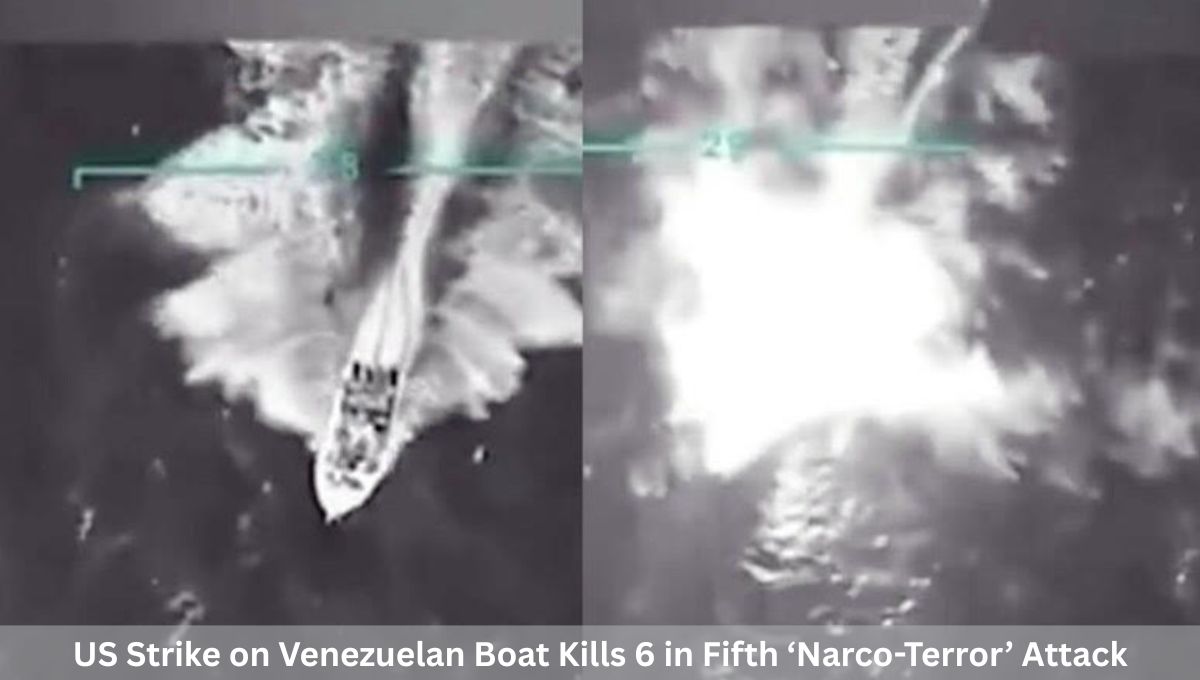
US Strike on Venezuelan Boat Kills 6 in Fifth ‘Narco-Terror’ Attack – escalating regional tensions and legal concerns. The United States has carried out another military strike on a vessel off the coast of Venezuela, killing six people on board, President Donald Trump announced on Tuesday.
In a statement on Truth Social, Trump said the attack targeted a boat “affiliated with a Designated Terrorist Organization (DTO)” and accused it of narcotics trafficking.
“Under my Standing Authorities as Commander-in-Chief, this morning the Secretary of War ordered a lethal kinetic strike on a vessel affiliated with a Designated Terrorist Organization,” Trump wrote.
“The strike was conducted in International Waters, and six male narcoterrorists aboard the vessel were killed in the strike. No U.S. Forces were harmed.”
The president provided no evidence to substantiate the claim that the boat was smuggling drugs or belonged to a terrorist organization.
A 30-second video Trump posted showed a small, stationary vessel in open water moments before being hit by a missile and engulfed in flames. The authenticity and context of the footage could not be independently verified.
This is the fifth such strike by the Trump administration since early September, as the White House escalates its “war on narcoterrorism” in the Caribbean.
US Strike on Venezuelan Boat Kills 6 in Fifth ‘Narco-Terror’ Attack
Fifth Strike Since September: 27 Reported Dead
Tuesday’s attack marks another episode in a growing series of U.S. maritime strikes targeting alleged drug-trafficking vessels.
According to official statements:
- September 2: First strike killed 11 people.
- September 15 & 19: Two smaller vessels destroyed, three deaths each.
- October 3: Fourth strike off Colombia’s coast, four killed.
- October 14: Fifth strike near Venezuela, six dead.
In total, 27 people have been reported killed in the operations. The Pentagon has provided no details about the victims’ identities or the nature of the alleged narcotics cargo.
White House Justifies Strikes as ‘Self-Defence’
Trump has repeatedly framed the attacks as “defensive actions” aimed at protecting U.S. citizens from cartels.
“These narcoterrorists move poison and violence into our country,” Trump said at a press briefing.
“Under my command, we will take them out — before they take more American lives.”
However, international law experts, human rights groups, and regional governments have questioned the legality of such strikes, noting that suspected drug traffickers do not constitute armed combatants under existing conventions.
Legal Debate: Is the US at War with Drug Cartels?
The Trump administration’s rationale for these operations stems from a recent Pentagon memo to Congress declaring that the United States is in a “non-international armed conflict” with designated drug cartels.
This interpretation allows the U.S. president to use wartime powers — including lethal military force — without congressional approval or direct provocation.
Legal scholars argue that the policy blurs the distinction between law enforcement and armed conflict, potentially setting a dangerous precedent.
“Drug traffickers are criminals, not enemy combatants,” said Prof. Sarah Cleveland, a former U.N. Human Rights Council member. “By categorizing them as terrorists, the administration claims authority to kill them anywhere in the world, without trial or imminent threat. That’s unprecedented.”
Even some conservatives have expressed concern. Republican Senator Rand Paul, co-sponsoring a War Powers Resolution to limit presidential authority, said:
“Blowing up boats without due process risks escalation and undermines constitutional oversight. Congress must reassert its role.”
Regional Condemnation and Rising Tensions
Venezuela and Neighbours Condemn Attack
The Venezuelan government condemned the latest strike, calling it a “flagrant violation of international sovereignty.”
President Nicolás Maduro said he has ordered the Venezuelan armed forces to full alert and is considering declaring a state of emergency.
“Venezuela will not tolerate foreign aggression under any excuse,” Maduro said in a televised statement. “These acts of war endanger civilians and regional peace.”
The governments of Colombia, Cuba, and Mexico issued similar statements calling for restraint and warning of escalating tensions across the Caribbean Sea.
Regional Militaries on Edge
Following the strike, radar monitoring systems across South America recorded increased U.S. military air activity near Venezuelan waters. According to independent defense analysts, at least eight U.S. warships, a nuclear-powered submarine, and F-35 aircraft remain stationed in the region as part of USSOUTHCOM operations.
US Military Build-Up in the Caribbean
The recent expansion of the U.S. Southern Command (SOUTHCOM) presence in the Caribbean has drawn global scrutiny.
Military officials say the deployments are designed to “disrupt narcotics trafficking routes”, but regional observers see a broader strategic objective — to pressure the Maduro regime and secure influence in Latin America.
The Pentagon confirmed that operations involve surveillance aircraft, coastal patrol vessels, and Marine expeditionary units based in Puerto Rico and Aruba.
“Our mission is deterrence and disruption,” a U.S. defense official said anonymously. “We are not targeting Venezuela directly, but we will act on intelligence of narcoterrorist activity anywhere in international waters.”
Trump’s Expanding Definition of ‘Terrorism’
Since early 2025, Trump has signed multiple executive orders reclassifying drug trafficking networks as “foreign terrorist organizations.”
The change effectively allows the U.S. military to use counter-terrorism authorities against non-state criminal actors — a major departure from past policy.
In a statement last month, Trump described narcotraffickers as “enemy fighters in a war against America’s borders.”
“We’re fighting a war,” he said. “They may not wear uniforms, but they are killing our people with fentanyl and heroin. We will hunt them down wherever they hide.”
Critics say this rhetorical shift is intended to justify military interventions in foreign jurisdictions under the banner of national security.
Legal Experts: ‘Dangerous Erosion of Norms’
Human rights lawyers and scholars have warned that the administration’s “war on narcoterrorism” could erode international humanitarian law standards.
Kenneth Roth, former head of Human Rights Watch, said:
“Labeling drug traffickers as terrorists opens a Pandora’s box. If every country adopted that view, the seas would become ungoverned killing zones.”
The American Civil Liberties Union (ACLU) also released a statement condemning the practice, noting that “no evidence has been presented to confirm any direct threat to U.S. lives or assets.”
Despite the backlash, Trump administration officials maintain that the strikes are lawful self-defense actions based on intelligence from Joint Interagency Task Force South (JIATF-S).
Congress Divided Over Presidential War Powers
The strikes have reignited a bipartisan debate in Washington about executive overreach.
The Senate rejected a Democratic-backed bill last week that sought to require congressional approval for any future “kinetic actions” targeting narcotrafficking vessels.
At the same time, Republican leadership largely defended Trump’s approach, arguing that it protects national interests.
Vice President JD Vance previously praised one of the Caribbean strikes as “a decisive action against evil.”
But Sen. Rand Paul sharply criticized that remark, calling it “despicable and thoughtless to glorify killing someone without a trial.”
Maduro’s Counter-Measures
In Caracas, President Maduro accused Washington of using “fabricated intelligence” to justify attacks aimed at destabilizing Venezuela.
The Venezuelan Ministry of Defence said it was deploying coastal radar units and naval patrols to prevent further incursions.
Maduro has also urged allies Russia, Iran, and China to denounce what he described as “imperialist aggression.”
The Venezuelan National Assembly convened an emergency session on Tuesday to discuss defensive readiness and potential legal recourse at the International Court of Justice (ICJ).
Trump Administration’s Political Messaging
The U.S. administration has consistently presented the strikes as proof of Trump’s “strong leadership” and commitment to national security ahead of the 2026 midterms.
In his Truth Social posts, Trump emphasized the “zero-tolerance” stance toward narcoterrorism:
“We are taking the fight to them. America will not wait for another overdose to act.”
Treasury Secretary Scott Bessent, speaking at the White House alongside Argentine President Javier Milei, said:
“We’re using our economic strength to create peace. It’s better to build bridges with allies than to shoot at narco gunboats.”
However, the strikes are increasingly being viewed as politically motivated shows of force, particularly given the absence of public evidence linking the destroyed vessels to drug cartels.
Lack of Transparency and Independent Verification
Thus far, neither the Pentagon nor U.S. Southern Command has disclosed:
- The identities or nationalities of those killed.
- The names of the vessels targeted.
- The nature or quantity of any seized narcotics.
The U.N. Office on Drugs and Crime (UNODC) has not independently confirmed that Venezuela’s waters are a major narcotics transit zone, though it acknowledges limited trafficking routes through the Caribbean.
Regional analysts note that Colombia and Central America remain the primary corridors for cocaine shipments, suggesting the strategic logic of these strikes may be more political than operational.
Background: Political and Diplomatic Context
The escalation comes amid a long-running U.S.–Venezuela standoff.
The United States continues to recognize opposition figure María Corina Machado as Venezuela’s “legitimate leader,” while Maduro remains in power domestically after disputed elections.
In March 2025, the Trump administration doubled a $50 million reward for information leading to Maduro’s arrest on drug-trafficking charges.
U.S. courts have indicted several Venezuelan officials, alleging links to the “Cartel of the Suns”, though Maduro denies involvement.
Also Read: The United States’ Dirty War on “Narco Terrorism”
International Reaction
Latin America Divided
While some U.S. allies like Brazil and Panama have remained silent, regional blocs such as CELAC and the Organization of American States (OAS) have urged de-escalation.
The European Union called for “restraint and transparency,” emphasizing the need for adherence to international law.
China’s foreign ministry warned that “militarization of the Caribbean” could destabilize the wider region, while Russia accused the U.S. of “neo-colonial adventurism.”
What Happens Next
Analysts say the Trump administration appears determined to expand maritime operations against alleged narcoterrorist groups, particularly in international waters near Venezuela, Colombia, and Central America.
The Pentagon has hinted at “Phase Two” operations, possibly involving armed drones and maritime blockades.
Diplomatic observers warn that continued unilateral strikes could further isolate Washington, provoke retaliatory moves from Caracas, and test the limits of international law.
“The danger is normalization,” said Dr. Fiona Hill, former National Security Council official.
“Once you accept targeted killings in peacetime, the line between war and policing disappears.”
Conclusion
The latest U.S. strike off Venezuela’s coast — the fifth in less than six weeks — marks a dramatic escalation in Trump’s campaign against what he calls “narco-terrorism.”
While the administration insists it is acting in self-defence, the absence of evidence, mounting regional anger, and legal ambiguity have left Washington facing growing criticism abroad. For now, the Caribbean Sea has become the latest front line in an unconventional war — one that blurs the boundaries between crime, terrorism, and sovereignty, and raises a fundamental question: where does law enforcement end and warfare begin?
Related Posts:
- Trump Says US Forces Launched Third ‘Lethal Kinetic…

- 9 Facts About Trump’s Drug Boat Strikes That Shook the World

- Trump Orders U.S. Military Strike on Venezuelan…

- US Military Kills Three in Second Strike on…

- Trump Considers Military Strikes on Venezuelan Drug…

- 9 Explosive Signals as Trump Warns Maduro and U.S.…
