In international waters, the US Military Kills Three in Second Strike on Venezuelan Drug Boat: Trump Warns “We Are Hunting You” Amid Rising Tensions. The conflict between the United States and Venezuela has entered a dangerous new phase after the US military carried out a second strike on an alleged Venezuelan drug-trafficking vessel, killing three men in international waters.
President Donald Trump announced the operation on his social media platform Truth Social, warning drug cartels that Washington would continue its campaign of “kinetic strikes” in the Caribbean. The move follows an earlier strike two weeks ago that left 11 dead and has already fueled an intense political, legal, and diplomatic confrontation between Washington and Caracas.
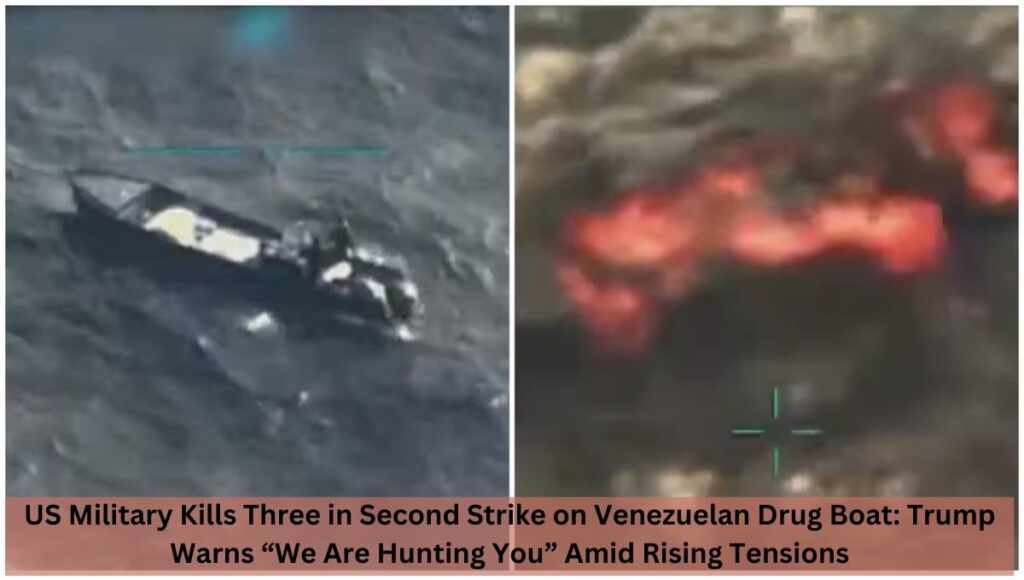
US Military Kills Three in Second Strike on Venezuelan Drug Boat: Trump Warns “We Are Hunting You” Amid Rising Tensions
Trump Announces Second Strike
On Monday morning, President Trump said US forces had conducted another “kinetic strike” against “extraordinarily violent drug trafficking cartels and narcoterrorists” operating in the US Southern Command (SOUTHCOM) area of responsibility.
“The strike occurred while these confirmed narcoterrorists from Venezuela were in international waters transporting illegal narcotics — a deadly weapon poisoning Americans — headed to the US,” Trump declared.
He added that three men were killed in the attack and no US personnel were harmed. A nearly 30-second video posted alongside the statement showed a vessel exploding in flames on open waters, though no conclusive evidence of narcotics was visible.
Trump’s Justification: A Threat to US Security
Framing the strike as essential to defending national interests, Trump insisted that Venezuelan-linked cartels pose a direct risk to US national security, foreign policy, and vital interests.
“BE WARNED — IF YOU ARE TRANSPORTING DRUGS THAT CAN KILL AMERICANS, WE ARE HUNTING YOU!” he said in all caps.
The president claimed that narcotics smuggling has had “devastating consequences on American communities for decades, killing millions of citizens,” and vowed that his administration would continue its crackdown.
Speaking later from the Oval Office, Trump asserted that the vessel’s cargo — which he described as “big bags of cocaine and fentanyl spattered all over the ocean” — proved the legitimacy of the strike. However, reporters noted that the video footage released offered no such evidence.
Venezuela Condemns the Attack
Venezuelan President Nicolás Maduro responded by denouncing the strike as “US aggression.”
At a press conference with military leaders, Maduro said:
“This isn’t tension. It is aggression all down the line. The US government is trying to justify the launch of a criminal attack on our country.”
He accused Washington of conducting a coordinated campaign of judicial, political, diplomatic, and military aggression designed to destabilize Venezuela and remove him from power.
Maduro also branded US Secretary of State Marco Rubio the “lord of death and war”, highlighting Rubio’s vocal support for US strikes against drug cartels in Latin America.
Escalation in the Caribbean
The second strike comes against the backdrop of a major US military build-up in the Caribbean.
- Washington has deployed the Iwo Jima Amphibious Ready Group, the 22nd Marine Expeditionary Unit, and ten F-35 fighter jets to Puerto Rico.
- Venezuelan F-16 fighter jets were spotted flying near a US Navy destroyer shortly after the first strike earlier this month, prompting warnings from Trump that any hostile aircraft would be shot down.
- Caracas has accused US forces of boarding Venezuelan fishing boats and detaining them illegally, heightening fears of further escalation.
Maduro said his government would “fully exercise its legitimate right to defend itself” and warned Venezuelans to prepare for a long confrontation.
First Strike: 11 Killed
The latest attack follows the September 6 strike in which the US military destroyed another vessel it claimed was carrying drugs from Venezuela. That incident left 11 people dead and intensified criticism of the Trump administration’s strategy.
At the time, Senator Jack Reed, the ranking Democrat on the Senate Armed Services Committee, questioned the legality of the action:
“There is no evidence — none — that this strike was conducted in self-defense. Under both domestic and international law, the US military simply does not have the authority to use lethal force against a civilian vessel unless acting in self-defense.”
Experts in maritime law have also warned that such actions could violate international conventions, particularly when carried out in international waters.
Rubio and Hegseth Defend US Action
Despite criticism, senior US officials have defended the strikes. Defense Secretary Pete Hegseth said the US had “absolute and complete authority” to carry out the operations.
“We knew exactly who they were, exactly what they were doing, what they represented, and why they were going where they were going,” Hegseth told reporters earlier this month.
When pressed on how the US identified the targets, he declined to share details:
“Why would I tell you that?” he replied.
Secretary of State Marco Rubio, meanwhile, has argued that the strikes are necessary to combat cartels “flooding American streets and killing Americans.”
Also Read: US strike on Venezuelan drug boat kills 11, Vance says ‘best use of military’
Growing Legal and Diplomatic Questions
While Trump and his team continue to present the strikes as decisive action against narco-terrorism, critics insist that Washington may be overstepping international law.
- International law experts have said the operations risk being classified as extrajudicial killings if the alleged traffickers were not given due process.
- Human rights advocates warn of civilian casualties and the potential for misidentification of fishing vessels in a region where many locals rely on small boats for their livelihood.
- Several senators have raised concerns that Trump is using the US military for law enforcement purposes, which is generally prohibited under US law.
The Venezuelan government has also accused Washington of trying to manufacture a pretext for broader regime change operations in Caracas.
Maduro’s Position: Resistance and Defiance
Maduro has denied US allegations linking him to drug cartels, including the infamous Cartel of the Suns and Tren de Aragua.
He has dismissed Washington’s $50 million reward for his capture as an “imperialist move.”
Instead, Maduro has urged Venezuelans to enlist in the civilian militia, a force long used to support government rallies and parades. Public sector employees report being pressured to join, underscoring the government’s effort to mobilize society in the face of growing external threats.
“Relations with the US have been destroyed by their bomb threats,” Maduro said. “We have moved from battered relations to completely broken ones.”
What Comes Next?
As tensions escalate, speculation grows that the US may extend its campaign to target drug cartels on Venezuelan soil.
When asked by reporters if strikes on the Venezuelan mainland were possible, Trump offered a vague response:
“We’ll see what happens. Venezuela is sending us their gang members, their drug dealers and drugs. It’s not acceptable.”
For now, Washington continues to emphasize its commitment to stopping narcotics trafficking by sea, while Caracas insists it is facing an undeclared war.
Conclusion
The US strikes on alleged Venezuelan drug boats have ignited a volatile mix of military confrontation, political rhetoric, and legal uncertainty.
With two deadly strikes in just two weeks, and rhetoric hardening on both sides, the risk of a wider conflict between Washington and Caracas is growing. Whether these actions succeed in curbing drug trafficking remains unclear, but one thing is certain: US-Venezuela relations are now at their lowest point in decades.
Also Read: Trump Warns India, Pakistan, China and 20 Others of ‘Serious Consequences’ Over Drug Trafficking
Related Posts:
- Trump Says US Forces Launched Third ‘Lethal Kinetic…

- 9 Facts About Trump’s Drug Boat Strikes That Shook the World

- US Strike on Venezuelan Boat Kills 6 in Fifth…

- Trump Considers Military Strikes on Venezuelan Drug…

- Trump Orders U.S. Military Strike on Venezuelan…

- Trump Signs Secret Order Targeting Latin American…