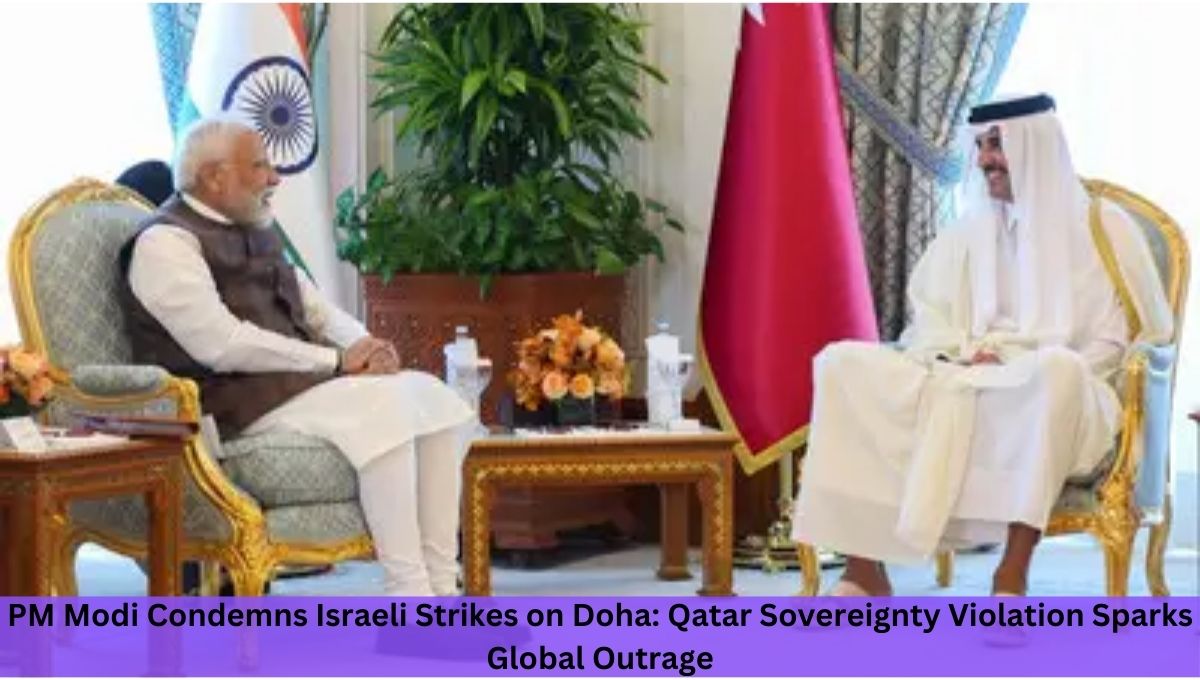
Amid US-backed Gaza ceasefire talks, PM Modi Condemns Israeli Strikes on Doha: Qatar Sovereignty Violation Sparks Global Outrage. Prime Minister Narendra Modi has strongly condemned Israeli airstrikes on the Qatari capital Doha that targeted senior Hamas leaders during US-backed Gaza ceasefire talks.
Calling the attack a “violation of Qatar’s sovereignty,” Modi expressed “deep concern” and urged dialogue and diplomacy to prevent further escalation in the Middle East. The rare military strike on Qatari soil, which killed multiple Hamas members and a Qatari security officer, has triggered international outrage. The attack has not only strained Israel-Qatar relations but also caused friction with the United States and rattled global energy markets.
PM Modi Condemns Israeli Strikes on Doha: Qatar Sovereignty Violation Sparks Global Outrage
PM Modi Expresses Solidarity with Qatar
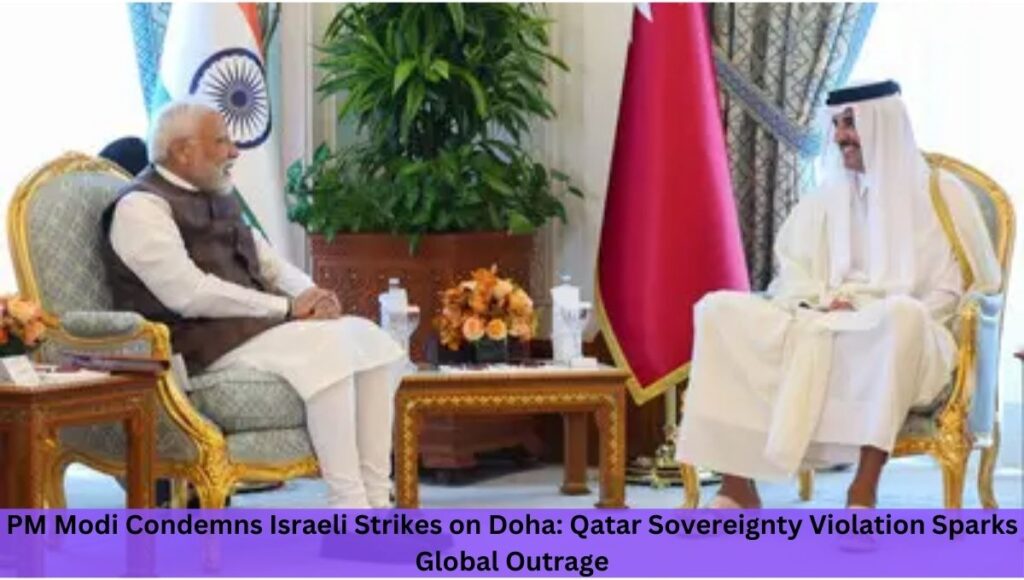
A day after the Israeli strikes, PM Modi held a phone call with Qatar’s Emir, Sheikh Tamim bin Hamad Al-Thani.
“Spoke with Amir of Qatar Sheikh Tamim Bin Hamad Al-Thani and expressed deep concern at the attacks in Doha. India condemns the violation of the sovereignty of the brotherly State of Qatar,” Modi tweeted.
The Prime Minister praised Qatar’s role as a mediator in the Gaza peace talks and emphasized India’s consistent position of resolving disputes through dialogue. He added:
“We support resolution of issues through dialogue and diplomacy, and avoiding escalation. India stands firmly in support of peace and stability in the region, and against terrorism in all its forms and manifestations.”
Both leaders reaffirmed their commitment to strengthening the India-Qatar Strategic Partnership and agreed to maintain close communication on regional developments.
Details of the Israeli Strike in Doha
According to Hamas, at least five people were killed in the Israeli strike, including three bodyguards of senior Hamas leaders. Among the dead were:
- Hammam al-Hayya, son of Hamas chief negotiator Khalil al-Hayya
- Jihad Labad, office manager of Khalil al-Hayya
- Moamen Hassouna, Abdullah Abdul Wahid, and Ahmed al-Mamluk, Hamas bodyguards
- Badr al-Humaidi, a corporal in Qatar’s Internal Security Force
Qatari authorities confirmed that two more individuals remain missing, with human remains still being identified at the site of the bombing.
The Israeli military dubbed the operation “Summit of Fire”, claiming it was aimed at eliminating “terrorist masterminds” of Hamas’s October 7, 2023 attacks on Israel, in which over 1,200 people were killed and 251 taken hostage.
However, Hamas declared that the assassination attempt had “failed”, insisting its negotiating delegation survived and would continue peace talks.
Qatar Condemns “Cowardly Attack”
Qatar strongly denounced the Israeli action as a “grave violation of international law” and accused Israel of deliberately targeting residential buildings in Doha housing Hamas political bureau members.
Foreign Ministry spokesperson Majed Al-Ansari said:
“The cowardly attack deliberately targeted residential buildings in Doha. It is a violation of Qatar’s sovereignty and international law.”
Qatar’s Prime Minister Sheikh Mohammed bin Abdul Rahman Al Thani went further, calling the strike “state terror” in an interview with CNN.
He warned that the incident had “just killed any hope” for the remaining Gaza hostages and urged regional partners to develop a collective response.
Trump Rebukes Netanyahu: “Not Wise”
The Israeli strike also created tensions between Israel and the United States. According to The Wall Street Journal, former US President Donald Trump rebuked Prime Minister Benjamin Netanyahu in a heated phone call, telling him the operation was “not wise.”
Trump reportedly warned that the move risked undermining delicate US-backed ceasefire efforts. Netanyahu defended his decision, saying he had only a “brief window” to act.
Although the first call was contentious, a second conversation later the same day was more cordial, with Trump asking if the strike had succeeded. Netanyahu admitted he was not yet sure.
Senior US officials told the Journal that Trump has grown increasingly frustrated with Netanyahu’s unilateral actions, which often complicate Washington’s Middle East diplomacy.
White House spokesperson Karoline Leavitt confirmed that the US was notified in advance of the Israeli operation but stressed that Trump did not approve it.
Instead, he instructed his envoy Steve Witkoff to inform Qatar, though Doha said it was contacted only 10 minutes after the strike.
Trump later wrote on Truth Social:
“Unilaterally bombing inside Qatar, a sovereign nation and close ally of the United States, that is working very hard and bravely taking risks with us to broker peace, does not advance Israel or America’s goals.”
Arab World Reacts: Calls for Collective Action
The attack on Doha has united the Arab world in condemnation.
- United Arab Emirates: President Sheikh Mohammed bin Zayed Al Nahyan flew to Doha in a show of solidarity, calling the Israeli strike a “criminal attack” that endangered Middle East peace and stability.
- Saudi Arabia: Crown Prince Mohammed bin Salman denounced Israel’s “brutal aggression” and is expected to travel to Doha to discuss next steps.
- Qatar: Sheikh Mohammed confirmed that discussions were underway for a regional summit to coordinate a collective Arab response.
Also Read: GCC Activates Joint Defence Mechanism as Doha Summit Condemns Israel’s Strike on Qatar
The Fate of Hamas Leaders Remains Unclear
Despite Hamas’s insistence that its negotiators survived, speculation remains about the fate of chief negotiator Khalil al-Hayya.
Qatar’s interior ministry confirmed the death of al-Hayya’s son Hammam, but his father has yet to appear publicly.
Hamas has not provided evidence of his survival. Israeli officials, meanwhile, have expressed doubts about the success of the operation.
Netanyahu Defends Israeli Action
Defying international outrage, Netanyahu defended the strikes, accusing Qatar of providing safe haven to terrorists.
“I say to Qatar and all nations who harbour terrorists: you either expel them or you bring them to justice. Because if you don’t, we will,” Netanyahu warned.
In response, Qatar’s prime minister shot back, saying Netanyahu himself “needs to be brought to justice” at the International Criminal Court, where arrest warrants for Netanyahu and former Defense Minister Yoav Gallant were issued last year over alleged war crimes in Gaza.
Also Read: Israeli PM Netanyahu apologises to Qatar over Doha attack
Impact on Gaza Ceasefire and Hostage Talks
The Israeli strike comes at a fragile moment in the Gaza conflict. Qatar, alongside Egypt and the US, has been mediating negotiations for a ceasefire and the release of remaining hostages.
Qatari officials now fear the attack has derailed these efforts. Sheikh Mohammed said he had met hostage families just hours before the strike and that they had been “counting on this mediation.”
While Israel insists the strike could “open the door to an end of the war,” Hamas has vowed that its negotiating stance remains unchanged.
Oil Prices Rise Amid Escalating Tensions
Global energy markets reacted to the Doha strike with caution.
Brent crude futures rose $1.10 (1.7%) to $67.49 a barrel, while US West Texas Intermediate (WTI) crude gained $1.04 (1.7%) to $63.67 a barrel on Wednesday.
The gains reflected fears of potential supply disruptions in the Gulf region, though analysts cautioned that the rise may be temporary given ongoing oversupply.
Adding to tensions, Poland shot down drones over its airspace during a Russian attack on Ukraine, marking the first NATO engagement of its kind.
At the same time, US President Donald Trump urged the European Union to impose 100% tariffs on China and India, the two largest buyers of Russian oil, as part of efforts to pressure Moscow into peace talks.
Despite these calls, EU officials signaled reluctance to take such drastic measures, though they confirmed discussions about phasing out Russian fossil fuels.
Broader Implications for Global Diplomacy
The Israeli strike in Doha represents one of the most significant escalations in the Middle East in recent years. Its consequences are reverberating across:
- Regional Diplomacy: Qatar’s role as a mediator in Gaza is now in question, with Arab states rallying behind it.
- US-Israel Relations: Trump’s rebuke of Netanyahu highlights growing tensions in a partnership traditionally marked by strong alignment.
- India-Qatar Ties: PM Modi’s strong condemnation underscores India’s careful balancing act in the region, emphasizing sovereignty and diplomacy.
- Energy Markets: Rising oil prices illustrate how quickly Middle East instability can ripple through global economies.
Conclusion: A Test of International Response
The Israeli strikes on Doha have ignited a geopolitical firestorm. With Hamas leaders still unaccounted for, US-Israel tensions exposed, Arab states mobilizing, and oil prices climbing, the incident is far more than a targeted assassination attempt it is a test of how the world responds to violations of sovereignty in a volatile region.
For India, Prime Minister Modi’s statement not only aligns with India’s principles of diplomacy but also positions New Delhi as a responsible voice in the Middle East crisis. As Qatar weighs its response and Israel defends its actions, the international community faces a defining challenge: whether to reinforce diplomacy or risk deeper conflict in an already unstable region.
Related Posts:
- Trump’s 20-Point Gaza Peace Plan Gains Urgent Global…

- 9 Explosive Claims as Trump Says US Winning Iran War

- 7 Powerful Facts About Ayatollah Ali Khamenei’s…
- 5 Major Takeaways from the US Supreme Court's…

- 3 Explosive Conditions Iran Sets to End War with US…
- 7 Heartbreaking Facts About Venezuela's Earthquake Disaster